

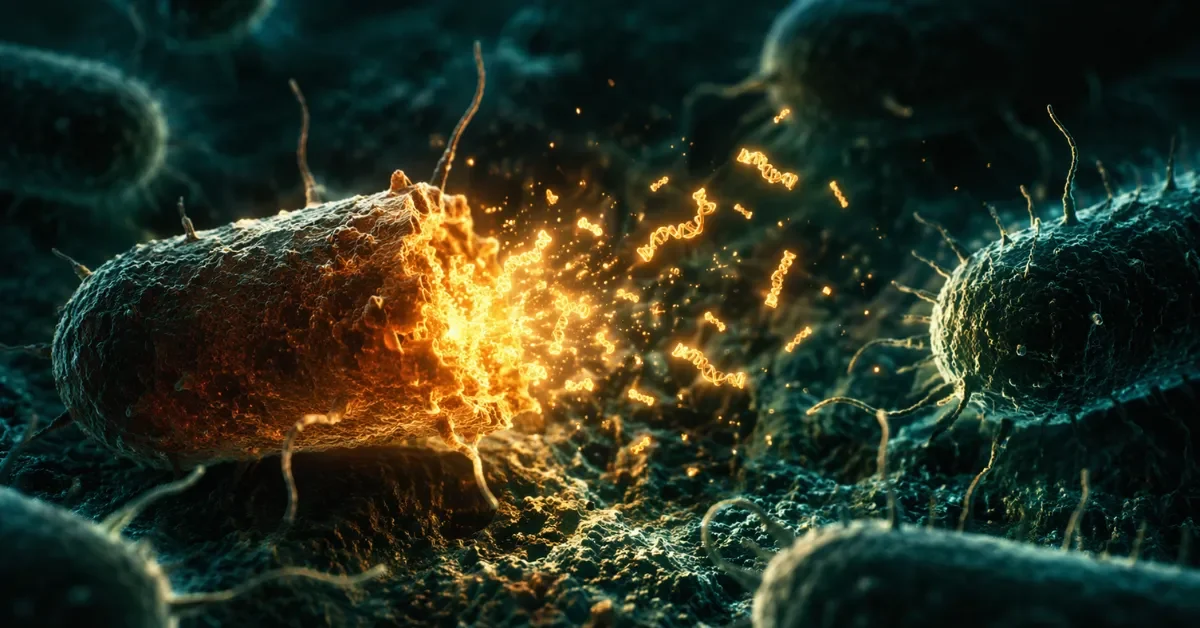
A groundbreaking discovery has revealed that some microorganisms are acting as kamikaze bacteria, intentionally destroying themselves to help their colonies survive. Researchers have found that these microscopic cells rupture and release genetic material, which often includes genes that make them resistant to modern medications. This self-destructive behavior actively accelerates one of the most pressing threats in modern medicine: the rapid spread of antibiotic resistance.
The new findings, published in the journal Nature Microbiology on April 16, come from a team of scientists at the John Innes Centre in the United Kingdom. Working alongside researchers from the University of York and the Rowland Institute at Harvard, the group identified a highly sophisticated mechanism that allows bacteria to intentionally explode. By sacrificing themselves, these single-celled organisms disperse tiny, DNA-packed delivery vehicles to surrounding cells.
Ancient Viruses Turned Genetic Couriers
When these bacteria collapse, they release structures known as gene transfer agents (GTAs). These tiny particles look and act very much like bacteriophages, which are viruses that naturally infect bacteria. However, these particular structures are no longer dangerous invaders. Over the course of evolutionary history, the bacteria managed to domesticate these ancient viral remnants and bring them entirely under their own control.
Instead of harming the host cell like a typical virus would, these gene transfer agents have been completely repurposed. The bacteria now use them as highly effective genetic messengers. Before the cell ruptures, these particles scoop up fragments of the dying bacterium’s DNA. Once released into the surrounding environment, they deliver this genetic cargo to neighboring bacteria.
This remarkable evolutionary twist allows beneficial traits to spread rapidly through a microbial population. If the exploding cell carried genes that confer resistance to certain drugs, those survival traits can be instantly shared with nearby bacteria, even if they are not directly related.
The LypABC Control Switch
For years, scientists did not fully understand how these gene transfer agents escaped from their host cells. The research team solved this mystery by using a deep sequencing screening method on a model bacterium known as Caulobacter crescentus. They discovered a specific cluster of three genes, named LypABC, which serves as a central control hub for the self-destruction process.
This three-gene system acts as a precise molecular switch that dictates exactly when the cell will undergo lysis, the technical term for breaking open. The researchers found that when the LypABC genes were removed from the bacteria, the cells were completely unable to rupture and release their genetic couriers. Conversely, when the system was overactivated, a massive number of cells underwent the fatal explosion process.
Interestingly, the LypABC system bears a striking structural resemblance to a bacterial immune system normally used to fight off viral infections. Dr. Emma Banks, the lead author of the study, noted the unique nature of this discovery. “What’s particularly interesting is that LypABC looks like an immune system, yet bacteria are using it to release GTA particles,” she said. “It suggests that immune systems can be repurposed to help bacteria share DNA — a process that can contribute to the spread of antibiotic resistance.”
The researchers also identified a separate regulatory protein that keeps this extreme activity under strict control. This regulation is essential for the survival of the bacterial colony. An uncontrolled or highly active LypABC system would become completely toxic and wipe out too many cells at once.
The Threat of Horizontal Gene Transfer
The discovery sheds new light on horizontal gene transfer, a process that allows bacteria to swap genetic material directly with one another rather than waiting for traits to pass down through reproduction. Horizontal gene transfer typically happens through three main avenues: transformation, which is the direct absorption of DNA fragments from the surrounding environment; conjugation, which involves the transfer of material through physical contact between two cells; and transduction, which relies on virus-mediated transport.
These self-sacrificing bacteria make this third method incredibly efficient. By deliberately destroying themselves, they maximize the amount of gene transfer agents released into their surroundings, increasing the likelihood that other cells will absorb the resistance genes.
This silent engine of genetic exchange has massive implications for global public health. The World Health Organization and the medical journal The Lancet currently classify antimicrobial resistance as a top-tier threat to humanity. According to their estimates, infections driven by antibiotic-resistant bacteria are directly responsible for more than 1.2 million deaths around the world every single year.
By understanding the exact molecular triggers behind this self-destructive behavior, the medical community may find new ways to fight back against drug-resistant superbugs. If scientists can figure out how the LypABC system is naturally activated and find a way to block this molecular switch, it could significantly slow down the speed at which resistant bacteria share their most dangerous traits. The next phase of research will focus on identifying the specific environmental signals that trigger this kamikaze behavior, paving the way for targeted treatments in the future.
