

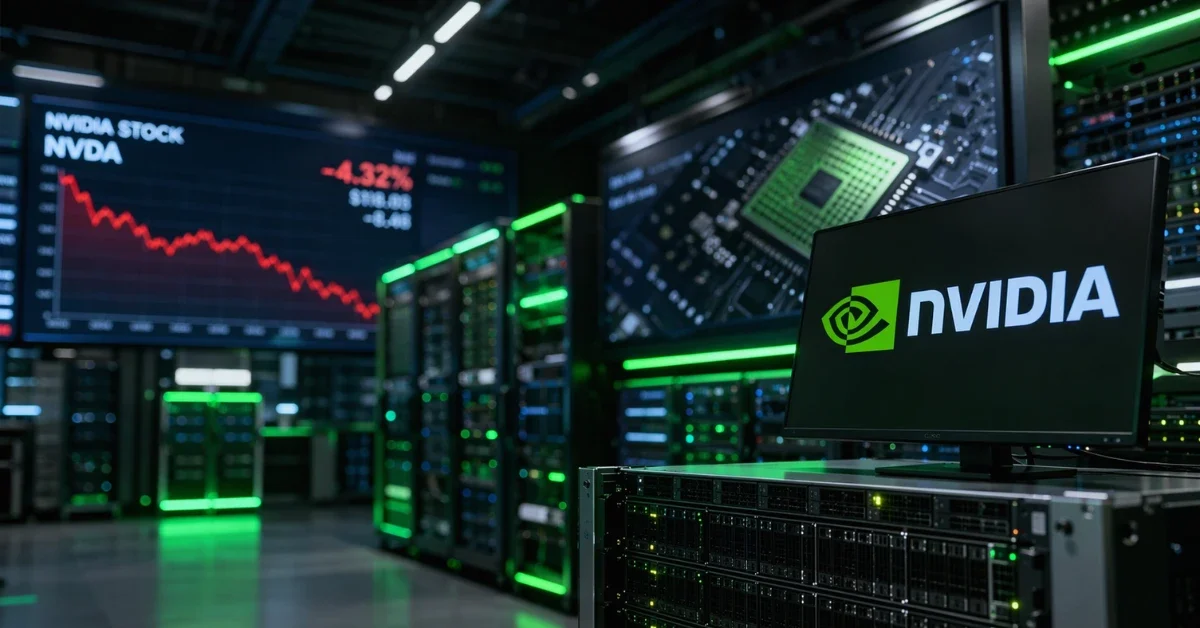
NVIDIA is facing a broader set of challenges even as demand for its AI hardware remains strong, with recent developments highlighting competition from rivals, regulatory scrutiny in several regions, questions about expansion plans, and concerns about China’s computing capacity.
The company still enters this period with strong momentum. NVIDIA shares rose to $200.67 in midday Nasdaq trading. At the same time, its most recent reported fiscal first quarter of 2026 showed data center revenue of $39.1 billion, up 73% from a year earlier, and total revenue of $44.1 billion.
PC Maker Rumor Denied
One of the latest headlines around Nvidia came from a report that said the company had been negotiating to buy a large PC-focused business, a move that would have reshaped the hardware market if it had happened. NVIDIA pushed back quickly, stating that “The media report is false; NVIDIA is not engaged in discussions to acquire any PC maker.”
The rumor still moved markets. HP, Dell, Asus, and Lenovo all saw similar share price rises on April 13, with HP and Dell climbing more than 5%, showing how seriously investors took the possibility before Nvidia denied it.
The story also surfaced at a time when Nvidia is already expected to expand further into computing systems beyond its core AI GPUs. The company is expected to launch N1 and N1X Arm processors for laptops in 2026, and Nvidia is also pushing for a bigger role in both datacenter and client computing.
Cerebras Adds Pressure
Competitive pressure is also coming from Cerebras Systems, which disclosed its filing for a U.S. initial public offering and moved closer to the public markets as it seeks to benefit from stronger interest in AI-linked listings. The company is making its second attempt to go public after withdrawing a prior IPO filing last year following a fundraise that valued it at about $8 billion.
Cerebras is trying to challenge Nvidia with a different type of AI chip that avoids reliance on high-bandwidth memory, which analysts have described as one of the industry’s biggest bottlenecks. The company is focused on inference and tied much of its growth to OpenAI, including a $20 billion multi-year deal under which OpenAI will deploy 750 megawatts of Cerebras chips.
The filing also showed fast growth. Cerebras reported revenue of $510 million for the year ended December 31, up from $290.3 million a year earlier, and posted a profit of $1.38 per share compared with a loss of $9.90 per share in the prior year.
Antitrust Scrutiny Grows
At the same time, Nvidia is facing increasing antitrust attention. Scrutiny now spans the United States, the European Union, France, and China, with analysts pointing to Nvidia’s 98% share of data-center GPU revenue as a major reason regulators are paying close attention.
Regulators are examining whether Nvidia’s combination of CUDA software, Mellanox networking, and orchestration tools could limit competition. At the same time, Nvidia argues that customers can still choose AMD, Intel, or custom silicon alternatives. The U.S. Justice Department reportedly issued civil investigative demands in late 2024, and the European Commission cleared Nvidia’s Run: ai purchase in December 2024 after an Article 22 referral.
In China, regulators disclosed a preliminary finding that Nvidia violated anti-monopoly law and conditions tied to the Mellanox deal, creating possible financial and strategic consequences for the company. Those issues matter because Nvidia still relies on Chinese demand even as U.S. export controls restrict top-end accelerators.
Jensen Huang’s China Warning
NVIDIA is also looking outward at geopolitical risks tied to AI capacity. Speaking on the Dwarkesh Patel podcast, Chief Executive Jensen Huang said China has an “enormous” amount of compute, including fully powered data centers sitting empty, and warned that the capacity needed to train a Mythos-level model is already available there.
Huang said the United States and Nvidia should still be in a strong position, but he also argued that dialogue matters. He said, “We want the United States to win,” while also calling it essential for American and Chinese AI researchers to talk and agree on what AI should not be used for.
Revenue Still Breaking Records
Even with those pressures, Nvidia’s business remains powerful. Gaming revenue in the latest reported quarter rose 42% to a record $3.8 billion, and full fiscal 2026 revenue reached $215.9 billion, showing that the company’s lead in accelerated computing continues to translate into massive sales as the AI buildout continues.
NVIDIA’s path forward is not without risk, but the scale of demand for its hardware means the company still has substantial room to navigate the competitive, regulatory, and geopolitical headwinds closing in around it.
