

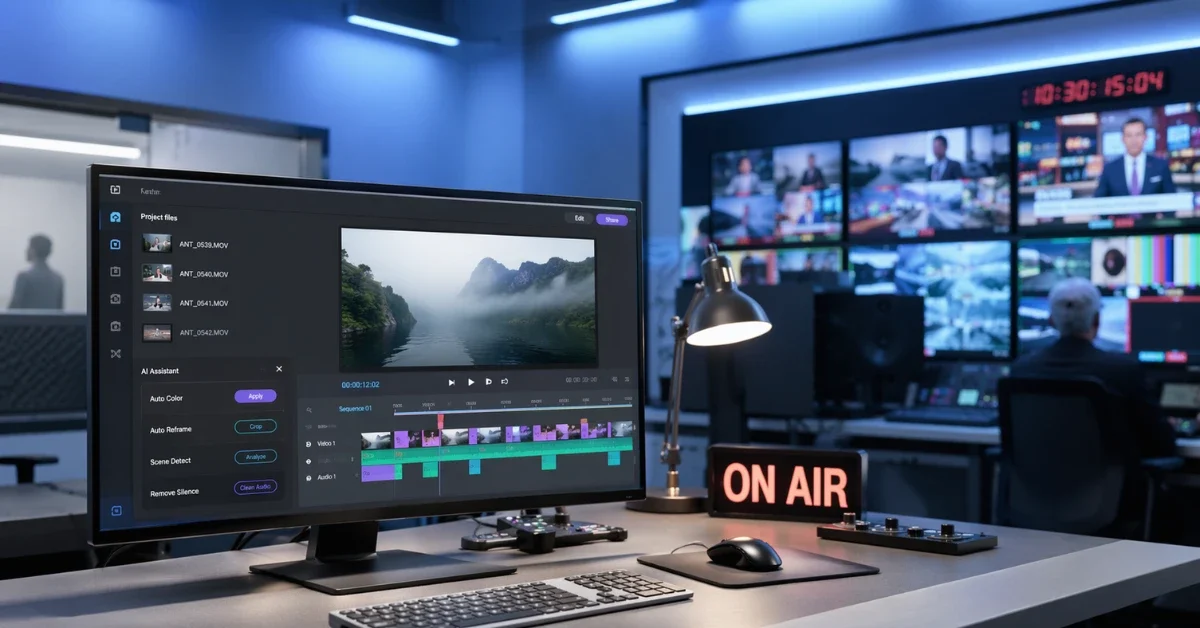
AI filmmaking is moving beyond demos and into everyday production in 2026, as editing platforms, broadcast vendors, and creative software companies roll out tools built for real workflows. New product updates and industry reports show AI being used for tasks such as search, voice generation, live cropping, metadata handling, and image and video creation inside broader production systems.
That shift is changing how studios, broadcasters, and content teams think about AI filmmaking. The focus is no longer only on flashy experiments. More companies are talking about workflow fit, speed, security, rights management, and whether these tools can work inside established editing and delivery pipelines.
Editing suites add deeper AI tools
One of the clearest signs of that change is Blackmagic Design’s DaVinci Resolve 21. The update brings photo editing into the free software alongside a long list of video-focused upgrades. It also adds AI tools that can de-age faces, reshape faces, remove blemishes, search for people or objects in footage, and find keywords in dialogue.
The release goes further than basic cleanup. AI CineFocus can change the perceived depth of field in a shot, including adding bokeh and simulating rack focus. AI Speech Generator can create voiceovers from text and even replicate a user’s own voice from a 10-second sample. The update also adds AI SlateID for extracting metadata from clapperboards, plus AI UltraSharpen and AI Motion Deblur for sharpening footage and reducing motion-blur artifacts. On top of that, Fusion gets more than 70 new graphics through the Krokodove toolset, while Resolve adds virtual reality updates, support for Meta Quest and YouTube presets, and new options for handling HDR and SDR trim passes from a single timeline.
A separate industry report published in early April said AI-native video pipelines are moving from pilot programs into day-to-day production. According to that report, studios, streamers, and brands are consolidating workflows around multimodal models, cloud rendering, and rights-aware asset management. It also said enterprise buyers are paying close attention to workflow integration, security controls, and the economics of production, rather than treating AI as a standalone novelty.
Hollywood sees promise and limits
Even with that momentum, some film executives are drawing a line between useful production tools and actual creative replacement. Jason Blum, founder and CEO of Blumhouse Productions, said a partnership with Meta to make three AI shorts brought a strong backlash online, but he also said the experience taught him a lesson: AI is not close to replacing filmmakers.
Blum said he became very confident that AI would not make better content for a long time. He also argued that AI-generated material is more likely to compete with social media scrolling than with the experience of watching a movie. In his view, online creators may have more to worry about than directors and writers. At the same time, he said AI is not going away, even though he would prefer it did, and he wants his company to be able to provide information for filmmakers who choose to use it.
Those comments reflect a wider tension around AI filmmaking in 2026. The tools are getting stronger and more deeply embedded in professional software, but major creative figures are still separating production assistance from artistic judgment. That distinction may shape how quickly AI spreads in high-profile film projects compared with marketing, short-form video, and other fast-moving content categories.
Broadcast and browser tools widen access
The AI shift is also showing up in live production and browser-based creative tools. At NAB 2026, FOR-A said its show presence would focus entirely on software-defined, AI-driven solutions for the first time since its first NAB exhibition in 1980. Among the highlights was GoVertical! AiDi, an AI tool for real-time 9:16 autocropping and object tracking designed for live streaming to mobile platforms.
FOR-A said the underlying on-device AI system operates at broadcast speed, while some competing tools introduce delays of five to 10 seconds. The company also said the tool is already in heavy use by NBC Sports in its first commercial deployment. FOR-A’s broader lineup includes a software-defined live production platform called FOR-A IMPULSE, which combines switching, graphics, audio, media playback, and signal processing on GPU-powered servers. The company said AI-guided configuration is planned for future use, including automatic system diagram generation.
Another example comes from Editorialge Media, which launched ImagineLab.art as a browser-based AI workspace that brings image generation, video production, infographic design, and audio synthesis into one platform. The company said the goal is to reduce the need for multiple subscriptions and separate tools by letting users create, edit, and export multimedia content in one place. Together, these launches show how AI filmmaking is spreading across studio post-production, live video, and all-in-one creative platforms at the same time.
