

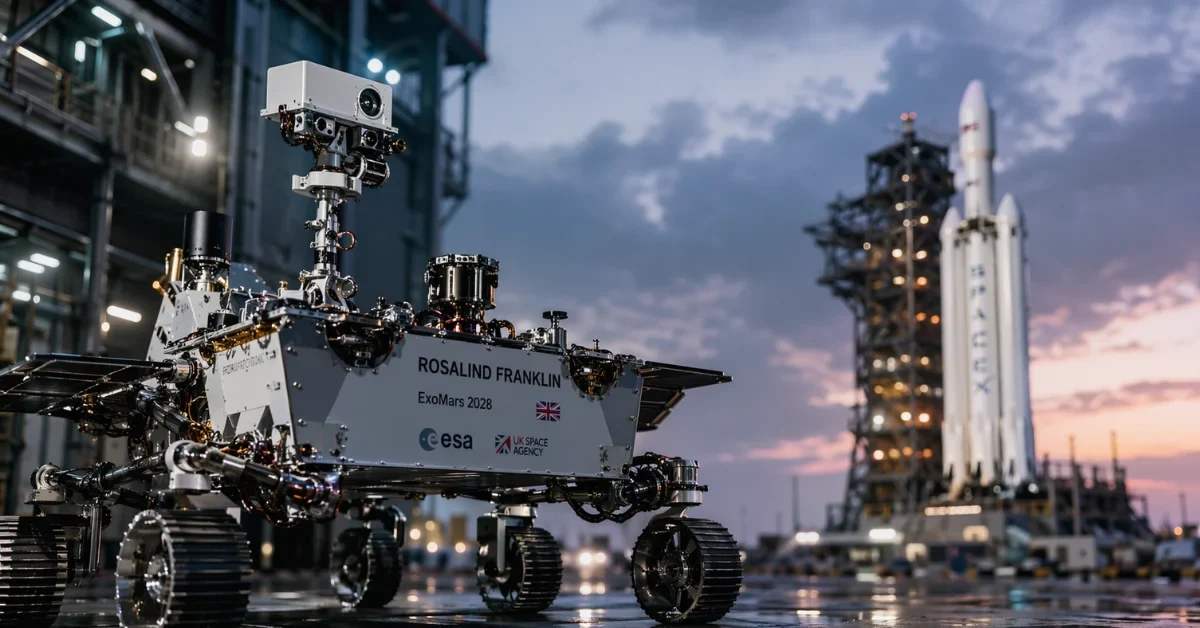
NASA has started the implementation phase of its support project for the European Space Agency’s Rosalind Franklin mission, a major step for one of the most delayed Mars rover programs in recent years. The current plan calls for SpaceX’s Falcon Heavy to launch the Rosalind Franklin rover from NASA’s Kennedy Space Center in Florida no earlier than late 2028.
The mission is led by ESA, but NASA is providing key hardware and services through its Rosalind Franklin Support and Augmentation project, also known as ROSA. NASA said the mission is scheduled for 2028 and will make Rosalind Franklin the first Mars rover designed to search for signs of past or present life beneath the planet’s surface.
NASA support moves ahead
Under the ROSA project, NASA will provide the launch service, braking engines for the rover’s lander platform, and radioisotope heater units for the rover’s internal systems. The agency is also supplying specialized electronics and a mass spectrometer for the Mars Organic Molecule Analyzer, a science instrument that will look for the building blocks of life in samples collected at the landing site, Oxia Planum.
NASA said it gave approval for the project to begin implementation after earlier review milestones. The agency also said NASA and ESA signed a memorandum of understanding in early 2024 to expand NASA’s work on the ExoMars Rosalind Franklin rover, and later in the year, the project passed its preliminary design review and moved forward in Phase B.
ESA remains responsible for the spacecraft itself, including the carrier module, landing platform, rover, and surface operations. NASA’s Launch Services Program is managing the launch service for the mission, which the agency said was awarded under the NASA Launch Services II contract.
A mission with a long history
Rosalind Franklin is part of Europe’s ExoMars program, which Space.com said was established about 15 years ago with NASA as a key partner. The program includes two missions: the Rosalind Franklin rover and the Trace Gas Orbiter, which was built to study methane and other compounds from orbit around Mars.
Earlier plans for ExoMars looked very different. Space.com reported that both missions were originally expected to launch on United Launch Alliance Atlas V rockets, with the orbiter planned for 2016 and the rover planned for 2018, before NASA left the program in 2012 because of budget issues.
After that, ESA turned to Russia for support. According to Space.com, Russia successfully launched the Trace Gas Orbiter in 2016 on a Proton rocket and built a landing platform and some science instruments for Rosalind Franklin.
Delays changed the plan
The rover’s path to launch has been repeatedly pushed back. Space.com reported that Rosalind Franklin was delayed by several problems, including parachute concerns and supply-chain disruptions linked to the COVID-19 pandemic.
ESA had prepared the rover for a planned September 2022 launch on a Proton rocket, but that plan collapsed after Russia invaded Ukraine in February 2022. Space.com said Europe then cut most of its space cooperation with Russia, including work connected to ExoMars.
That left ESA searching for new support once again. In 2024, NASA and ESA signed a new agreement laying out NASA’s role in the mission, including the launch vehicle, part of the propulsion system needed for a Mars landing, and heaters to protect the rover’s electronics and scientific instruments during cold Martian nights.
Why the launch matters
The launch decision also gives SpaceX a new milestone. Space.com reported that this is the company’s first Mars launch contract, even though founder Elon Musk has long said Mars has been a central goal for SpaceX.
Engadget reported that NASA confirmed the pending launch of ESA’s Rosalind Franklin rover and said the current plan is to use a Falcon Heavy rocket from Kennedy Space Center. The outlet also noted that the timing is still being worked out, but the launch will not happen until at least 2028.
For ESA and NASA, the renewed plan offers a clearer route forward after years of redesigns, delays, and changing international partnerships. If the schedule holds, Rosalind Franklin will head to Mars later this decade with a mission focused on one of the biggest questions in planetary science: whether signs of life can be found below the Martian surface.
