

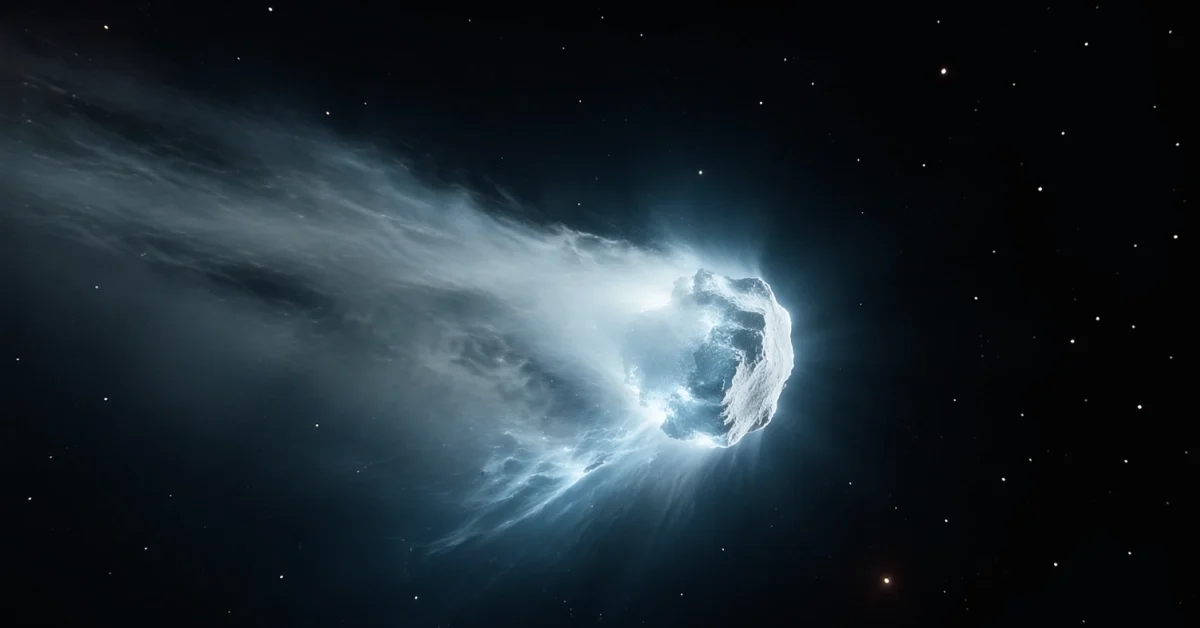
Astronomers are monitoring a frozen visitor from deep space that is rewriting the rulebook on planetary science. Interstellar comet 3I/ATLAS, only the third known object to enter our solar system from another star system, is currently heading back into the dark reaches of space. Traveling on an extremely hyperbolic trajectory, telescopes have captured a wealth of data regarding its size and unusual behavior.
The more researchers study interstellar comet 3I/ATLAS, the more puzzling it becomes. Observations reveal a massive solid core and a bizarre chemical composition that includes unexpected levels of methane, carbon dioxide, and heavy metals. This rare flyby provides scientists with an invaluable opportunity to understand the distant environments where ancient objects form.
A Massive and Misunderstood Core
Determining the exact size of the comet was initially a major challenge. Early estimates in July 2025 suggested the diameter could be anywhere from a fraction of a mile to over a dozen miles wide. This uncertainty occurred because the solid nucleus is surrounded by a highly reflective cloud of gas and dust known as a coma, making the core appear much larger and brighter than it actually is.
Recent high-resolution data from the Hubble Space Telescope and the James Webb Space Telescope have pinned down a more accurate measurement. Scientists used a nucleus extraction method to separate the solid core’s signal from the glowing dust cloud. They calculate that the solid core is roughly 2.6 kilometers wide. This makes the object tens of times more massive than any previously observed interstellar visitor.
Surging Methane Emissions
As the comet approached our sun, its outermost layers of volatile ices showed only weak signs of outgassing. Researchers believe these top layers were heavily irradiated by cosmic rays during the object’s billion-year journey through the galaxy. The situation changed dramatically as the comet made its closest approach to the sun in late October 2025 and began its outward journey.
By December, data from the James Webb Space Telescope showed the comet releasing increasing amounts of methane. Scientists conclude the sun’s heat melted away the ancient outer crust, exposing the pristine inner icy layers. Methane is well known on Earth as a greenhouse gas that is eighty times more powerful at warming our atmosphere than carbon dioxide over a two-decade period. In space, this methane stream acts as a chemical fingerprint revealing the object’s internal structure.
Unexpected Carbon Dioxide and Nickel
Methane was not the only surprise beneath the surface. Astronomers were stunned to find an extraordinary abundance of carbon dioxide in the comet’s coma. While comets naturally contain water, the ratio of carbon dioxide to water in this object was measured at eight to one. This ratio is among the highest ever observed and sits six standard deviations above normal expectations.
Spectral analysis also revealed the presence of the heavy metal nickel. Even more unusual is that this nickel appeared without iron, a chemical signature that is incredibly rare in celestial bodies. The comet is highly depleted in carbon chain compounds, making its overall chemical makeup vastly different from that of typical comets.
SPHEREx Detects Organic Building Blocks
NASA’s SPHEREx space telescope turned its infrared instruments toward the comet in December 2025. The mission detected a rich mix of organic molecules, including methanol, cyanide, and additional methane.
On Earth, these specific organic compounds are fundamental components for biological processes. However, mission scientists emphasize that these molecules can easily form through non-biological, abiotic processes in the extreme cold of interstellar space. The detection provides strong evidence of complex chemistry occurring beyond the influence of our sun.
Juice Spacecraft Captures Massive Water Spray
While NASA focused on infrared signatures, the European Space Agency’s Juice spacecraft measured the volume of material escaping the comet. Just days after the closest approach to the sun, instruments detected an enormous release of water vapor.
The comet was actively venting 2,000 kilograms of water every second. To put this output into perspective, the science team noted this is equivalent to emptying seventy Olympic-sized swimming pools every day. Juice revealed that the vast majority of this water vapor was escaping from the sun-facing side of the object, sublimating from icy dust grains in the coma rather than directly from the solid nucleus.
Leaving the Solar System
Interstellar comet 3I/ATLAS is moving too fast to be captured by the gravitational pull of our sun. It is now safely past Jupiter and continuing its journey back into deep space, never to return. While the window to observe this traveler is rapidly closing, the immense amount of data gathered will keep scientists busy for years as they decode the origins of this frozen wanderer.
