

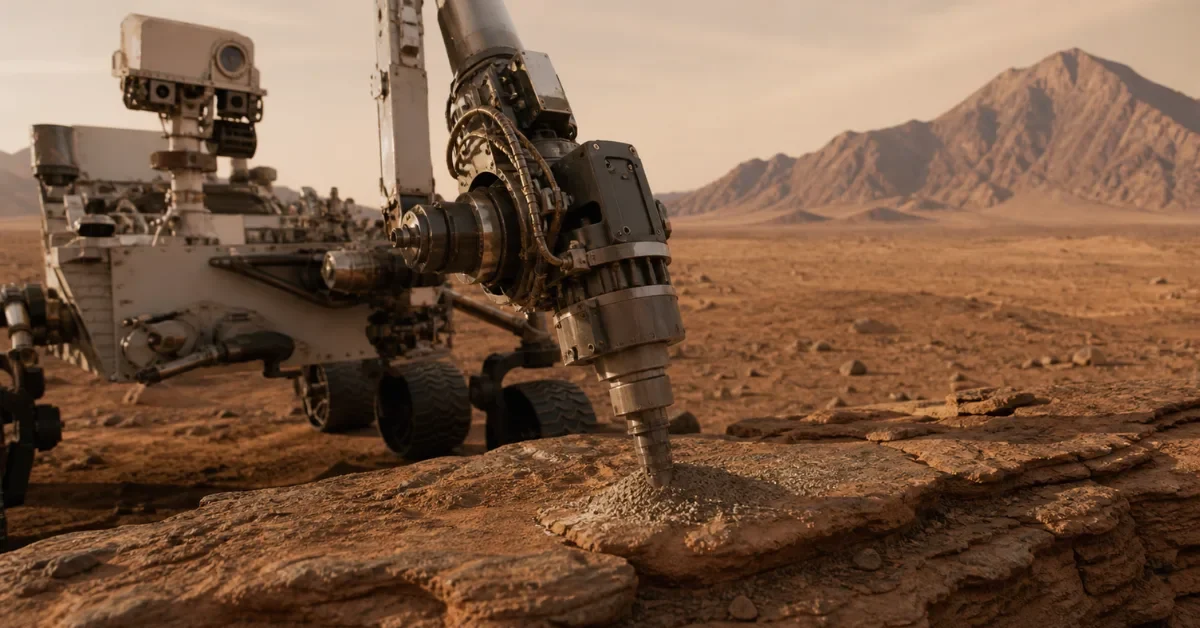
NASA’s Curiosity Mars rover has uncovered the most diverse collection of Mars organic molecules ever detected, offering profound new clues about the planet’s ancient history. Hidden within a 3.5 billion-year-old rock, this chemical treasure trove contains multiple compounds that have never been seen on the Red Planet before. The landmark discovery reignites excitement about whether Mars once possessed the right conditions to support life.
The historic findings come from a Martian rock sample nicknamed “Mary Anning 3,” which was successfully extracted by the rover in 2020. After years of meticulous laboratory analysis, researchers confirmed the presence of 21 distinct carbon-containing molecules. Out of this impressive group, seven chemical structures were detected for the very first time on the Martian surface.
Finding such a wide variety of organic compounds in a single rock demonstrates that ancient Martian sediments are not the completely sterile wastelands scientists once feared. Instead, these degraded but readable chemical records prove that complex organic matter can endure extreme radiation and harsh environmental changes over billions of years.
Unlocking Chemical Secrets Within the Mary Anning 3 Rock
The source of this unprecedented chemical diversity is a slab of clay-rich sandstone situated on the lower slopes of Mount Sharp. Billions of years ago, this region near the Martian equator was an active oasis covered by a network of lakes and streams. Water flowed and dried up repeatedly over immense stretches of time, leaving behind clay minerals that are exceptionally good at preserving delicate chemical structures.
Within this ancient lakebed, Curiosity deployed its sophisticated onboard mini-laboratory, known as Sample Analysis at Mars. To access the hidden compounds, the rover performed a rare and complex wet chemistry experiment that had never been executed on another planetary body.
The process involved dousing the powdered rock sample with a highly alkaline chemical reagent called TMAH. When heated, this chemical successfully broke apart large, tightly bound macromolecular carbon structures into smaller, readable fragments. Because the rover only carried two cups of this specific reagent, the science team had to be extremely strategic when selecting the Mary Anning site for the test.
Building Blocks of Life or Geological Wonders?
Among the 21 detected Mars organic molecules are sulfur-bearing compounds, oxygen-carrying fragments, and multiple ring-shaped carbon structures like naphthalene and benzothiophene. However, the most captivating discovery within the sample is a newly identified nitrogen heterocycle. This specific type of molecule features a ring of carbon atoms that incorporates nitrogen.
On Earth, nitrogen heterocycles are considered essential chemical precursors to RNA and DNA, the nucleic acids responsible for storing and transmitting genetic information in all known living organisms. Detecting these precursors on the Martian surface represents a major leap forward in understanding the planet’s prebiotic chemistry.
Despite the excitement surrounding these DNA precursors, scientists emphasize that the presence of these chemicals is not definitive proof of ancient alien life. Organic molecules contain carbon and are the fundamental building blocks of biology as we know it, but they can also form naturally without any biological activity.
The researchers cannot yet determine the exact origin of these compounds. The molecules might have been left behind by ancient microbial life, delivered to the Martian surface by crashing meteorites, or generated entirely by natural geological activities. Regardless of their origin, their preservation strengthens the case that if microbial life ever did exist on the Red Planet, the chemical evidence of its presence could still be waiting to be found today.
Guiding the Next Generation of Space Exploration
Discovering that complex organic chemistry can survive for 3.5 billion years provides a massive boost to upcoming space exploration efforts. Understanding how well these compounds handle extreme radiation over geological timescales helps scientists assess the true habitability of ancient Martian environments.
The successful use of wet chemistry techniques on Curiosity will directly influence how future spacecraft search for signs of life. Upcoming scientific endeavors, including the Rosalind Franklin rover mission to Mars and the Dragonfly expedition to Saturn’s moon Titan, plan to utilize similar chemical tests to hunt for preserved organic carbon.
For now, the Curiosity rover continues its slow, methodical climb up Mount Sharp in Gale Crater. As it continues to ingest and analyze samples of Martian rock and soil, scientists remain hopeful that the rugged landscape will yield even more diverse organic materials, bringing humanity one step closer to understanding the chemical history of our solar system.
