

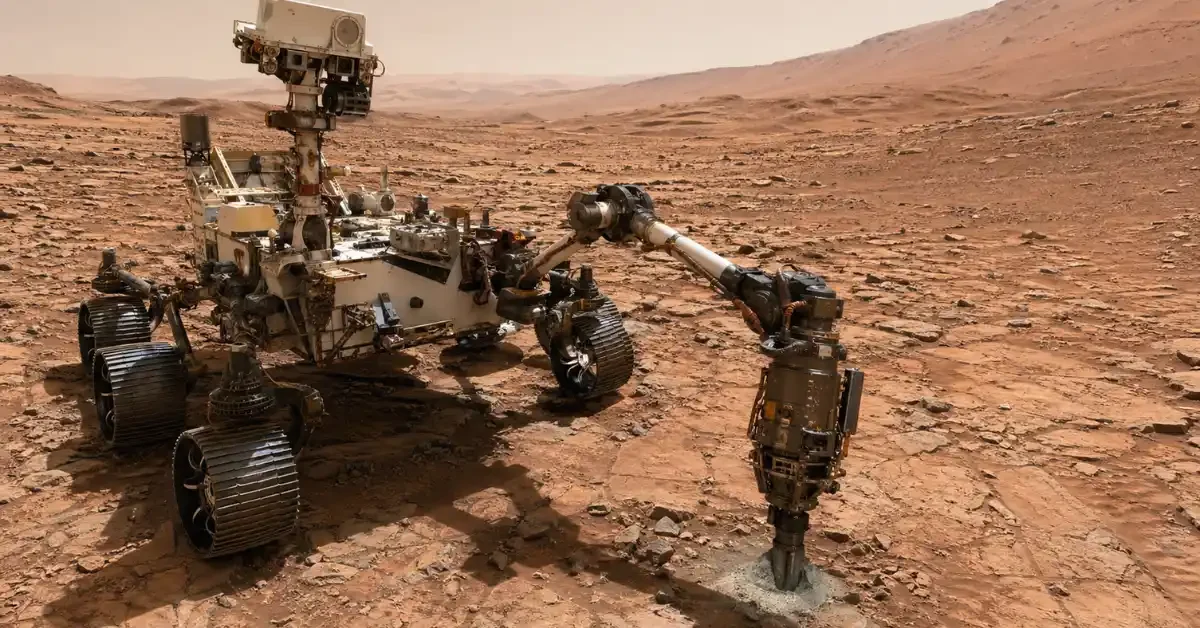
NASA’s Curiosity rover has made a groundbreaking discovery that is reshaping our understanding of the Red Planet. Deep within ancient Martian rocks, the spacecraft uncovered the most diverse collection of Mars organic molecules ever detected. The historic find includes more than 20 distinct carbon-containing compounds, seven of which have never been seen before on the planet.
This detection provides crucial clues about the planet’s past. While scientists cannot yet confirm if these chemicals resulted from biological processes or geological activity, their presence confirms that ancient Mars possessed the right chemical ingredients to potentially support life. The discovery, published recently in the journal Nature Communications, marks a significant milestone in the ongoing search for extraterrestrial habitability.
Uncovering Complex Chemical Structures
The newly discovered chemicals were extracted from a rock sample nicknamed “Mary Anning 3,” honoring the famous English paleontologist. Curiosity drilled into this rock back in 2020 while exploring the Glen Torridon region of Gale Crater. Scientists believe this specific area was once filled with lakes and streams billions of years ago. As the ancient oasis surged and dried up repeatedly, it left behind clay-bearing sandstones that are highly effective at preserving chemical signatures.
Among the materials identified in the 3.5-billion-year-old rock were nitrogen heterocycles, which are known as early building blocks for DNA and RNA. The rover also detected benzothiophene, a large, sulfur-rich molecule frequently found in meteorites. The detection of these compounds is vital because organic molecules contain carbon, a fundamental requirement for all known life forms.
However, researchers are careful to point out that these findings do not confirm the past existence of alien life. According to NASA researchers, organic molecules can be created by both biological and non-biological processes, meaning their presence alone is not definitive proof of life. Instead, the discovery highlights that the planet once had conditions suitable for organic chemistry to thrive.
A First-of-Its-Kind Planetary Experiment
To detect these complex structures, the Curiosity rover performed a unique chemical experiment that had never been attempted on another world. The rover utilized its onboard Sample Analysis at Mars instrument suite, which functions as a miniature laboratory. Inside this laboratory, scientists used a special chemical reagent called tetramethylammonium hydroxide.
This chemical is designed to break apart large, complex organic macromolecules so that the rover’s instruments can properly analyze them. Because Curiosity carried only two small cups of this valuable chemical, the mission team had to carefully choose the perfect location to conduct the test. They selected the clay-rich Knockfarrill Hill area of Glen Torridon because it offered the highest potential for preserving ancient organic matter.
By successfully using the chemical solution, scientists proved that large organic molecules can survive the harsh, radiation-battered environment of the Martian surface for billions of years. This process of extracting gases from heated rock powders allowed researchers to identify the hidden chemical diversity locked within the planet’s crust.
Tracing Origins Across the Solar System
The results of this chemical analysis offer a fascinating glimpse into the shared history of our solar system. Amy Williams, the lead researcher on the study, noted that the findings present an intriguing connection between Earth and its planetary neighbor. Because chemicals like benzothiophene are often delivered by meteorites, it is possible that space rocks brought the same organic materials to both planets millions of years ago.
This shared chemical history raises compelling questions for researchers. If Earth and Mars both received the same fundamental building blocks from meteorite impacts, scientists want to know why life flourished on Earth while Mars eventually transformed into a freezing, barren desert. The prevailing theory suggests that as Earth maintained a stable climate and liquid water, Mars gradually lost its protective atmosphere, halting the advancement of complex biological chemistry.
Despite the differences in how the two planets evolved, the successful preservation of these compounds provides hope. It demonstrates that deep beneath the harsh surface, the geological record of the solar system remains intact and waiting to be explored.
Shaping Future Space Exploration
The success of the Curiosity rover’s experiment is already influencing the next generation of space exploration. By proving that this specific wet chemistry method works effectively on another planet, NASA and its international partners have a proven blueprint for future missions designed to detect signs of life.
Upcoming scientific expeditions are currently planning to incorporate similar chemical tests. The European Space Agency’s Rosalind Franklin rover, which is designed to drill deep below the Martian surface, will carry a version of this experiment. Additionally, the Dragonfly mission heading to Saturn’s organically rich moon, Titan, will utilize similar mass spectrometer technology to search for complex molecules.
While humanity still lacks definitive proof of life beyond Earth, each new rock sampled brings scientists one step closer to answering that ultimate question. The continuous discoveries made by Curiosity ensure that the search for ancient habitable environments remains one of the most exciting frontiers in modern science.
