

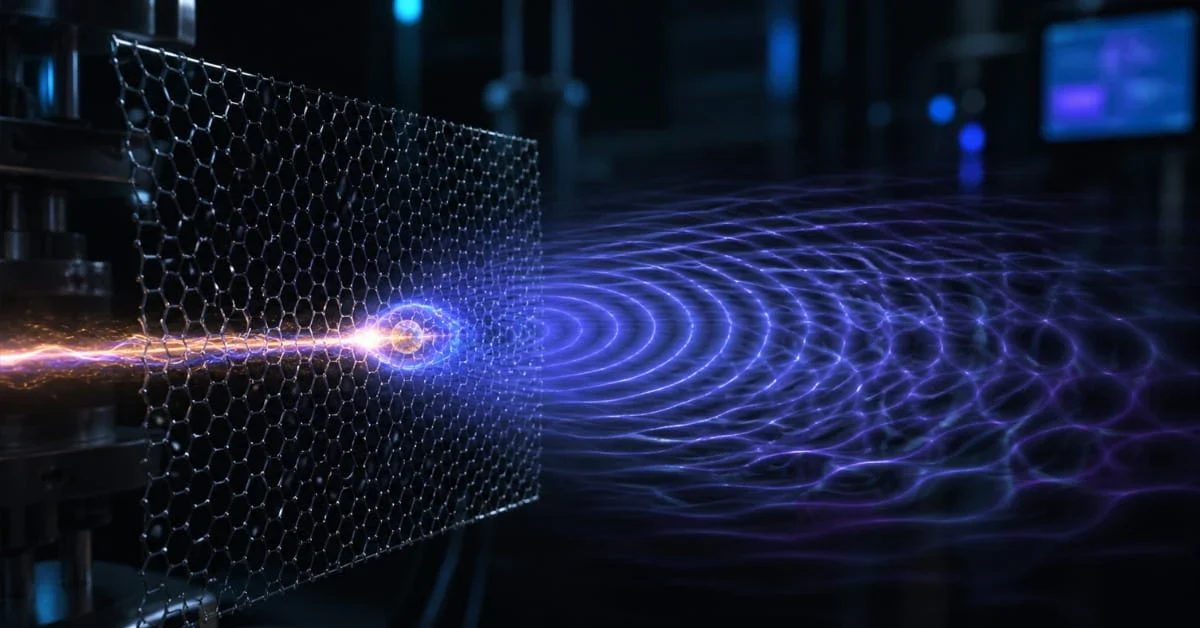
Quantum physics consistently challenges our understanding of reality by revealing that the universe’s building blocks act in counterintuitive ways. In a major milestone for fundamental physics, researchers have successfully demonstrated positronium wave behavior for the very first time. By observing an exotic, short-lived antimatter atom diffracting exactly like a wave, scientists have pushed the known boundaries of wave-particle duality into entirely new territory.
A research team at the Tokyo University of Science, led by Professor Yasuyuki Nagashima alongside Associate Professor Yugo Nagata and Dr. Riki Mikami, conducted the groundbreaking experiment. Their work confirms that even unstable, matter-antimatter systems obey the complex rules of quantum mechanics, acting as unified quantum objects.
The Fundamentals of Wave-Particle Duality
One of the core principles separating quantum mechanics from classical physics is the realization that microscopic particles do not just act as solid objects. Under the right conditions, they behave as continuous waves. This concept was historically cemented by the famous double-slit experiment, which showed that a single electron could pass through two openings simultaneously, interfering with its own wave-function to create a distinct pattern of light and dark bands on a detector.
Over the decades, scientists successfully demonstrated this matter-wave diffraction with neutrons, helium atoms, and even massive molecules. However, witnessing the same phenomenon in an antimatter system proved incredibly difficult.
Positronium presents a unique challenge. It is an ephemeral, two-body system made of an electron and its exact antimatter counterpart, a positron. The two particles orbit a shared center of mass and have equal masses. Structurally, the system is similar to a hydrogen atom but remains incredibly unstable, typically self-annihilating shortly after forming. Because of this fleeting existence, scientists struggled to observe how a beam of this material would act during diffraction.
Crafting a Coherent Antimatter Beam
To finally capture this elusive phenomenon, the Tokyo University of Science team had to engineer a highly controlled experimental environment. The breakthrough required generating a stable, high-quality stream of particles with the right energy range and coherence to produce visible interference effects.
The researchers started by creating negatively charged positronium ions. Once they established this base, they fired a precisely timed laser pulse at the ions to strip away an extra electron. This delicate procedure left behind a fast-moving, electrically neutral, and coherent beam of positronium atoms.
Scientific publications note varying timelines regarding the announcement, with some reports dating to January 2026 and others to April 2026. Regardless of the exact reporting date, the experimental setup achieved unprecedented precision. The method generated beams reaching energies up to 3.3 kiloelectron volts (keV), maintaining a narrow energy spread and a tightly focused trajectory.
Passing Through a Graphene Target
The researchers then directed this high-energy beam toward a specialized target: a graphene sheet consisting of two to three atomic layers. The experiment took place inside an ultra-high vacuum to ensure the graphene surface remained completely clean, which was critical for observing unobstructed diffraction effects.
Graphene was chosen because the spacing between its atoms perfectly matched the de Broglie wavelength of the positronium at the specific energies utilized in the lab. As the stream passed through the thin carbon layers, some of the atoms were transmitted and successfully picked up by a position-sensitive detector.
The resulting measurements displayed a distinct diffraction pattern. Despite being composed of two distinct entities—a regular matter electron and an antimatter positron—the positronium did not split apart or diffract independently. Instead, the pair acted together as a single, unified quantum wave.
Unlocking New Scientific Applications
Proving that this exotic atom functions as a coherent matter wave is more than just a theoretical victory. The successful observation of wave-particle duality in this system paves the way for practical advancements in both applied and fundamental physics.
Because positronium is electrically neutral, it can interact with surfaces without causing the damage typically associated with charged particle beams. This makes it a valuable tool for materials science. Researchers could use it to conduct non-destructive analyses of delicate structures, including specialized insulators and magnetic materials that normally disrupt or deflect electrically charged beams.
Investigating Antimatter and Gravity
Beyond materials testing, this milestone opens new doors for investigating the universe’s most profound mysteries. One of the largest unanswered questions in modern physics is exactly how antimatter interacts with gravitational forces. Direct measurements of this relationship have never been successfully achieved, not even for solitary electrons.
By mastering the control and observation of coherent antimatter beams, scientists can now conceptualize highly sensitive interference experiments designed to test gravity’s pull on antimatter. Future research using these diffraction techniques could reveal whether antimatter falls exactly like regular matter, unlocking secrets about the fundamental laws of the cosmos.
