

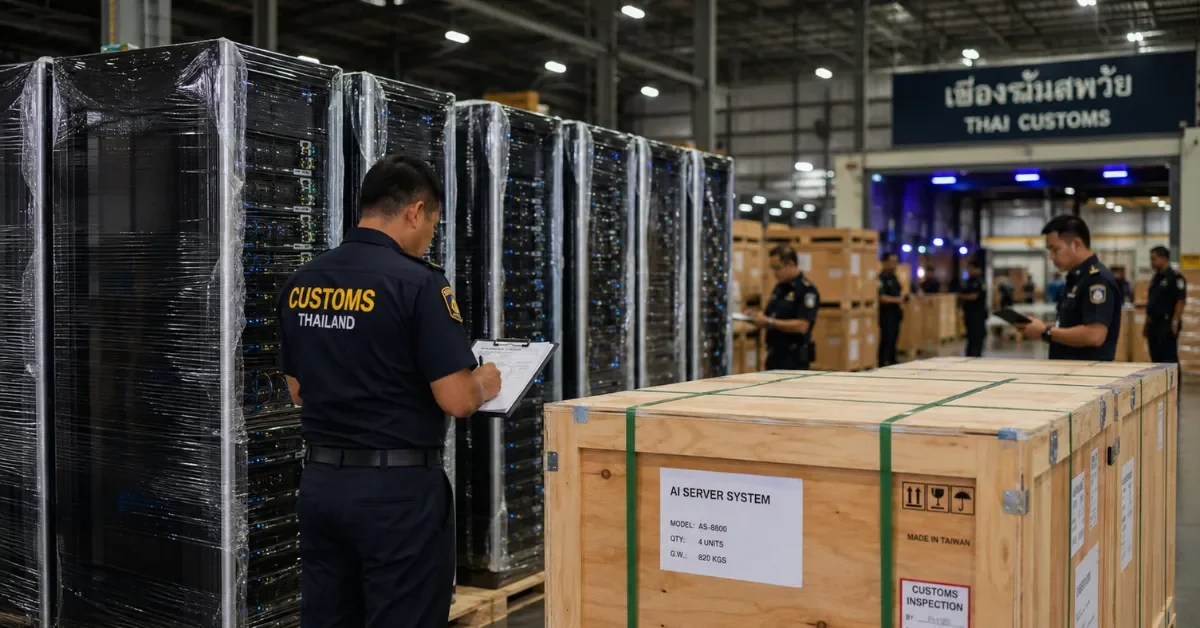
U.S. authorities suspect that advanced Nvidia chips inside Super Micro Computer servers were routed toward Alibaba through Thailand, putting fresh attention on how AI hardware may have moved through Southeast Asia despite export controls. Bloomberg News identified the intermediary buyer in the case as Bangkok-based OBON Corp, a company that prosecutors referred to in court filings as “Company-1.”
The report says some of the servers sold to OBON allegedly went to Alibaba Group Holding as an end customer. Alibaba told Reuters it has no business ties with Super Micro, OBON, or any third-party brokers named in the indictment, and it also said banned Nvidia chips have never been used in its data centres. NVIDIA said it expects partners across its ecosystem to follow strict compliance rules and that it will keep working with the government to enforce those requirements. Super Micro did not immediately respond to Reuters’ request for comment, while OBON could not be immediately reached in the Reuters account and had not issued a public response in the Economic Times report.
Alleged shipping route
The Alibaba angle grows out of charges filed in March, when the U.S. Justice Department accused Super Micro co-founder Yih-Shyan Liaw, sales manager Ruei-Tsang Chang, and contractor Ting-Wei Sun of running a scheme to move U.S.-made AI servers through Taiwan to Southeast Asia and then into China. Prosecutors alleged the servers were repackaged into unmarked boxes before being smuggled onward, and they said the operation involved at least $2.5 billion in U.S. AI technology. Reuters’ account said more than $500 million was shipped between April and mid-May 2025, while Asia Times cited Justice Department language saying about $510 million worth of servers were diverted to China between late April and mid-May 2025.
Asia Times reported that prosecutors also described the use of non-functional “dummy” servers in Thailand after new U.S. guidelines took effect in May last year. According to that report, the dummy units were allegedly placed at declared storage sites so they would appear to match official purchase records during compliance checks. Prosecutors also alleged that packaging, labels and serial-number stickers were reused so the staged inventory could withstand routine visual inspections.
Super Micro said it was not named as a defendant in the case and described the alleged conduct as a violation of company policies and export-control requirements. The company said two employees were placed on administrative leave, its relationship with the contractor was terminated, and Liaw later resigned from the board with immediate effect.
Separate DOJ case
A separate U.S. case described by ACS Information Age involved Chinese national Stanley Yi Zheng and two U.S. citizens, Matthew Kelly and Tommy English, who were accused of trying to obtain computer servers containing export-controlled chips and send them to China through pass-through companies in Thailand. That report said one order involved 750 servers valued at about $170 million, including 600 servers with Nvidia H100 chips. It also cited another purchase order for 232 Supermicro server units valued at nearly $62 million.
ACS reported that Nvidia and Supermicro staff cancelled suspicious orders in early 2024 after spotting warning signs, including that one company in the scheme was based in China. Nvidia later confirmed to PCMag, as cited by ACS, that the would-be smugglers did not clear its diligence process and did not receive GPUs from the company. The three men were charged with conspiring to commit smuggling and export-control violations, with Zheng arrested on March 22 and Kelly and English surrendering three days later.
Export controls under pressure
The wider dispute reflects long-running U.S. restrictions on advanced chip exports to China. Reuters’ account says the United States banned exports of high-end Nvidia chips to China in 2022 over concerns they could be used for military purposes, while sales of Nvidia’s H200 chips were approved in January this year under certain conditions. Asia Times also reported that Senators Jim Banks and Elizabeth Warren called on Commerce Secretary Howard Lutnick to suspend Nvidia export licenses to China and Southeast Asian intermediaries after Liaw’s arrest.
Together, the allegations show how closely regulators are now watching third-country intermediaries, warehousing and reseller networks in the global AI supply chain. They also deepen scrutiny on whether advanced servers and chips can be redirected across multiple jurisdictions even when the manufacturers and named customers publicly deny wrongdoing and say they are following export laws.
