

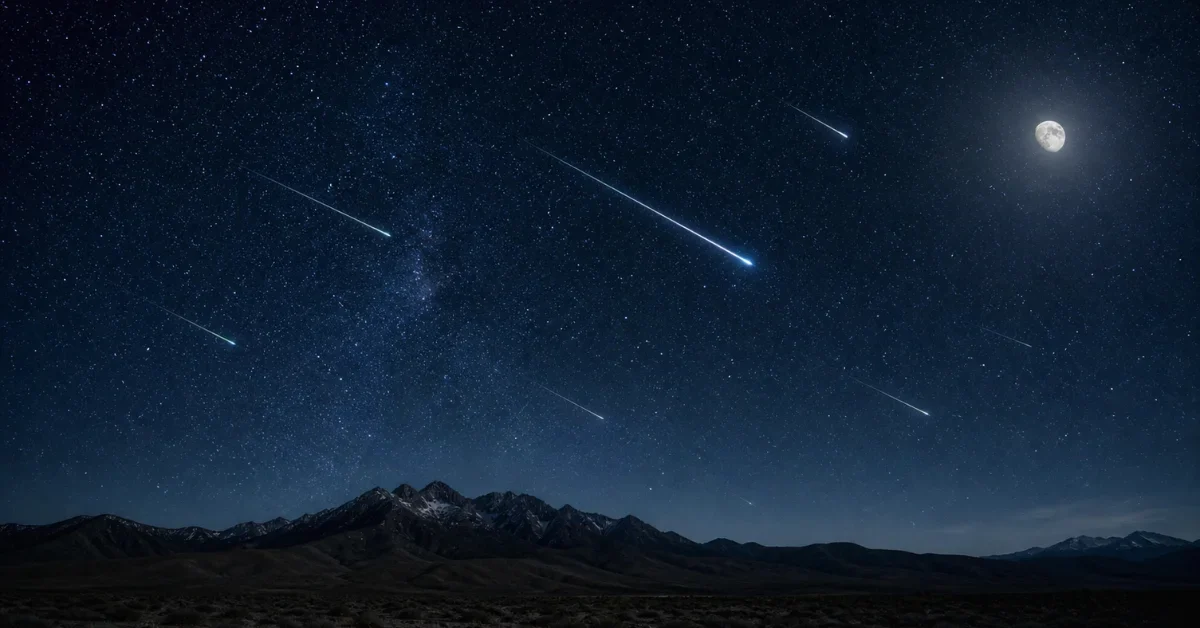
The highly anticipated Eta Aquarid meteor shower 2026 is about to reach its peak, offering skywatchers an opportunity to witness a spectacular cosmic event. Every spring, the night sky comes alive as the Earth charges through trails of celestial debris left behind by one of the most famous space objects in history. This May, observers have the chance to see these fast-moving shooting stars streak across the darkness.
The peak of the shower is expected to take place in the early morning hours of Tuesday, May 5, carrying over into Wednesday, May 6. While the shower provides an exciting viewing opportunity, conditions this year will not be entirely ideal. The peak happens to coincide with a bright waning gibbous moon. This moonlight interference will undoubtedly wash out the fainter meteors, making the overall display harder to glimpse.
The Origins of the Eta Aquarids
Meteor showers occur when our planet passes through streams of dust and small rocks discarded by comets traveling through the solar system. The Eta Aquarid meteor shower is made up of debris left behind by Halley’s Comet. As the Earth intersects this trail, the tiny fragments enter our atmosphere at incredibly high speeds.
These meteors travel across the sky at approximately 41 miles, or 66 kilometers, per second. Because of this extreme velocity, the Eta Aquarids are not typically known for producing large fireballs. Instead, they are celebrated for leaving glowing trains of debris—luminous streaks that linger briefly in the sky after the initial flash. The active period for this shower begins in mid-April and stretches until late May, giving the Earth plenty of time to pass through the meteor stream.
Radiant Point and Constellation
Meteor showers get their names from the constellation from which the shooting stars appear to originate, known as the radiant point. From our perspective, the Eta Aquarids seem to radiate from the constellation Aquarius.
To pinpoint this location, astronomers note that the Aquarius constellation sits at a right ascension of 23 hours and a declination of negative 15 degrees, generally viewable at latitudes between 65 and negative 90 degrees. During the peak dates, the radiant point rises in the early hours and slowly climbs toward its highest point just as dawn approaches. Understanding its position helps explain why certain times and locations offer better viewing experiences.
How Hemisphere Impacts Visibility
Your location plays a massive role in how many shooting stars you can witness. The Eta Aquarids strongly favor the Southern Hemisphere, where they consistently rank as one of the most prolific showers of the year. Under clear and dark conditions, southern observers might typically witness a maximum rate of about 50 meteors per hour. Unfortunately, the bright moon this year could cut that number by half.
For viewers located in the Northern Hemisphere, the display is historically much more modest. Because the radiant point remains relatively low on the horizon, fewer meteors are visible. Estimates for the North conflict vary depending on the source. According to astronomy publications, observers north of the equator can expect around 10 to 30 meteors per hour. In contrast, national news agencies report that northern skywatchers will likely see fewer than 10 shooting stars per hour due to the bright conditions. Interestingly, peak rates can occasionally rise higher than expected due to gravitational resonance with Jupiter.
Best Viewing Strategies and Tips
Despite the interference from the waning gibbous moon, catching a glimpse of the Eta Aquarid meteor shower 2026 is highly possible with the right approach.
Finding the Right Time
The best time to view the shower is right before dawn. The American Meteor Society lists the predicted peak time as 3:51 UTC on May 5, but peak activity stretches across multiple days. Waking up early ensures the radiant is at its highest in the dark sky.
Choosing a Location and Adjusting
To combat the moon’s brightness, head to the darkest possible location. Find a spot away from city lights, where light pollution will not further dim the view. Once you arrive, lean back and allow your eyes time to adapt to the dark environment. It generally takes at least 20 to 30 minutes for your eyes to fully adjust.
Keeping It Simple
There is no need for special equipment. Telescopes and binoculars restrict your field of vision, causing you to miss fast-moving streaks. The secret is simply to take in as much of the sky as possible. Avoid using your mobile phone, as the bright screen ruins your night vision. If you need a flashlight, make sure it has a red light setting to preserve your eyes’ adaptation to the dark. With patience, you can still enjoy Halley’s Comet debris lighting up the atmosphere.
