

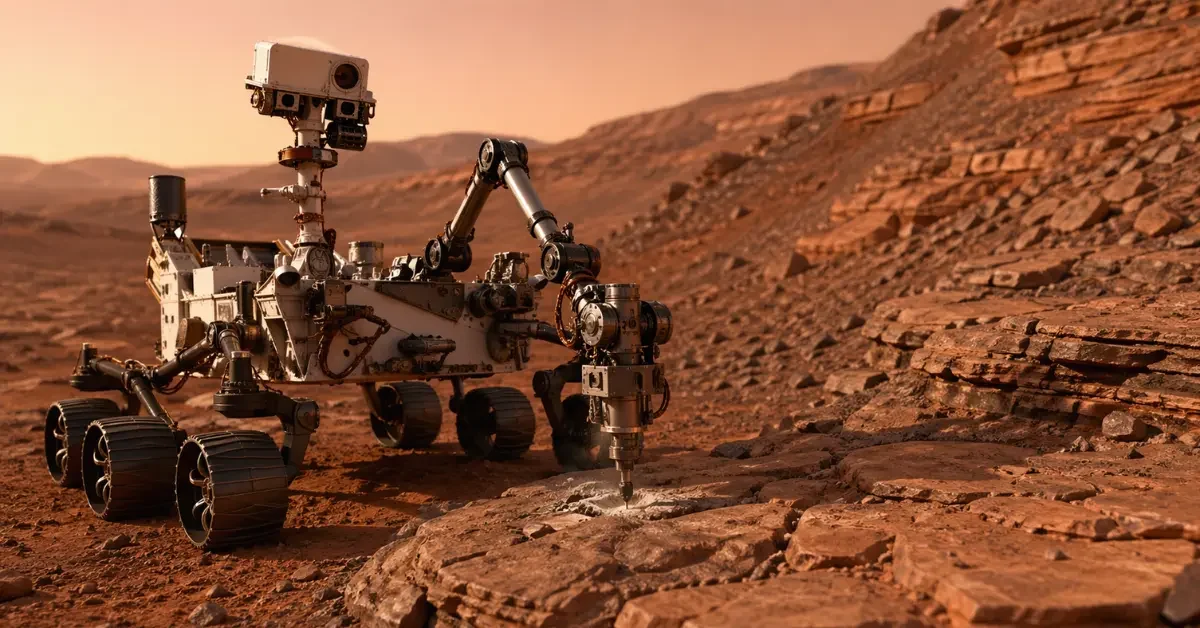
NASA’s Curiosity rover has uncovered the most diverse collection of organic molecules ever found on Mars, with 21 carbon-containing compounds identified in a single rock sample — seven of them detected on the Red Planet for the very first time.
The discovery, detailed in a paper published in Nature Communications on April 21, 2026, confirms that ancient Mars once had the chemical conditions necessary to support life. Scientists are careful to note, however, that organic molecules can form through both biological and non-biological processes, and the finding is not proof that life ever existed on Mars.
The “Mary Anning 3” Sample
The rock at the center of this discovery carries the nickname “Mary Anning 3,” named after the celebrated 19th-century English fossil collector and paleontologist. Curiosity drilled and collected the sample back in October 2020 from a section of Mount Sharp that was once blanketed by lakes and streams billions of years ago.
That ancient watery environment left behind rich deposits of clay minerals, which are particularly effective at trapping and preserving organic compounds over long timescales. Scientists say the sample’s survival after billions of years of exposure to Mars’s intense radiation and oxidation is itself a significant finding, because it broadens what we know about the kinds of molecules that can endure on the Martian surface.
Seven Molecules Never Seen on Mars Before
Among the seven newly detected molecules, two stand out as especially significant. The first is a nitrogen heterocycle — a ring-shaped structure made of carbon atoms that also includes nitrogen. On Earth, these structures are considered chemical precursors to RNA and DNA, the nucleic acids that carry and transmit genetic information.
“That detection is pretty profound because these structures can be chemical precursors to more complex nitrogen-bearing molecules,” said Amy Williams, lead author of the paper and a researcher at the University of Florida in Gainesville. “Nitrogen heterocycles have never been found before on the Martian surface or confirmed in Martian meteorites.”
The second notable find is benzothiophene, a molecule that contains both carbon and sulfur and has been detected in numerous meteorites. Some scientists believe meteorites like these may have scattered prebiotic chemistry across the early solar system, potentially giving rise to the building blocks of life on multiple worlds.
How the Discovery Was Made
Both this latest batch of findings and the 2025 discovery of Mars’s largest-ever organic molecules — long-chain hydrocarbons called decane, undecane, and dodecane — were made using Curiosity’s onboard minilab, the Sample Analysis at Mars instrument, known as SAM.
SAM works by receiving pulverized rock powder drilled from Martian rock, then heating it in a high-temperature oven to release gases for analysis. For the Mary Anning 3 sample, scientists used SAM’s rare “wet chemistry” capability, which involves dropping a sample into a small cup of a powerful chemical solvent called tetramethylammonium hydroxide, or TMAH. Only two such cups were available on the rover, and this sample earned the distinction of being the first to receive that treatment.
To verify their results, the research team ran the same TMAH process on a fragment of the Murchison meteorite — a more-than-4-billion-year-old space rock that landed on Earth and is one of the most-studied meteorites in history. The Murchison sample broke down into some of the same molecules found in Mary Anning 3, including benzothiophene, adding confidence that the Martian molecules could be fragments of even more complex compounds once relevant to life.
What This Means for the Search for Life
Scientists stress that none of this constitutes definitive proof of past life on Mars. Organic molecules can arise from purely geological processes, and distinguishing between biological and non-biological origins requires far more analysis than a rover can perform on another planet.
Still, the significance of the find is hard to overstate. “This collection of organic molecules once again increases the prospect that Mars offered a home for life in the ancient past,” said Ashwin Vasavada, the mission’s project scientist at NASA’s Jet Propulsion Laboratory.
What Comes Next
These findings are already shaping the design of future Mars missions. NASA Goddard Space Flight Center has contributed key components, including a mass spectrometer, to the Mars Organic Molecular Analyzer — a next-generation version of SAM — for ESA’s Rosalind Franklin Mars rover. A similar instrument, called the Dragonfly Mass Spectrometer, will fly to Saturn’s moon Titan aboard NASA’s Dragonfly rotorcraft. Both instruments will support wet chemistry using the same TMAH solvent that proved so effective on Mars.
Meanwhile, Curiosity recently used its second and final TMAH cup while exploring ancient groundwater formations called boxwork ridges. Scientists are still analyzing those results, with a future peer-reviewed paper expected to follow. The rover, built by JPL and managed by Caltech, continues to push the boundaries of what humanity knows about life’s potential beyond Earth.
