

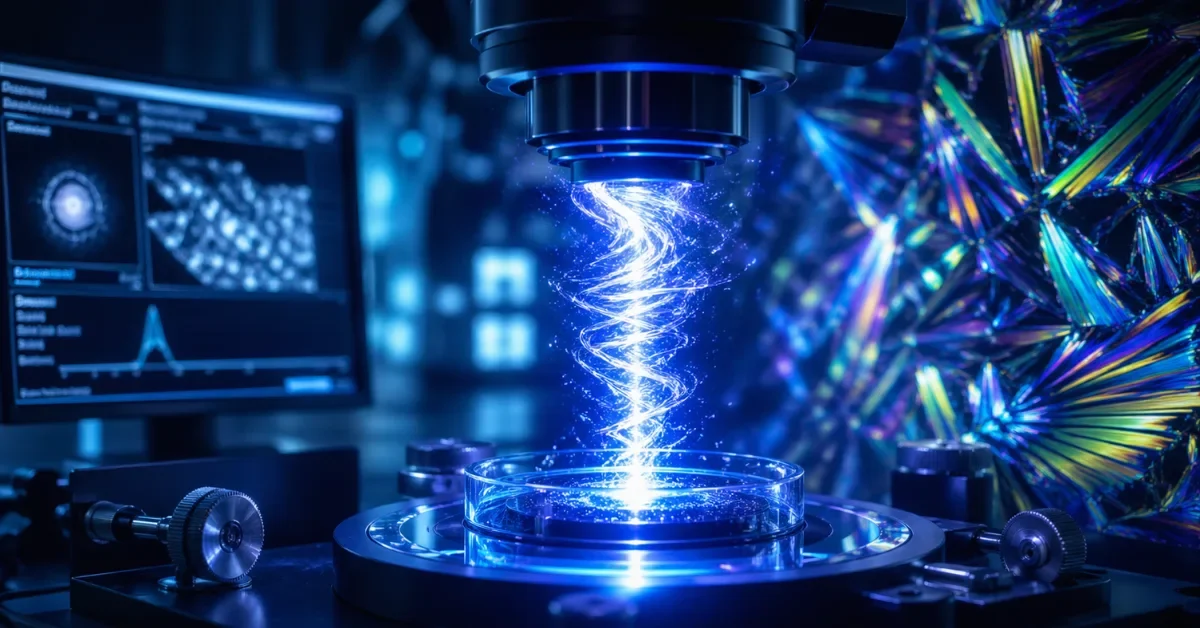
Can light twist and swirl like a miniature whirlwind? A collaborative team of physicists has proven that it can. In a groundbreaking discovery, researchers have successfully generated “optical tornadoes” within extremely small structures. These swirling beams of light possess vortex-like properties that mimic the dynamic behavior of a whirlwind, opening a completely new pathway for manipulating light at the microscale.
This recent breakthrough was achieved by an international scientific collaboration featuring experts from the Faculty of Physics at the University of Warsaw, the Military University of Technology, and the Institut Pascal CNRS at Université Clermont Auvergne. Published in the prestigious journal Science Advances, their research demonstrates how synthetic magnetic fields can be used to create miniature light sources with highly complex structures. By shifting away from traditional, highly complex nanotechnology, the scientific team has discovered a simpler and more efficient method to control the fundamental properties of light.
Harnessing Liquid Crystals and Torons
Instead of relying on intricate, expensive, and difficult-to-scale nanotechnology manufacturing processes, the researchers utilized a surprisingly simple setup based on liquid crystals. These self-organizing materials provide an ideal, highly responsive environment for shaping the behavior of light waves. Within this unique liquid crystal environment, the scientists leveraged specific self-organizing structures known as “torons.”
Torons act as highly effective miniature traps for the light. When light enters these specific structures, the torons trap and manipulate it, causing the beams to spiral and rotate in intricate, vortex-like ways. By using these self-organizing torons, the researchers were able to reliably guide the light waves into forming the swirling optical tornadoes. This approach boldly demonstrates that sophisticated light manipulation can be achieved through materials that naturally organize themselves, rather than strictly requiring materials that are artificially engineered atom-by-atom at the nanoscale.
Generating Stable Light in the Ground State
One of the most impressive and critical aspects of this scientific discovery is the incredible stability of the generated light. The research team was able to achieve the twisting optical tornado effect while keeping the light in its most stable, lowest-energy state. In physics, this is known as the ground state. Generating these unusual optical properties directly in the ground state makes it far easier to consistently produce stable, laser-like beams without requiring massive amounts of energy to maintain the effect.
To carefully verify the behavior of the entire system and officially create the laser effect, the researchers added a specific laser dye to their liquid crystal setup. This crucial addition allowed them to observe and measure the precise characteristics of the light they were manipulating.
Dr. Marcin Muszyński, a key researcher involved in the project, highlighted the practical significance of the results. “We obtained light that not only rotates but also behaves like laser light: it is coherent and has a well-defined energy and emission direction,” he stated. This high level of coherence and precise emission direction are essential, non-negotiable qualities for any practical laser application. His statement proves that these optical tornadoes are not just a visual curiosity in a laboratory, but a highly functional and measurable form of laser light.
Photons Behaving Like Quarks
The theoretical foundation of this optical experiment is just as fascinating as the physical results observed in the lab. The researchers drew upon highly advanced physics theories to guide their experimental approach and understand their findings.
Prof. Dmitry Solnyshkov explained the complex underlying mechanics by pointing to concepts that typically only apply to subatomic particles. “It’s interesting that our approach draws inspiration from very advanced theories involving a so-called vectorial charge,” he noted. “So, in a way, we’ve managed to make photons behave not even like electrons, but like quarks, the charged particles which make up protons.”
By utilizing a synthetic magnetic field within the miniature liquid crystal structures, the team essentially forced the photons—the fundamental, massless particles of light—to behave in ways that entirely defy their typical nature. Mimicking the physical behavior of quarks represents a major conceptual leap in how scientists understand and control the fundamental properties of light waves.
Transforming Quantum Technologies and Optical Communication
The successful creation of these optical tornadoes paves the way for a wide range of future innovations in the field of photonics. Because the liquid crystal and toron setup is fundamentally simpler than existing nanoscale engineering techniques, it enables the potential development of much more scalable photonic devices. Manufacturers could potentially produce these components far more easily than traditional miniature lasers.
These miniature, complex light sources hold immense potential for the future of global technology. In the crucial realm of optical communication, where light is rapidly used to transmit data over long distances, these highly coherent and precisely directed beams could lead to significantly more efficient and robust networks.
Furthermore, the unprecedented ability to manipulate light at such a fundamental level, successfully forcing photons to adopt complex properties like vectorial charge, is highly relevant for the rapidly advancing field of quantum technologies. By proving that synthetic magnetic fields and self-organizing materials can seamlessly generate stable, twisting laser light, this international team of physicists has expanded the boundaries of modern science. Their miniature optical tornadoes offer a clear and promising glimpse into the future of scalable, high-performance optical devices.
