

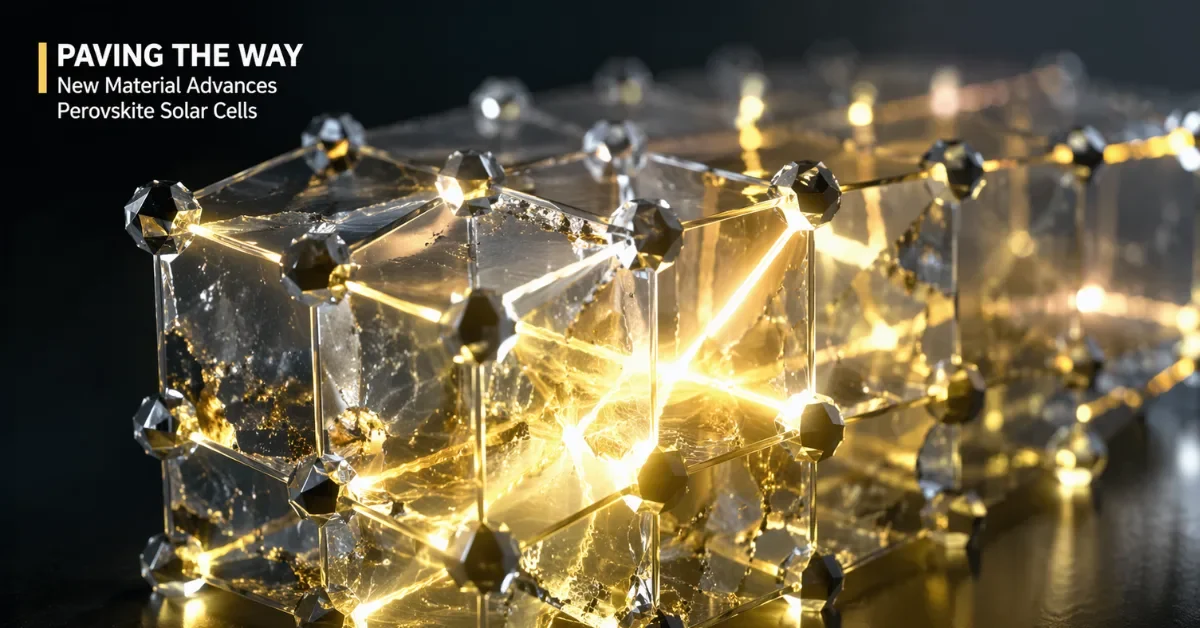
Scientists at the Institute of Science and Technology Austria (ISTA) have solved a mystery surrounding the performance of next-generation renewable energy materials. They discovered that structural flaws inside lead-halide perovskite solar cells actually improve their ability to generate electricity. This research, published in the journal Nature Communications, reveals that naturally occurring imperfections create microscopic networks that efficiently separate and guide electric charges.
These findings explain how low-cost materials can rival the efficiency of highly refined silicon solar panels. By mapping the crystals, researchers identified specific regions that function as dedicated superhighways for energy flow.
The Mystery Behind Low-Cost Solar Power
For decades, the energy industry has relied on silicon to manufacture solar panels. Silicon-based technology requires expensive, ultra-pure single-crystal wafers to function effectively. In silicon cells, any structural flaws trap electrical charges, preventing them from generating usable electricity.
In contrast, lead-halide perovskites are produced using simple, solution-based manufacturing methods. This inexpensive approach naturally leaves the material packed with impurities and structural defects. Despite these obvious flaws, perovskite solar cells achieve energy conversion rates approaching those of ultra-pure silicon.
Researchers Dmytro Rak and Zhanybek Alpichshev at ISTA set out to understand how this seemingly impossible feat occurs. Their findings provide a physical explanation that accounts for almost all the documented properties of these materials.
How Electrical Charges Move Through Materials
To understand this discovery, it helps to examine how solar panels capture sunlight. When light strikes a solar cell, it creates negatively charged electrons alongside positively charged spaces known as “holes.” Together, these paired charges form an exciton.
Naturally, these opposite charges want to recombine quickly. For a solar panel to generate power, the electrons and holes must remain separated and travel to the electrodes. This internal journey covers hundreds of microns. On a human scale, traveling that distance would be equivalent to moving hundreds of kilometers.
In traditional silicon, charges only survive this long journey because the material is flawlessly pure. Because perovskites are filled with defects, scientists struggled to explain how charges could successfully navigate the material without getting lost along the way.
Microscopic Highways for Energy Flow
The ISTA research team suspected that hidden internal forces within the perovskites were pulling the electrons and holes apart. They tested this hypothesis by injecting charges deep inside unmodified, single-crystal perovskite materials.
The researchers observed a consistent electrical current flowing in a single direction, even when no external voltage was applied. This proved that powerful internal forces were separating the charges at specific boundaries called “domain walls,” where the physical structure slightly shifts.
These interconnected networks of domain walls act as dedicated highways. When sunlight creates an electron and a hole near a domain wall, the local electric field pushes them apart. The electron moves to one side of the boundary, while the hole goes to the opposite side. Physically separated, the charges cannot recombine. They drift safely along the domain walls for what researchers describe as eons on a charge carrier’s timescale, eventually reaching the electrodes.
Making the Invisible Networks Visible
Confirming the existence of these deep networks presented a major hurdle. Most measurement tools only examine a material’s surface, making it difficult to study domain walls hidden deep inside the crystal.
Rak utilized his chemistry background to develop a novel visualization method. Because perovskite materials conduct ions, Rak introduced silver ions to act as internal markers. These ions migrated through the material and accumulated directly along the hidden domain walls.
Once in place, the ions were converted into solid metallic silver. This process made the entire internal network visible under a microscope. Alpichshev compared this qualitative technique to medical angiography, a procedure used to map hidden blood vessels in living tissues.
The Future of Renewable Energy Technology
Since their impressive light-converting abilities were rediscovered, lead-halide perovskites have sparked excitement across the energy sector. Beyond solar panels, they exhibit astounding quantum properties at room temperature and show promise for advanced LEDs and X-ray imaging.
Until now, scientific efforts to improve perovskite solar cells focused on tweaking their chemical composition, yielding limited progress. This new understanding fundamentally shifts the approach to advancing solar technology. By recognizing that internal defects are beneficial, scientists can deliberately engineer the internal structural networks. Guiding the formation of these charge highways could lead to a new generation of solar panels that are cheaper to produce and capable of unprecedented efficiency.
