

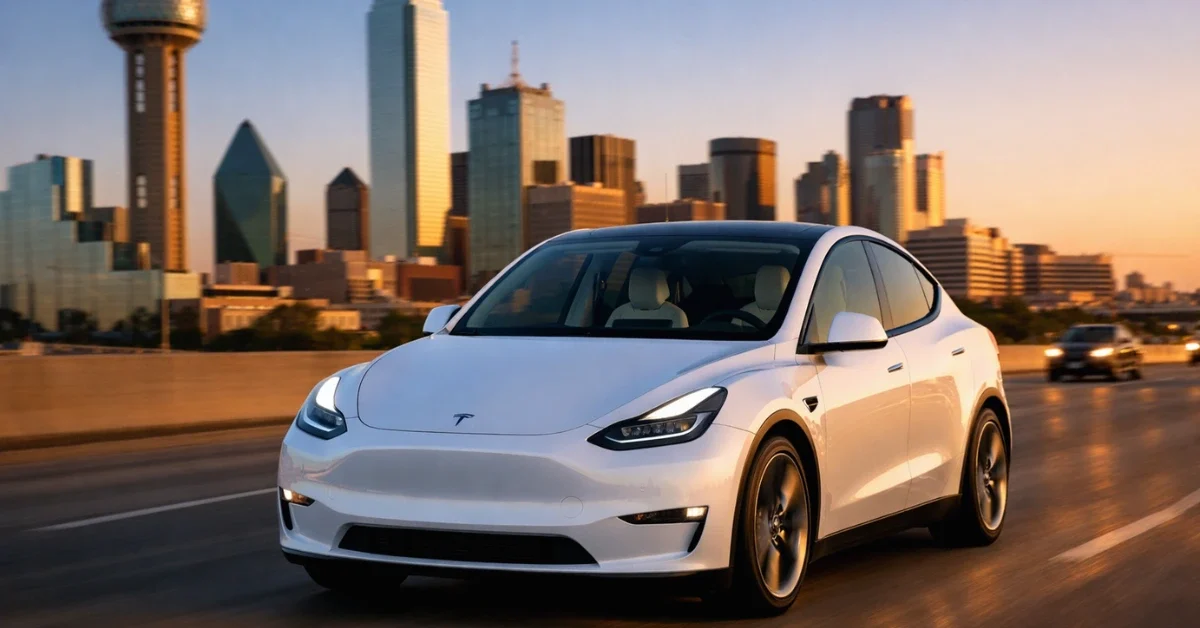
Tesla’s robotaxi service has officially rolled out in Dallas and Houston, Texas — bringing fully driverless rides to two major American cities and pushing the boundaries of autonomous transportation further than ever before. The expansion, announced on April 18, 2026, makes Tesla the first automaker to offer unsupervised robotaxi rides in multiple Texas cities simultaneously.
The company shared the news through its official Tesla Robotaxi social media account with a post stating, “Robotaxi is now rolling out in Dallas & Houston,” accompanied by a 14-second video showing a Tesla vehicle navigating streets with no human monitor or driver in the front seat. The clip, shot from the passenger perspective, captures the vehicle moving through suburban roads in both cities without any driver assistance.
Service Now Spans Three Texas Cities
With these two launches, Tesla now operates robotaxi services across three Texas cities. Austin was the first city to get the service, where Tesla started offering rides without safety drivers in January 2026 — roughly ten months after Waymo launched its own driverless program there. Dallas and Houston both opened as unsupervised operations from day one, skipping the supervised ramp-up phase that characterized the Austin launch.
Tesla also continues to offer a more limited ride service in the San Francisco Bay Area, but that program still uses human safety drivers. The Texas markets represent the company’s only fully driverless commercial operations.
According to geofence maps Tesla shared alongside the announcement, the initial service areas are defined zones: a compact coverage area in Houston covering parts of Willowbrook and Jersey Village, and a similarly bounded area in Dallas near Highland Park and central neighborhoods.
Early Fleet Numbers Are Small but Growing
The early fleet size in both new cities is modest. Crowdsourced data from the Robotaxi Tracker website registered only a single active vehicle in each new city at launch, compared to 46 vehicles logged as active in Austin. That said, reports indicate Houston’s deployment base had over 30 vehicles prepositioned — more than twice the number Austin had on its opening day.
Tesla had signaled these launches months in advance. During its Q4 2025 earnings call in January 2026, the company confirmed plans to expand its robotaxi program aggressively, with Dallas, Houston, Phoenix, Miami, Orlando, Tampa, and Las Vegas all targeted for launch in the first half of 2026.
A Passenger’s Bumpy First Ride in Dallas
Not everyone’s robotaxi experience in Dallas went smoothly. Chris Ramos, a 34-year-old Dallas resident, eagerly tried the service after spotting the launch announcement online. He waited nearly two hours before securing a ride from a Bank of America parking lot, after a Tesla customer support representative told him the service hadn’t launched in his specific zone yet.
Once underway, the ride started well. Ramos noted the vehicle handled city driving capably, though it missed a few traffic signals — such as failing to recognize that it could turn right at a red light.
Things got more stressful when the robotaxi missed an exit and entered a highway where traffic was moving at 80 to 90 miles per hour. At first, the vehicle sped up to keep pace with surrounding traffic — then it abruptly began slowing down, as if preparing to pull over on the shoulder. “Cars were zooming past us. You don’t pull over on the highway unless it’s like a super emergency or something,” Ramos said.
A Tesla representative appeared to remotely take over the vehicle at that point, keeping it in the slow lane until it was guided off the highway. But the chaos didn’t stop there. The robotaxi missed its final destination, took Ramos to the wrong location, and then circled a hotel repeatedly before support redirected it. “I went around that hotel about five times,” he recalled, “in the same loop, hitting the same speed bumps.” The vehicle also once attempted to drop him off about 2.6 miles from his actual destination.
The full journey covered roughly 11 miles and took 54 minutes, costing about $18 — compared to a $16 Waymo ride that only covered 3 miles, he noted.
Despite the rough patches, Ramos remained a supporter of the technology. “I truly believe that the future is autonomous,” he said, though he added, “I wouldn’t recommend this for my grandmother.”
Safety Record and Analyst Scrutiny
Tesla’s Austin robotaxi program has not been without its own safety concerns. According to a February 2026 filing, Tesla reported that its Austin robotaxis have been involved in 14 crashes since launch. These incidents have drawn attention from safety watchdogs and investors alike.
The Dallas and Houston expansions arrive at a moment when Tesla is under intense scrutiny from both regulators and the financial community. Some analysts view the robotaxi rollout as a critical milestone that validates the company’s autonomous technology ambitions. Others have raised questions about whether rapid expansion is outpacing safety readiness.
The company has not yet publicly commented on individual incidents like Ramos’s highway experience. Tesla did not respond to a media inquiry about the matter that was sent after business hours.
What Comes Next for Tesla’s Robotaxi Push
Tesla’s broader roadmap calls for expansion into several more U.S. cities before the end of the first half of 2026. Whether the company can maintain that aggressive timeline — while also managing safety issues and building public trust — will be one of the defining stories of the autonomous vehicle industry this year.
For now, riders in Dallas and Houston are getting their first taste of a driverless future. It’s a future that, based on early accounts, still has a few speed bumps to work through.
