

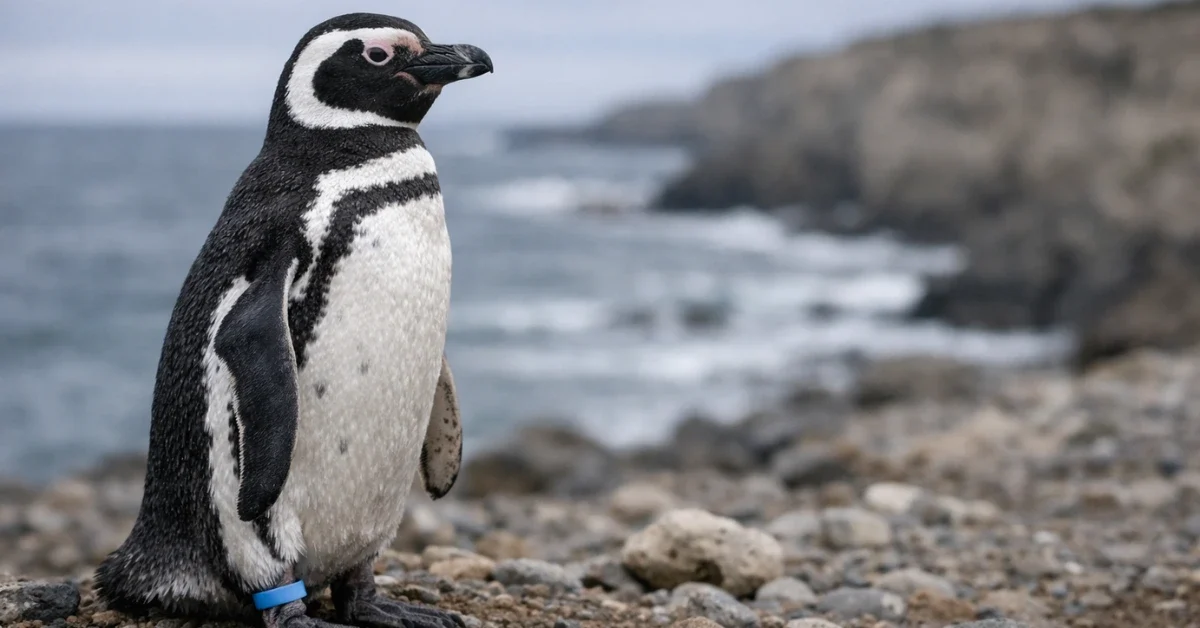
Scientists have turned Magellanic penguins along Argentina’s Patagonian coast into unwitting environmental monitors — and the results are troubling. A new study found traces of PFAS, the synthetic chemicals commonly known as “forever chemicals,” in more than 90 percent of the sampled birds, despite their remote habitat far from industrial centers.
The research, led by scientists from the University of California, Davis, and the State University of New York at Buffalo, represents a proof-of-concept for a novel, non-invasive approach to tracking chemical pollution in hard-to-reach ecosystems. The findings were published in the journal Earth: Environmental Sustainability.
Tiny Leg Bands, Big Discoveries
Instead of drawing blood or plucking feathers — methods that have traditionally been used to track pollutant exposure in wildlife — the research team took a gentler approach. During the 2022–2024 breeding seasons, scientists fitted 54 Magellanic penguins with small silicone leg bands that acted as passive chemical samplers.
The bands sat loosely around the penguins’ legs for just a few days while the birds foraged to feed their chicks. During that time, the silicone material quietly absorbed traces of chemicals from the water, air, and surfaces the penguins encountered. Once collected, the bands were shipped to the University at Buffalo for laboratory analysis.
The results were striking. Per- and polyfluoroalkyl substances — a group of more than 10,000 synthetic chemicals — were detected in more than nine out of ten of the sampled bands. That detection rate, in one of the world’s most remote coastal environments, underscores just how far these chemicals have traveled from their sources.
Legacy Chemicals and Their Replacements
What made the findings particularly significant was not just the presence of older, well-known PFAS compounds but the detection of newer so-called “replacement” chemicals as well. Some of the most regulated and restricted PFAS have been phased out over the years, but industries often replaced them with alternative formulations that were marketed as safer options.
The study detected chemicals like GenX alongside these legacy pollutants — compounds typically associated with nearby industrial activity. Their appearance in such a remote region suggests these newer chemicals are not staying local. Instead, they are spreading globally and reaching even isolated ecosystems far from human industry.
“By using a non-invasive sampling approach, we were able to detect a shift from legacy PFAS to newer replacement chemicals in the penguins’ environment over time,” said Diana Aga, director of the UB RENEW Institute and SUNY Distinguished Professor in the UB Department of Chemistry, who served as senior author on the study.
Aga added that the presence of these replacement chemicals raises serious concerns about their persistence. Despite being designed as safer alternatives, they appear to be durable enough to travel across the globe and expose wildlife to potential risks.
Why “Forever Chemicals” Are a Concern
PFAS earned the nickname “forever chemicals” because they resist breaking down in natural environments — in living organisms or in the world around them. The group includes more than 10,000 synthetic compounds that have become, in practical terms, nearly inescapable on Earth.
Chronic exposure to certain PFAS has been linked to serious health effects, including some cancers, reduced fertility, and damage to the immune system. The fact that these chemicals are now showing up in Magellanic penguins — small seabirds living along a remote stretch of Patagonian coastline — highlights the global scale of the contamination problem.
Penguins as Environmental Sentinels
Beyond the alarming pollution findings, this study introduces a promising new tool for environmental monitoring. Penguins already range widely across ocean ecosystems as they hunt for food, making them natural candidates for detecting what is in the water and air around them.
By combining that natural behavior with passive silicone samplers, researchers can now gather real-time chemical data without harming the animals. The non-invasive design means the method could potentially be applied to other seabird species or in other remote regions where traditional environmental sampling is difficult or impossible.
The study’s broader message is clear: even the most isolated corners of the planet are not immune to human-made pollution. As new generations of synthetic chemicals continue to enter global supply chains and waterways, wildlife living thousands of miles from the source may bear an invisible chemical burden — one that a small silicone leg band is now capable of revealing.
