

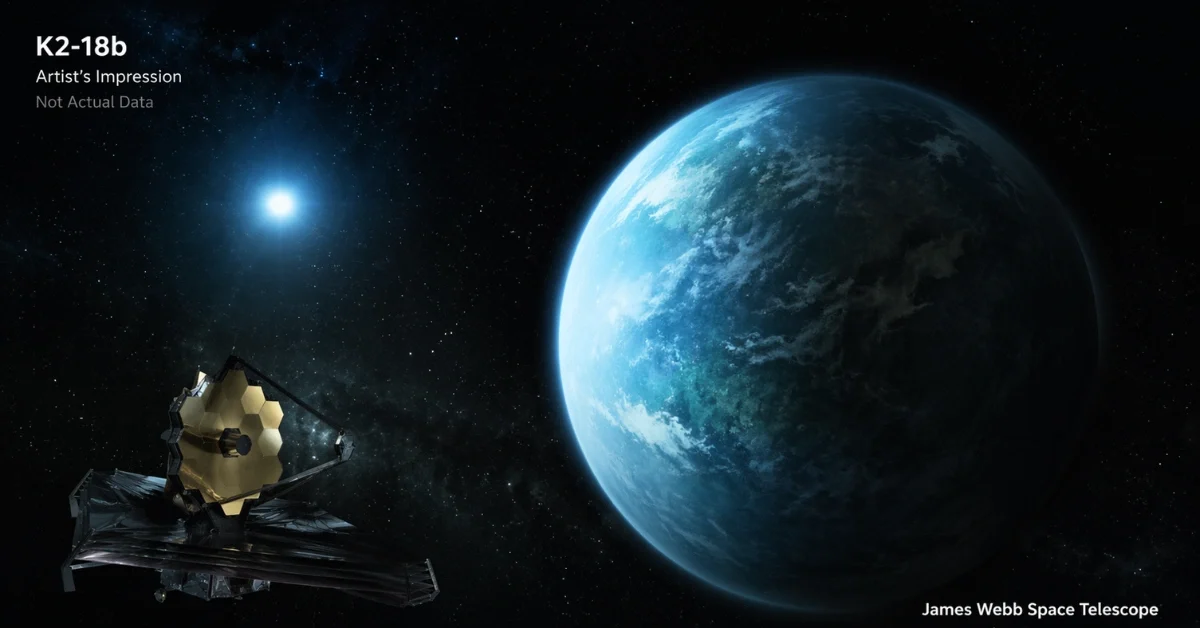
A new wave of reporting around K2-18b has pushed the exoplanet back into the center of the search for life beyond Earth, but the latest research does not settle the question. Scientists led by Nikku Madhusudhan reported a roughly 3-sigma detection of dimethyl sulfide, dimethyl disulfide, or both in the planet’s atmosphere, yet multiple sources stress that the signal remains tentative and far from proof of alien life.
K2-18b is described as a temperate sub-Neptune that orbits its star in the habitable zone. The planet is about two-and-a-half times the size of Earth and around 124 light-years away, helping explain why even promising data still require careful interpretation and follow-up.
What Webb Found
Earlier observations by the same team in 2023, using two different James Webb Space Telescope instruments, had already pointed to possible traces of dimethyl sulfide in the atmosphere of K2-18b. Those earlier observations also identified water vapor, carbon dioxide, and methane, while the dimethyl sulfide signal was considered faint and disputed by many astronomers.
The newer result has been described by the Cambridge-led team as the most promising sign yet of a possible biosignature outside the solar system, but even that description comes with caution. Researchers and independent astronomers alike emphasized that more data are needed before the signal can be confirmed.
Why Doubts Remain
A SETI Institute analysis says the reported signal is intriguing because these gases can be associated with biological activity, but it also calls the evidence modest, ambiguous, and potentially explainable by noise or systematic error. The same analysis says abiotic sources for these compounds exist and cannot yet be ruled out, while limited contextual data about the planet make interpretation highly uncertain.
That caution is echoed even more sharply in a later preprint titled K2-18b Does Not Meet The Standards of Evidence For Life. The authors say the previously published mid-infrared transit spectrum is highly susceptible to unresolved instrumental systematics, and they report that 87.5% of retrievals using their favored wavelength-binning scheme do not support the tentative DMS or DMDS signal.
The same study says methane and carbon dioxide remain detected in the full spectrum, but DMS and ethylene can trade places in the modeling, which weakens the case that a biosignature has been uniquely identified. Its authors conclude that red noise, rather than a real astrophysical signal, affects the mid-infrared data and that there is not yet statistically significant evidence for biosignatures in the atmosphere of K2-18b.
Alternative Explanations
Another 2026 preprint examining organosulfur chemistry on sub-Neptunes says at least one proposed abiotic pathway could produce observable amounts of DMS and DMDS, though the process depends strongly on an experimental quantity that has not yet been measured. That same paper says hydrocarbons, including ethane, offer a plausible alternative explanation for the reported organosulfur signal on K2-18b.
The authors also say sulfur hazes can form from hydrogen sulfide photochemistry and condense in the atmosphere of K2-18b even at trace abundances. Some other studies have argued the planet’s supposed ocean could instead be magma, adding another layer of uncertainty to claims about habitability.
What the Debate Means
Taken together, the current research paints K2-18b as an important test case rather than a confirmed breakthrough. The SETI Institute says the real value of the new study is that it helps show what further observational and experimental work is needed to test biosignature claims more robustly and improve the standards used to judge them.
Confirming a true biosignature requires follow-up studies and multiple converging lines of evidence, not one intriguing signal on its own. For now, K2-18b remains one of the most closely watched worlds in astronomy because it has produced suggestive data, but the scientific record available so far still points to uncertainty rather than confirmation.
