

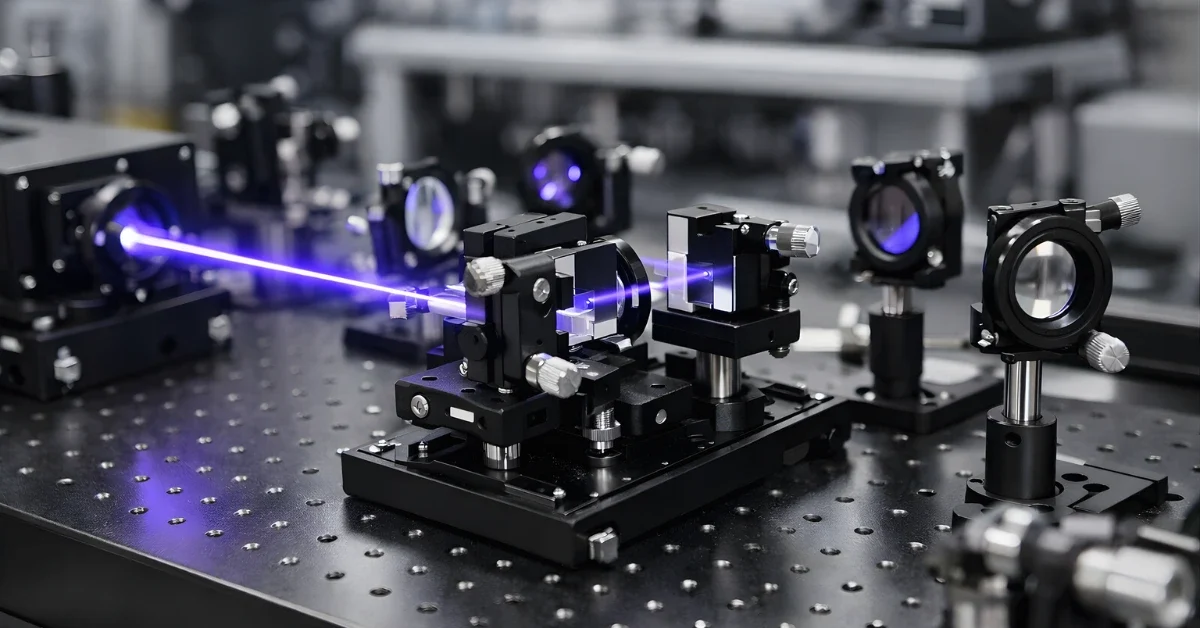
Physicists at the University of Vienna, working with colleagues at the University of Duisburg-Essen, have reported an experiment showing that large metal nanoparticles can still display quantum interference—a hallmark of quantum superposition. The team says the result pushes quantum behavior into a more “everyday” scale by using clusters made of thousands of sodium atoms and testing quantum mechanics in a stricter way than many earlier demonstrations.
The work involves cold sodium clusters that contain roughly 5,000 to 10,000 atoms and measure about 8 nanometers across, which the researchers compare to the size range of modern transistor structures. Despite being massive by quantum-experiment standards—more than 170,000 atomic mass units—the particles still produced a measurable interference pattern.
A separate Nature Podcast episode describing the milestone calls it the biggest “Schrödinger’s cat” yet and says physicists put 7,000 atoms into superposition, framing the achievement as a protein-sized superposition that surpasses previous experiments.
How the Vienna test worked
In quantum mechanics, matter can act like both a particle and a wave, and interference experiments have long demonstrated this for electrons, atoms, and small molecules. The new experiment extends that approach to metallic nanoparticles, aiming to show that wave-like behavior can survive even when the object is far larger than a typical atom-scale quantum system.
To run the test, the team generated cold sodium clusters and sent them through three diffraction gratings formed by ultraviolet laser beams. According to the University of Vienna’s description, the first laser grating helped place each cluster into a superposition of possible paths through the apparatus, and the possible paths later recombined. When the paths overlapped at the end, the researchers detected a “striped pattern” of metal that matched expectations from quantum theory.
The Debrief’s account similarly describes a setup using three ultraviolet laser diffraction gratings, where an initial beam places the particles into a superposition and the recombination produces a measurable pattern consistent with quantum interference. In both descriptions, the key point is that the nanoparticles behave like delocalized waves during their flight rather than as classical objects with a single, definite position at all times.
“Schrödinger’s cat” at a bigger scale
The researchers describe the result as a type of “Schrödinger cat state,” borrowing language from Erwin Schrödinger’s famous thought experiment about a cat that can be considered both alive and dead until observed. In this experiment, the analogy is that each metal cluster can be treated as being “here and not here” during the part of the run where it is not directly observed.
The University of Vienna report says the particles’ delocalization during this unobserved flight is dozens of times larger than the size of each individual nanoparticle. The Debrief likewise says the particles’ displacement spans distances many times larger than the particles themselves while they travel through the apparatus.
Lead author and doctoral student Sebastian Pedalino is quoted as saying, “Intuitively, one would expect such a large lump of metal to behave like a classical particle,” adding that the interference result supports the view that quantum mechanics remains valid at this scale without needing alternative models. The Debrief includes a closely matching quote attributed to Pedalino that makes the same point about how surprising it is to see interference from such a large “lump of metal.”
Record-setting “macroscopicity”
Beyond showing interference, the team emphasizes how strongly the experiment can test quantum theory using a metric called “macroscopicity,” developed to compare different quantum experiments on a common scale. The University of Vienna report says Klaus Hornberger and Stefan Nimmrichter introduced macroscopicity to help compare results across diverse platforms such as nano-oscillators, atomic interferometers, and related systems.
In this experiment, the macroscopicity value is reported as μ = 15.5. The University of Vienna report describes that figure as about an order of magnitude higher than other experiments worldwide, and says that achieving an equally strict test using electrons would require maintaining electron superposition for around 100 million years. The same report says the massive nanoparticles in the Vienna lab achieved the test in about one hundredth of a second.
The Debrief also reports a macroscopicity of μ = 15.5 and describes it as an order of magnitude greater than any other experiment the authors are aware of. It similarly contrasts the timescales by saying an equally rigorous electron-based test would have to run for about 100 million years, while the macro-scale test took roughly one hundredth of a second.
What comes next
The University of Vienna report says the experiment is aimed at improving understanding of why quantum physics can look strange while everyday objects appear to follow classical rules. It adds that future work will investigate even larger objects and other classes of materials, with the expectation of achieving even stronger tests of quantum physics.
The same report says that, with improved infrastructure and new equipment, the researchers aim to improve their record by several orders of magnitude in the coming years. It also describes the Vienna interferometer as a highly sensitive force sensor that can currently measure forces in the range of 10^-26 newtons and is expected to become even more sensitive. The report suggests this sensitivity could support precision measurements of properties such as electrical, magnetic, or optical behavior of isolated nanoparticles, positioning the setup as a potential complement to established tools in nanotechnology.
The Debrief reports that the findings appeared in Nature on January 21, 2026, under the title “Probing Quantum Mechanics with Nanoparticle Matter-wave Interferometry.” It also says the team plans to keep pushing toward larger systems and different materials, aiming for future macroscopic measurements with much higher precision.
