
By using this site, you agree to our Privacy Policy and Terms of Use.
Accept
VellaTimesVellaTimesVellaTimes
  • News
    NewsShow More
    Close-up of a silver espresso machine extracting a fresh shot of coffee into a glass cup in a softly lit cafe setting.
    Espresso Extraction Science: The Finer Grind Flaw
    May 18, 2026
    A smartphone resting on a wooden desk displaying an AI-powered Amazon search bar in a modern home office setting.
    Amazon Alexa for Shopping Replaces Rufus AI Assistant
    May 18, 2026
    Wide news-style image showing an OpenAI office scene with screens displaying audio waveforms and voice technology graphics
    OpenAI acquires Weights.gg to boost voice AI tools
    May 18, 2026
    Federal agents standing outside a modern university biology laboratory building at dusk during an active investigation.
    US Arrests Chinese Scientists for Smuggling Biological Materials
    May 18, 2026
    A dramatically lit modern corporate courtroom with futuristic technology elements, representing a high-stakes artificial intelligence legal trial.
    Elon Musk OpenAI Lawsuit Exposes Clashes Over AI Safety
    May 18, 2026
  • Technology
    TechnologyShow More
    Wide news-style image showing an OpenAI office scene with screens displaying audio waveforms and voice technology graphics
    OpenAI acquires Weights.gg to boost voice AI tools
    May 18, 2026
    A polished silicon wafer rests on a surface inside a modern semiconductor manufacturing facility.
    Samsung Strike Threatens Global AI Chip Production
    May 18, 2026
    A glowing computer screen displaying the text GPT-5.5 Instant in a modern, high-tech office environment with soft blue and purple lighting.
    GPT-5.5 Instant: OpenAI’s New Default ChatGPT Model
    May 10, 2026
    Wide view of a modern AI data center with server racks, glowing fiber-optic cables, and semiconductor hardware in the foreground.
    AI Infrastructure Spending Drives Nvidia, AMD Shares
    May 10, 2026
    A glowing computer monitor displaying lines of code and digital network graphics in a modern tech office setting.
    Airbnb AI Coding: 60% of New Software Now Generated by AI
    May 9, 2026
  • AI
    AIShow More
    A smartphone resting on a wooden desk displaying an AI-powered Amazon search bar in a modern home office setting.
    Amazon Alexa for Shopping Replaces Rufus AI Assistant
    May 18, 2026
    A dramatically lit modern corporate courtroom with futuristic technology elements, representing a high-stakes artificial intelligence legal trial.
    Elon Musk OpenAI Lawsuit Exposes Clashes Over AI Safety
    May 18, 2026
    A high-tech global map visualization showing glowing digital connections across different continents, representing the worldwide adoption of artificial intelligence.
    Global AI Adoption in 2026: Trends and Growing Divide
    May 10, 2026
    A modern smartphone displaying an artificial intelligence chat interface used for online shopping and product comparison.
    Alibaba Qwen AI Taobao Integration Launches Agentic Shopping
    May 10, 2026
    A split-screen illustration showing a high-tech modern office using advanced AI tools contrasted against an older, dimly lit workspace.
    Global AI Adoption Surges But Rich-Poor Divide Widens
    May 9, 2026
  • Science
    ScienceShow More
    Close-up of a silver espresso machine extracting a fresh shot of coffee into a glass cup in a softly lit cafe setting.
    Espresso Extraction Science: The Finer Grind Flaw
    May 18, 2026
    Federal agents standing outside a modern university biology laboratory building at dusk during an active investigation.
    US Arrests Chinese Scientists for Smuggling Biological Materials
    May 18, 2026
    Header image of a quantum communication lab setup with fiber-optic equipment, a telecom quantum dot device, and interferometer components used for long-distance quantum key distribution.
    Quantum Key Distribution Reaches 120 km With Quantum Dots
    May 10, 2026
    Abstract geometric representation of glowing quantum paraparticles interacting within a three-dimensional mathematical grid in deep blue and gold tones.
    Quantum Paraparticles Exist: New Math Challenges Physics
    May 10, 2026
    A large expedition cruise ship is navigating rough ocean waters under a cloudy sky.
    Global Authorities Respond to Andes Hantavirus Outbreak on MV Hondius Cruise Ship
    May 9, 2026
  • World
    WorldShow More
    Allu Arjun Commitment to Ethical Brand Partnerships
    Exploring Allu Arjun’s Commitment to Ethical Brand Partnerships
    December 18, 2023
    Orry aka Orhan Awatramani
    Orhan Awatramani ‘Orry’ Biography, Lifestyle and Rise to Fame
    December 8, 2023
    Alia Bhatt Latest Deepake Video Victim
    Alia Bhatt becomes latest victim of Deepfake Videos, Obscene Video goes Viral
    November 28, 2023
    Napoleon Movie Review
    Napoleon Movie Review: A Historical Epic by Ridley Scott Reviewed
    November 25, 2023
  • Bookmarks
Search
Category
  • News
  • Technology
  • AI
  • Science
  • World
Company
  • About Us
  • Contact Us
  • Fact Checking Policy
  • Terms & Conditions
  • Privacy Policy
  • Copyright Policy
Resources
  • Home
  • Web Stories
  • Bookmarks
  • Interests
  • Disclaimer
  • Sitemap
© 2022 VellaTimes • All Rights Reserved.
Reading: Scientists Identify Brain Receptors That Help Clear Alzheimer’s Plaques
Share
Notification Show More
Font ResizerAa
VellaTimesVellaTimes
Font ResizerAa
  • News
  • Technology
  • AI
  • Science
  • World
Search
  • Explore
    • News
    • Technology
    • AI
    • Science
    • World
  • Useful Links
    • About Us
    • Contact Us
    • Fact Checking Policy
    • Terms & Conditions
    • Privacy Policy
    • Copyright Policy
  • Home
  • Web Stories
  • Bookmarks
  • Interests
  • Disclaimer
  • Sitemap
© 2022 VellaTimes • All Rights Reserved.
News

Scientists Identify Brain Receptors That Help Clear Alzheimer’s Plaques

Nisha Pradhan
Last updated: 18/02/2026
Nisha Pradhan
Share
6 Min Read
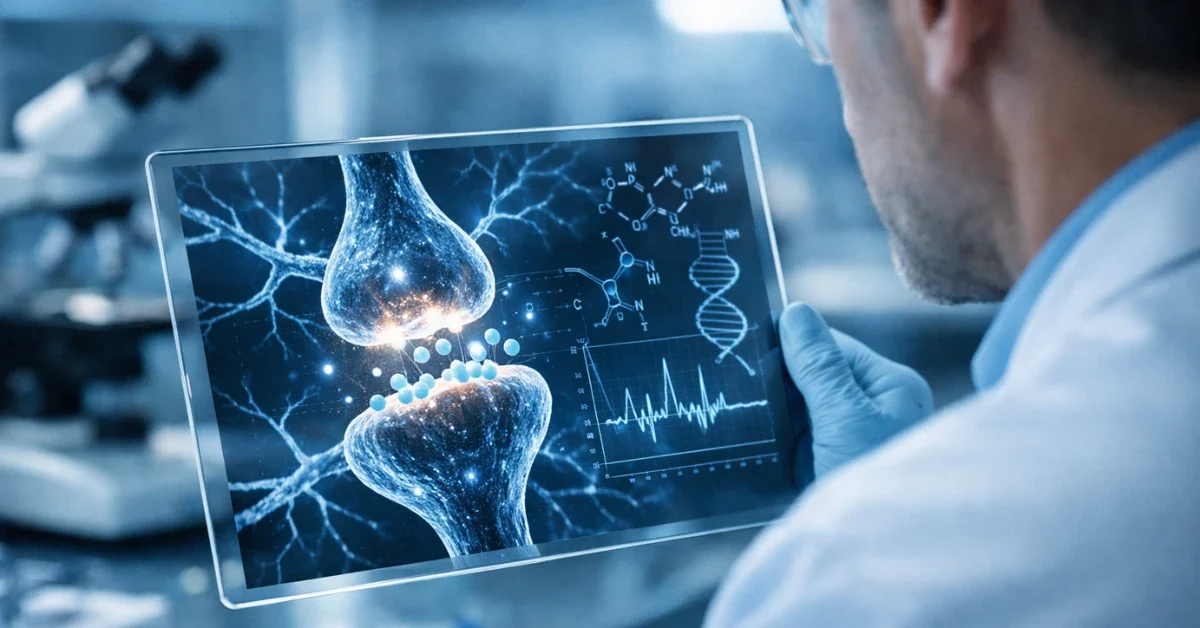
A scientist in a modern laboratory examining a 3D digital model of brain receptors and neurons on a transparent tablet.

Researchers have identified two specific brain receptors that act as “switches” to control the breakdown of amyloid beta, the toxic protein responsible for forming sticky plaques in the brains of Alzheimer’s patients. This groundbreaking discovery, announced by scientists at Karolinska Institutet in Sweden and the RIKEN Center for Brain Science in Japan, suggests that the brain’s natural defense systems can be activated to fight the disease. The findings could pave the way for safer, more affordable pill-based treatments that avoid the high costs and side effects associated with current antibody therapies.

Contents
Boosting the Brain’s Natural DefensesA Shift Toward Affordable Pill-Based TreatmentsRelated Advances: Nanotechnology Restores Brain FunctionThe Future of Alzheimer’s Therapy

The study, published in the Journal of Alzheimer’s Disease, focuses on two G protein-coupled receptors known as SST1 and SST4. When activated, these receptors trigger the release of an enzyme called neprilysin, which breaks down amyloid beta. This mechanism offers a potential alternative to today’s dominant treatments, which typically rely on infused antibodies to target plaques directly.

Boosting the Brain’s Natural Defenses

The research team conducted their experiments using genetically modified mice and laboratory cell cultures to understand how these receptors influence Alzheimer’s pathology. They discovered that when the SST1 and SST4 receptors were missing or blocked, levels of the neprilysin enzyme dropped significantly. This reduction impaired the brain’s ability to degrade amyloid beta, leading to increased plaque accumulation and memory problems in the mice.

Conversely, when the researchers administered a compound designed to stimulate these specific receptors, the results were promising. In mice exhibiting Alzheimer’s-like brain changes, activating SST1 and SST4 boosted neprilysin levels and successfully reduced the buildup of amyloid beta. Crucially, this biochemical change resulted in improved memory and behavior without causing serious side effects.

“Our findings show that the brain’s own defence against amyloid beta can be strengthened by stimulating these receptors,” said Per Nilsson, docent at the Department of Neurobiology, Care Sciences and Society at Karolinska Institutet.

A Shift Toward Affordable Pill-Based Treatments

One of the most significant aspects of this discovery is its potential to democratize access to Alzheimer’s care. Current advanced treatments often involve complex antibody drugs that are expensive to manufacture and require intravenous administration. These existing therapies can also carry the risk of significant side effects, such as brain swelling or bleeding.

Because SST1 and SST4 are G protein-coupled receptors, they are considered ideal targets for traditional drug development. Medications that target this class of receptors can often be formulated as small molecules—pills—that are cheaper to produce and easier for patients to take.

“If we can instead develop small molecules that pass the blood-brain barrier, our hope is that we will be able to treat the disease at a significantly lower cost and without serious side effects,” Nilsson explained.

Related Advances: Nanotechnology Restores Brain Function

This new understanding of brain receptors builds on a wave of recent momentum in Alzheimer’s research focused on restoring the brain’s natural clearance mechanisms. Late last year, a separate international team co-led by University College London (UCL) and the Institute for Bioengineering of Catalonia (IBEC) demonstrated a different approach using nanotechnology.

In that study, researchers used “supramolecular” nanoparticles to repair the blood-brain barrier and restore vascular function in mice. Unlike the receptor-based approach, which targets enzyme production, this method focused on the brain’s vascular system. The nanoparticles acted as a drug themselves, triggering a cascade effect that cleared amyloid beta and other toxic molecules.

The results of the nanoparticle study were striking. Researchers observed a 50-60% reduction in amyloid beta levels in the brain just one hour after injection. Furthermore, the treatment reversed memory loss in older mice. In one experiment, 18-month-old mice treated with the nanoparticles exhibited behavior comparable to healthy, younger mice.

“The long-term effect comes from restoring the brain’s vasculature,” noted Giuseppe Battaglia, a lead author of the nanotechnology study. “We think it works like a cascade: when toxic species such as amyloid-beta accumulate, disease progresses. But once the vasculature is able to function again, it starts clearing amyloid-beta and other harmful molecules.”

The Future of Alzheimer’s Therapy

Both the recent receptor discovery and the nanotechnology breakthrough highlight a shifting paradigm in treating neurodegenerative diseases. Rather than simply attacking the plaques with external antibodies, scientists are finding ways to repair or reactivate the body’s intrinsic physiological processes.

Whether through stimulating specific receptors to boost enzyme activity or repairing the vascular “gatekeepers” of the brain, these approaches aim to restore balance to the brain’s environment. As research progresses, these “switches” and repair mechanisms could finally offer effective, accessible solutions for the millions of people living with Alzheimer’s disease.

TAGGED: Alzheimer's research, amyloid beta, brain receptors, dementia treatment, Karolinska Institutet, medical breakthrough, neprilysin, neuroscience
Share This Article
Facebook Twitter Whatsapp Whatsapp Telegram Copy Link
By Nisha Pradhan
I am a passionate content creator with a deep love for travel, music, and food. Using my unique blend of these interests, I genuinely enjoy crafting high-quality travel, lifestyle, and entertainment-related news content.
Leave a comment

Leave a Reply Cancel reply

Your email address will not be published. Required fields are marked *


Most Read

AI-powered turret control unit tested in Russia for drones

January 30, 2026

Artemis II rollout: NASA moves moon rocket to Pad 39B

January 17, 2026

Baidu Ernie 5.0 debuts as assistant hits 200M MAUs

January 26, 2026

New Mitochondrial Capsule Therapy Treats Major Diseases

March 20, 2026

OpenAI London Research Hub Becomes Largest Outside US

February 27, 2026

DeepSeek V4 Model Will Run Entirely on Huawei AI Chips

April 5, 2026

Related News

Close-up of a silver espresso machine extracting a fresh shot of coffee into a glass cup in a softly lit cafe setting.
News

Espresso Extraction Science: The Finer Grind Flaw

Nisha Pradhan Nisha Pradhan May 18, 2026
A smartphone resting on a wooden desk displaying an AI-powered Amazon search bar in a modern home office setting.
News

Amazon Alexa for Shopping Replaces Rufus AI Assistant

Sameer Katoch Sameer Katoch May 18, 2026
Wide news-style image showing an OpenAI office scene with screens displaying audio waveforms and voice technology graphics
News

OpenAI acquires Weights.gg to boost voice AI tools

Rakesh Paul Rakesh Paul May 18, 2026

About Us

VellaTimesVellaTimesVellaTimes

VellaTimes is a leading news portal that covers the latest trending news in technology, lifestyle, entertainment, automobiles, travel, and sports.

Explore

  • News
  • Technology
  • AI
  • Science
  • World

Useful Links

  • About Us
  • Contact Us
  • Fact Checking Policy
  • Terms & Conditions
  • Privacy Policy
  • Copyright Policy

Subscribe Us

Subscribe to our newsletter for the Latest News and Top Stories!

© 2022 VellaTimes • All Rights Reserved.
  • Home
  • Web Stories
  • Bookmarks
  • Interests
  • Disclaimer
  • Sitemap
adbanner
AdBlocker Detected
Our site is an advertising supported site. Please whitelist us to support our work.
Okay, I'll Whitelist