

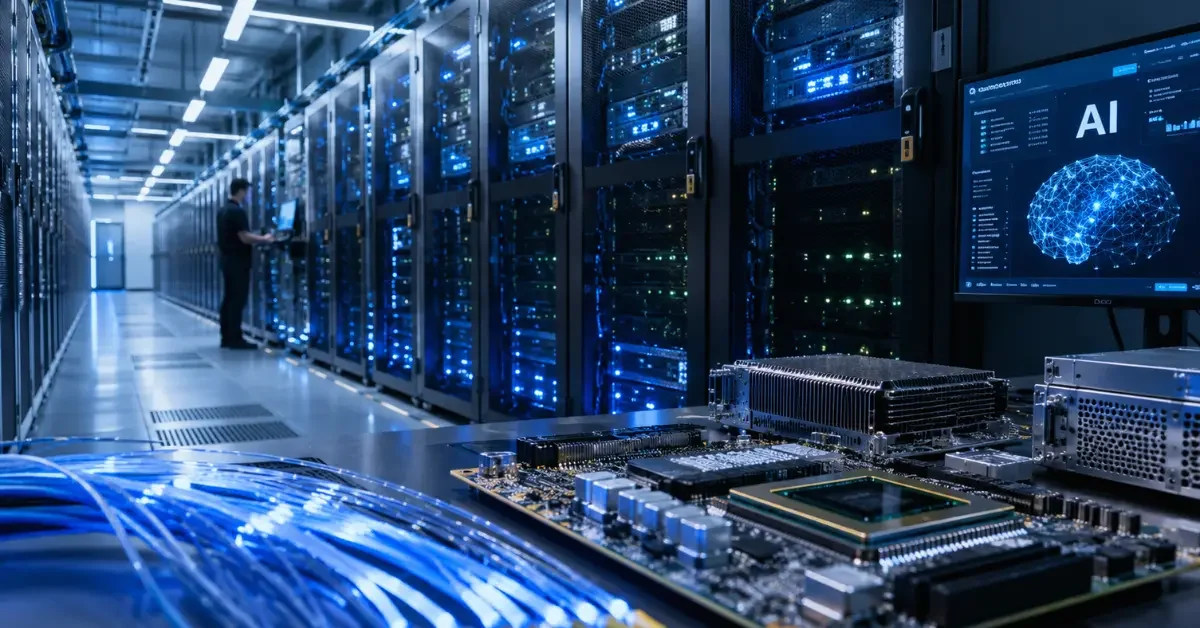
AI infrastructure spending is driving fresh moves across the tech sector, with major companies increasing capital spending, Nvidia backing new U.S. fiber plants, and AMD climbing after strong results tied to AI chip demand.
The trend is reshaping both company budgets and investor expectations as businesses race to build the hardware and network capacity needed for larger artificial intelligence systems. Goldman Sachs said that shift is already visible in the S&P 500, while Nvidia’s Corning deal and AMD’s latest quarter show how the spending wave is reaching both infrastructure and semiconductor markets.
Capex overtakes buybacks
Goldman Sachs said AI capital spending is rising while share buybacks are slowing, especially among the largest technology companies leading the current AI buildout.
The firm projects S&P 500 capital expenditure growth of 33% in 2026, while gross buybacks are expected to rise only 3%. For comparison, Goldman said capex growth was 20% in 2025, while buybacks increased 9%.
Goldman also said first-quarter earnings showed the same pattern, with S&P 500 capex growth tracking at 39% compared with just 1% for gross buybacks. That gap suggests companies are putting more cash toward expansion, research, and AI-related projects instead of returning as much money to shareholders.
The shift is even more pronounced among hyperscalers. Goldman said Amazon, Google, Meta, Microsoft, and Oracle are expected to spend $755 billion in capex in 2026, an 83% year-over-year jump.
According to the firm, consensus estimates show hyperscaler capex amounting to 100% of cash flows from operations this year. Goldman said that leaves little room to return cash to shareholders without sharply slowing capex growth, drawing down cash balances, or taking on more debt.
The same group now allocates 15% of total cash spending to buybacks, down from an average of 27% between 2017 and 2022, Goldman said. It also noted that in 2025, those five companies accounted for 34% of the S&P 500’s capex and research spending, but only 10% of buybacks and dividends.
Nvidia backs fiber expansion
NVIDIA is also putting money directly into the physical systems needed to support AI growth. Tom’s Hardware reported that the company is investing $300 million in Corning under a long-term agreement tied to three new U.S. facilities in North Carolina and Texas that will produce optical fiber for AI data centers.
The report said Corning will increase its U.S. optical connectivity manufacturing output by a factor of 10 and expand domestic fiber production capacity by more than 50% through the project. The new plants are expected to employ 3,000 people.
Tom’s Hardware also said the fiber will be supplied to builders of hyperscale data centers that deploy Nvidia AI hardware. It described Corning as the world’s largest maker of optical cables, with a 10.4% market share.
The investment shows that the AI race is not only about designing faster chips. It is also about making sure data centers have the networking materials needed to move massive amounts of information at scale.
AMD gains on AI chip demand
AMD’s latest results added another sign that investor appetite for AI-linked chip companies remains strong. The Economic Times reported that AMD shares surged nearly 13% after the company posted stronger-than-expected quarterly results and issued a second-quarter revenue forecast of $11.2 billion, plus or minus $300 million, above Wall Street estimates of $10.52 billion.
The company also guided for adjusted gross margins of about 56%, ahead of analyst expectations of 55.4%, according to the report. For the March quarter, AMD reported adjusted earnings of $1.37 per share on revenue of $10.25 billion.
The biggest boost came from the data center business, where revenue rose 57% year over year to $5.8 billion. The Economic Times said AMD is benefiting from demand for both graphics processing units used to train AI models and central processing units that are becoming more important as companies scale AI applications through inference.
The report also said AMD announced a deal earlier this year to supply up to $60 billion worth of AI chips over five years to Meta Platforms, with an option for Meta to take up to a 10% stake in AMD. It added that AMD struck a separate AI partnership with OpenAI last year.
That momentum has shown up in the stock. The Economic Times said AMD shares were up nearly 60% this year, compared with about 6% for Nvidia and around 48% for the Philadelphia Semiconductor Index.
Together, these developments point to a broader market shift as AI infrastructure spending spreads across budgets, supply chains, and stock performance. Goldman said reduced buyback activity among hyperscalers will weigh on aggregate S&P 500 buybacks, but it also noted that some of that pressure could be offset by companies benefiting from Big Tech’s AI spending, including chipmakers.
