

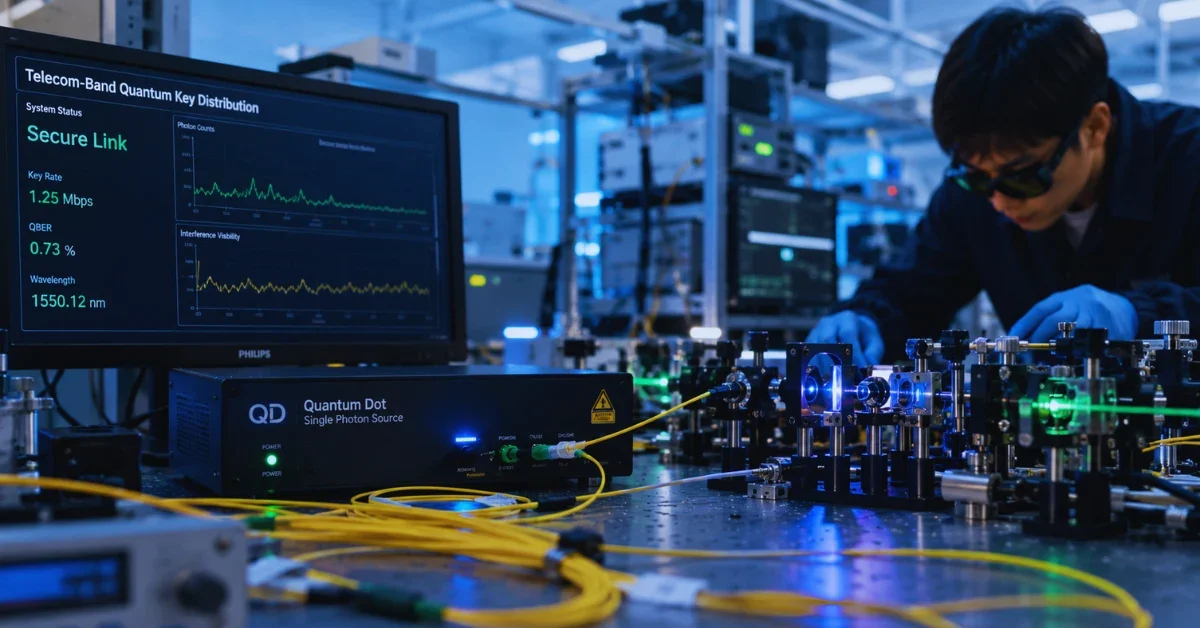
Quantum key distribution moved a step closer to real-world deployment after researchers demonstrated secure key exchange over a fiber link of 120 kilometers using a telecom quantum dot source and time-bin encoding. The study describes the result as the first experimental validation of a telecom-band quantum key distribution system that combines a quantum dot single-photon source with time-bin encoding.
The work was published in Light: Science & Applications and is also reflected in the paper’s PubMed record and preprint version. Across those sources, the experiment is presented as a proof of concept that achieved long-distance transmission, stable operation, and what the authors call the highest secure key rate among time-bin quantum key distribution systems based on single-photon sources.
First Time-Bin Quantum Dot Test
The researchers built a time-bin encoded quantum key distribution system around a high-brightness quantum dot single-photon source operating at telecom wavelength. According to the study description, earlier quantum key distribution demonstrations with deterministic single-photon sources had mainly used polarization encoding, which can be affected by birefringence, polarization-mode dispersion, and polarization-dependent loss in practical fiber networks.
Time-bin encoding was the alternative used here. The sources describe time-bin encoding as inherently robust and already widely used in mature quantum key distribution systems that rely on weak coherent laser pulses, while noting that it had not previously been experimentally demonstrated together with a deterministic single-photon source.
How the System Operated
In the experiment, the team generated three separate time-bin qubit states in both deterministic and random modes using a self-stabilized time-bin encoder. That encoder converted polarized single photons from a telecom C-band quantum dot into encoded quantum signals for transmission through optical fiber.
At the receiving end, the qubits were decoded with an actively stabilized interferometer that included a phase shifter. The setup was designed to support extended operation without manual adjustment, and the sources say it ran continuously for more than six hours.
Distance, Stability, and Key Rate
The reported transmission distance was more than 120 kilometers over standard optical fiber. Even after traveling that distance, the system kept the average quantum bit error rate below 11 percent.
The study also reports a quantum dot source operating at about 76 MHz and producing bright, highly pure single photons. Under finite key conditions, the average secure key rate was about 15 bits per second, which one source says is suitable for practical encrypted text messaging applications.
Those performance figures matter because the paper frames the result not only as a laboratory milestone but also as a sign that solid-state single-photon emitters can be integrated into stable and field-deployable quantum key distribution systems. The journal abstract and related coverage both describe the advance as a substantial step toward robust and scalable quantum-secure communication networks based on solid-state single-photon technology.
Why the Result Stands Out
The sources emphasize that time-bin encoding offers an advantage in real fiber environments because it is naturally less sensitive to channel fluctuations than many polarization-based approaches. That makes the combination of telecom-band quantum dots and time-bin encoding notable for long-distance communication, where temperature changes, vibrations, and other environmental effects can disrupt the signal.
The paper’s author list includes researchers from institutions in Germany and China, reflecting the international nature of the project. Taken together, the study, abstract, and coverage point to a clear message: the 120-kilometer demonstration shows that quantum dot sources can support stable, long-distance quantum key distribution in a form that aligns more closely with practical fiber-based networks.
