

Astronomers have known for about a century that the universe is constantly expanding. To understand exactly how fast this growth is happening, scientists calculate a vital metric known as the Hubble constant. However, different measurement techniques stubbornly refuse to agree on a single number. This ongoing discrepancy, referred to as the Hubble tension, is widely considered one of the most significant unresolved puzzles in modern cosmology.
Now, a team of astrophysicists and physicists from the University of Illinois Urbana-Champaign and the University of Chicago has proposed a groundbreaking solution. In a recent study published in Physical Review Letters, the researchers detail a new method that uses the faint, collective hum of colliding black holes—known as the gravitational-wave background—to independently measure the universe’s expansion rate. By listening to these tiny ripples in spacetime, scientists hope to finally resolve the Hubble tension.
The Hubble Tension Dilemma
Traditionally, scientists have relied on two primary strategies to measure the expansion of the cosmos. One approach looks at the early universe by analyzing the cosmic microwave background, which is the residual radiation left over from the Big Bang. The second method examines the more recent, local universe by measuring the distances and speeds of flickering supernovae, often called standard candles.
Because both techniques are grounded in established physics, they should theoretically produce the exact same Hubble constant. Instead, they consistently yield conflicting results. The disagreement has reached a high level of statistical significance, leaving experts to wonder whether the mismatch is due to unidentified measurement errors or if it signals the need for entirely new physics. Proposed explanations for the anomaly include early bursts of dark energy, strange interactions between dark matter and neutrinos, or shifting dark energy dynamics.
The Power of Stochastic Sirens
To bypass the limitations of electromagnetic observations, the research team turned to gravitational waves. Originally predicted by Albert Einstein’s theory of general relativity, gravitational waves are subtle ripples in the fabric of spacetime caused by the violent mergers of massive objects like neutron stars and black holes.
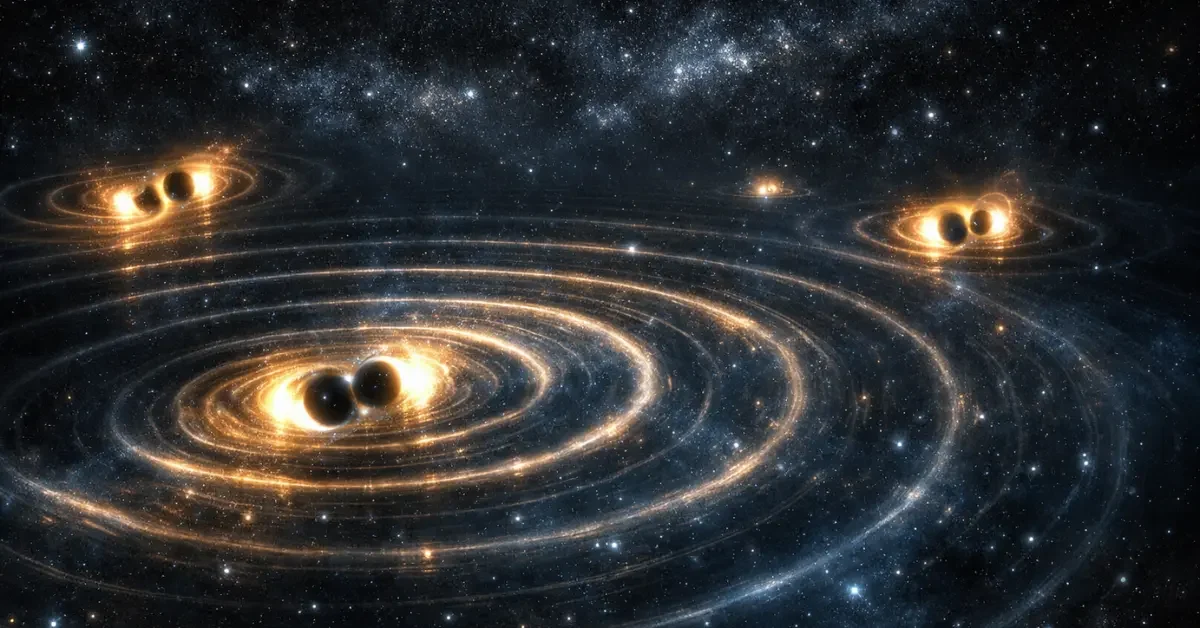
Since 2015, the global LIGO-Virgo-KAGRA collaboration has successfully detected hundreds of individual black hole collisions. While these distinct events are incredibly useful, researchers realize they represent only a fraction of the mergers happening across the cosmos. Countless other distant collisions are too faint for current instruments to pick up individually. Together, these unresolved mergers create a random, collective signal known as the gravitational-wave background.
The researchers named their new approach the stochastic siren method. Lead study author Bryce Cousins explained that because astronomers can observe the rates of individual black hole collisions, they can estimate the massive number of unobserved events that make up this background hum.
The strength of this cosmic hum is directly tied to how fast the universe is expanding. If the Hubble constant is lower, indicating a slower expansion rate, the total observable volume of the universe is smaller. In a more compact universe, black hole collisions are packed closer together, which would amplify the overall strength of the gravitational-wave background.
Narrowing Down the Cosmic Expansion Rate
By applying their stochastic siren method to current data from gravitational wave detectors, the team demonstrated that the background hum is not currently loud enough to be heard. This non-detection is highly significant because it already provides evidence against a very slow cosmic expansion rate.
Even without directly capturing the gravitational-wave background, the absence of a strong signal allows scientists to establish strict upper limits on the Hubble constant. When the researchers combined their stochastic method with existing data from individual black hole mergers, they achieved a more precise estimate of the expansion rate that falls directly within the range associated with the Hubble tension.
Independent experts recognize the value of this approach. Chiara Mingarelli, an assistant professor of physics at Yale University who was not involved in the research, noted that a genuinely independent measurement based entirely on gravitational waves is extremely valuable. The method completely bypasses the electromagnetic distance ladder and the cosmic microwave background, offering a fresh perspective on the debate.
A New Era for Cosmology
While the current constraints are still broad, the stochastic siren method establishes an innovative framework for future cosmological research. University of Chicago physics professor Daniel Holz highlighted that introducing an entirely new tool for cosmology is a rare and exciting development that can reveal crucial details about the age and composition of the universe.
As detector technology continues to improve, astronomers anticipate that the gravitational-wave background will be directly detected within the next six years. Until that milestone is reached, the stochastic siren method will continue to refine the possible range of the Hubble constant. Ultimately, this cosmic hum could determine whether the Hubble tension is merely a measurement error or the gateway to a radical new understanding of the universe.
