

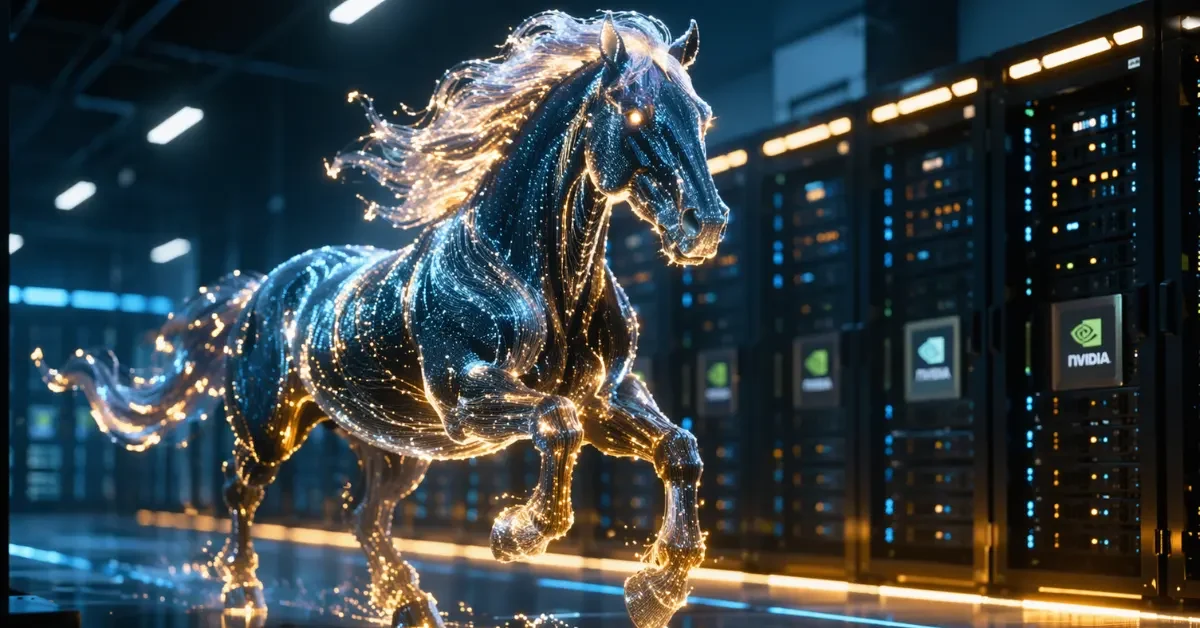
Alibaba Group has officially claimed ownership of HappyHorse-1.0, a highly rated artificial intelligence video generation tool that recently conquered global benchmark leaderboards under an anonymous alias. The model’s unexpected debut and top-tier performance have cemented the Chinese tech giant’s position in the fiercely competitive AI race, filling a market void left by the recent shutdown of OpenAI’s Sora.
HappyHorse-1.0 surfaced on the independent benchmarking site Artificial Analysis around April 7 without any corporate branding. It quickly surged to the number one spot in blind-test evaluations for both text-to-video and image-to-video generation. On Friday, developers revealed via a newly created profile on X that the platform is a project from Alibaba. The company later confirmed the announcement through its primary corporate account.
Dominating the AI Benchmarks
The AI video model achieved an Elo score of 1,383 in the text-to-video category, outperforming ByteDance’s previously leading Seedance 2.0 by 111 points. It also secured the top rank for silent video generation, while performing strongly in audio categories. Artificial Analysis employs a blind testing mechanism where users worldwide compare generated videos without knowing the model’s identity. The results are aggregated using an Elo rating system, creating a leaderboard based strictly on human visual preferences.
According to a spokesperson for Alibaba Token Hub (ATH), the model was developed by the Innovation Business Unit under the newly formed ATH business group. However, the Global Times reported that the tool was created by the Future Life Lab team within Alibaba’s Taotian Group. Both sources agree the project was led by Zhang Di, an AI veteran who reportedly returned to Alibaba in November after a five-year absence.
Technical Innovations and Market Impact
Currently in closed beta testing, HappyHorse-1.0 relies on architectural and algorithmic innovations rather than massive computational scale. The 15-billion parameter model achieves eight-step ultra-fast inference, allowing it to handle complex dynamic scenes efficiently. Early tests demonstrated its ability to generate coherent visuals and realistic lighting over long durations, such as depicting flowers blooming and withering in a vase over two weeks.
Alibaba plans to release an application programming interface in the near future, enabling external developers to access the model’s functions and assess its commercial viability. HappyHorse-1.0 represents Alibaba’s best-scoring video product to date. The company previously released AI video systems, including the Wan creator, which ranked roughly twenty spots lower on the same leaderboard.
Industry analysts note that an open-source strategy could accelerate the development of a thriving ecosystem for these AI models. While HappyHorse-1.0 is designed to be open source, with technical details expected upon public release, official repository links are not yet available. This approach could lower deployment costs and enable startup ventures to commercialize the technology rapidly.
The mysterious rise of the HappyHorse AI model generated significant buzz across the artificial intelligence industry and capital markets. Speculation regarding Alibaba’s involvement drove the company’s Hong Kong-listed shares up by as much as 6.75 percent on Wednesday. Following Friday’s official disclosure, the stock experienced an additional 2.12 percent increase.
Shifting Dynamics in Global Video AI
The success of HappyHorse-1.0 marks a major breakthrough for Chinese companies striving to dominate the global AI landscape. The video generation market has seen rapid shifts recently. OpenAI discontinued its Sora application in March due to high computing expenses and commercialization difficulties. Meanwhile, ByteDance halted the rollout of Seedance 2.0 following copyright infringement allegations from Hollywood studios. These setbacks have provided an advantage to Chinese developers, whose products now populate the top spots on the Artificial Analysis leaderboard.
Alibaba’s aggressive push into artificial intelligence aligns with a broader corporate restructuring. Chief Executive Officer Eddie Wu has made AI development the primary objective across the company’s diverse operations. In March, Alibaba consolidated its AI services under the ATH umbrella, chaired by Wu, and elevated its Tongyi research lab into an independent business unit.
Strategic Investments and Infrastructure
In tandem with the HappyHorse-1.0 reveal, Alibaba Cloud spearheaded a 2-billion-yuan ($293 million) Series B funding round for ShengShu Technology, a Beijing-based startup behind the Vidu AI video tool. The investment round included participation from Baidu Ventures, TAL Education Group, the China Internet Investment Fund, and Luminous Ventures.
ShengShu’s Vidu platform is marketed toward independent creators and animators, offering diverse artistic styles. Its latest iteration, Vidu Q3 Pro, ranks seventh in text-to-video and tenth in image-to-video on the Artificial Analysis leaderboard, directly competing with both Seedance 2.0 and Alibaba’s own HappyHorse. ShengShu Technology plans to use the proceeds to develop a general world model that processes multimodal data to simulate human perception, bridging digital and physical environments.
China is also aggressively pursuing independence in AI chip technology to support these massive computational requirements. China Telecom recently announced plans to establish a computing center in southern China utilizing chips designed by Alibaba. This facility will feature 10,000 Zhen semiconductors tailored specifically for AI applications, capable of operating systems with hundreds of billions of parameters.
