

Physicists have reported a new measurement of the gravitational constant, or Big G, after a 10-year effort led by Stephan Schlamminger at the National Institute of Standards and Technology, but the result does not end the long-running debate over gravity’s exact strength. Published in Metrologia, the study found a value of 6.67387 × 10^-11 meters cubed per kilogram per second squared, which NIST said is 0.0235% lower than the earlier French result the team set out to replicate.
The new gravitational constant measurement matters because Big G helps describe the attraction between any two masses anywhere in the universe, yet scientists have been trying to pin it down for more than 225 years without full agreement. A dozen precision experiments over the past 50 years have produced a spread of values, showing how difficult it remains to measure gravity as accurately as other fundamental constants. The newly published value is smaller than some previous measurements and closer to the officially recommended value than the original French experiment, but it still leaves the bigger puzzle unresolved.
Why Big G Remains Hard to Measure
Researchers say gravity is the weakest of nature’s four fundamental forces, which makes lab measurements especially challenging. NIST explained that scientists can test Big G only by measuring the tiny attraction between masses small enough to move and weigh in a laboratory, and those masses are about 500 billion trillion times smaller than Earth. That means the force being measured is extremely faint, even with highly sensitive equipment.
The disagreement is small in everyday terms, but it stands out in precision physics. NIST said differences among recent measurements are about one part in 10,000, which is too large to dismiss as routine experimental error. Most other fundamental constants are known far more precisely, making Big G an unusual outlier.
Recreating a French Experiment
To investigate the mismatch, Schlamminger and his colleagues recreated a torsion balance experiment first performed in France in the early 2000s and described by NIST as a precision experiment conducted by the International Bureau of Weights and Measures in Sèvres in 2007. The team’s goal was not to add another completely different approach, but to test whether the earlier setup would give the same answer when rebuilt and studied again.
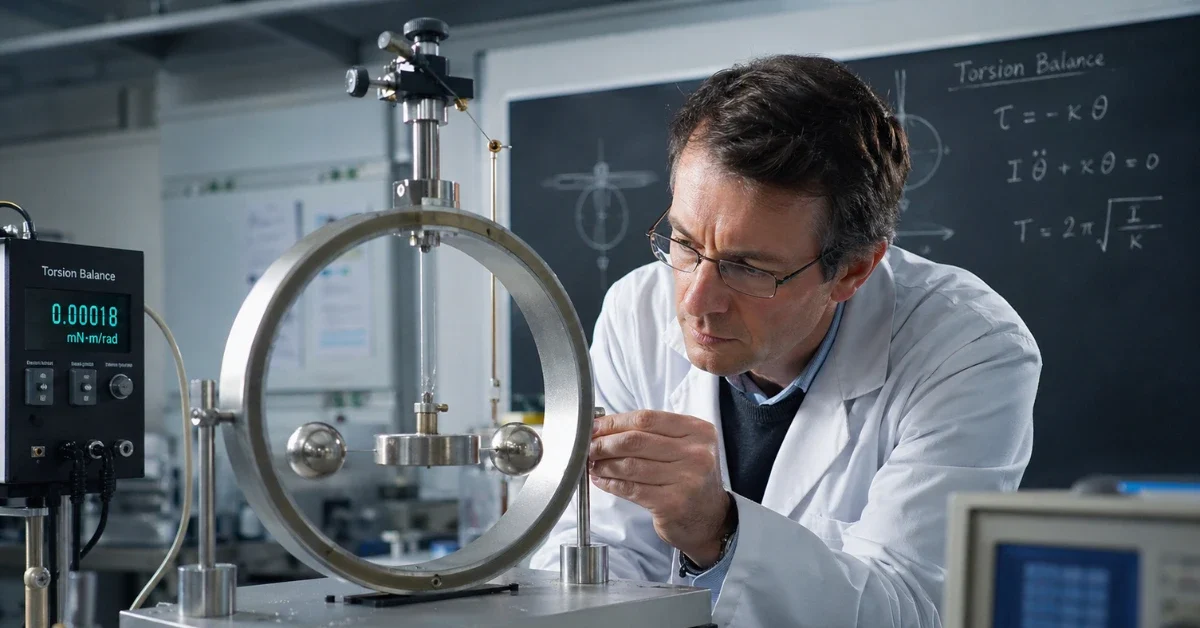
The experiment used four large masses on a rotating ring around four smaller masses on a suspended disk, and the researchers calculated G by tracking the tiny motion caused by gravitational pull. NIST said the setup also used a second method in which voltages applied to electrodes created an electrostatic torque that balanced the gravitational torque, giving another estimate of Big G. Schlamminger’s team then repeated the study with copper masses and again with sapphire masses, finding virtually identical results.
Hidden Effects and a Delayed Result
The team tried to guard against bias by hiding part of the calibration from themselves until the end of the project. NIST described how Schlamminger nearly revealed the hidden number in 2022 but stopped after realizing that air pressure could subtly skew the measurement, and the researchers later identified previously unaccounted-for effects, including air pressure. The hidden value was finally opened during a July 11, 2024, conference presentation, and the result showed the NIST measurement would not match the French one.
That outcome means the decade-long study adds an important new data point without settling the wider argument over Big G. NIST said the difference is not large enough to change bathroom-scale readings or routine weighing, but small discrepancies in science have sometimes pointed to deeper issues in how nature is understood. If the disagreements ever turned out to reflect nature rather than measurement problems, they would force a major rethink of physics.
What Comes Next
For now, the latest study sharpens the mystery instead of closing it. NIST said Schlamminger considers the work a meaningful addition to the body of evidence, even though it does not resolve the problem, and he added that younger generations of scientists will need to continue the search. As of this new result, the gravitational constant remains one of the hardest numbers in physics to measure with confidence.
