

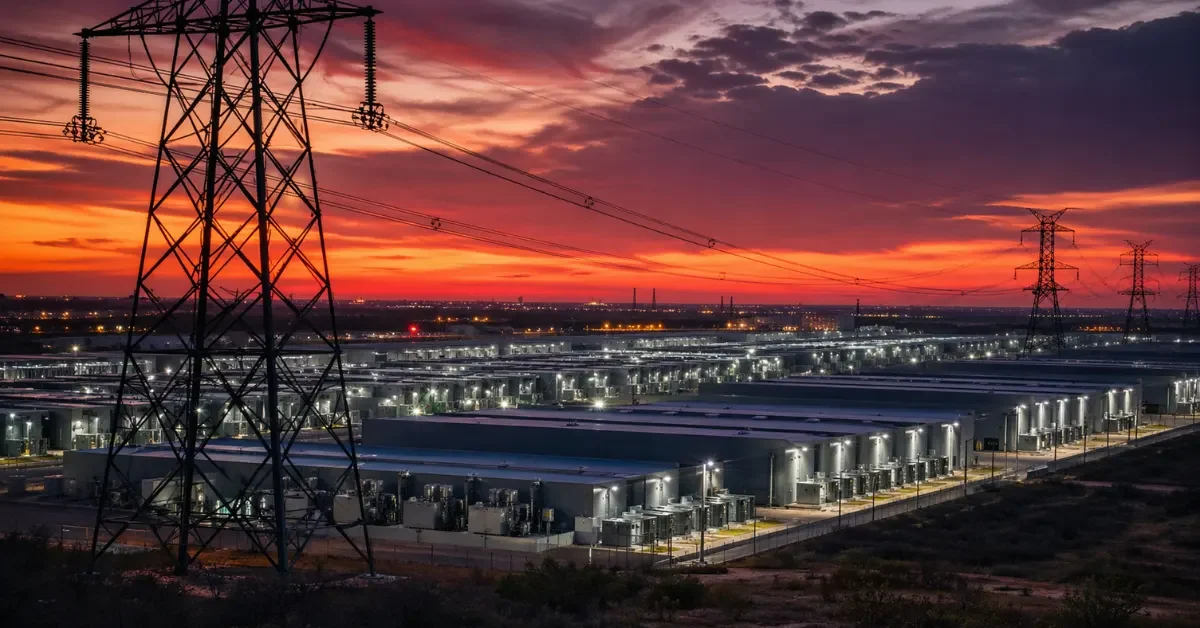
The artificial intelligence revolution is reshaping the global energy and real estate landscape, pushing companies to pour billions of dollars into data center infrastructure — and straining the power grids that keep it all running. From massive lease deals to record-breaking chip revenues, the AI data center boom is moving faster than the world’s power systems can keep up.
A $7.5 Billion Lease and Surging Spending
Applied Digital recently signed a $7.5 billion AI data center lease with a major U.S. hyperscaler, signaling just how aggressively companies are committing to long-term infrastructure growth. This deal is part of a wider wave of spending, as corporations across the technology sector continue pouring billions into AI infrastructure projects. The scale of these investments underscores how central data centers have become to the next phase of the AI economy.
Intel’s latest earnings report reinforced that momentum. The company’s data center and AI segment brought in $5.1 billion in revenue — a 22% jump compared to the same period a year ago — easily surpassing analyst expectations of $4.4 billion. Analysts described the demand driving those results as “insatiable,” pointing to a relentless appetite from hyperscalers building out next-generation AI computing environments.
Texas at the Breaking Point
Nowhere is the strain more visible than in Texas. The state is on track to become the world’s data center capital by 2030, overtaking Virginia — but the infrastructure needed to support that growth is struggling to keep pace. The Electric Reliability Council of Texas (ERCOT), the state’s grid operator, recently told regulators that power demand is on track to quadruple by 2032, driven almost entirely by the surge in large data center projects seeking grid connections.
That kind of growth is unprecedented. ERCOT’s existing power plants and transmission lines simply do not have the capacity to absorb the incoming wave of projects, and as a result, some data center developers in Texas could face wait times stretching several years before they can connect to the grid. The situation has grown serious enough that ERCOT itself has expressed concerns about the accuracy of its own demand forecast and has asked regulators to evaluate whether an adjustment is needed.
The Midcontinent Independent System Operator (MISO), which manages the grid across 15 states in the Midwest, South, and Mountain West, is facing similar pressures. It projects a 35% increase in demand by 2035, largely driven by massive data center projects from companies like Amazon, Google, Microsoft, Meta, OpenAI, and Oracle.
Developers Go Off-Grid
Faced with years-long waits for utility connections, a growing number of data center developers are bypassing the public grid entirely and building their own on-site power plants. Most of these “behind-the-meter” systems run on natural gas, including the high-profile Stargate data centers being developed by Oracle and OpenAI in Abilene and Shackelford County, Texas.
At Data Center World 2026, JT Steenkamp, vice president of projects and technology at Prologis Mobility, described the challenge in stark terms. According to Steenkamp, the United States could face roughly 200 gigawatts of new AI-driven power demand by the end of the decade, while simultaneously retiring more than 100 gigawatts of existing capacity — leaving what he described as a 300-gigawatt gap to solve for.
Steenkamp pointed to distributed, on-site power generation paired with large-scale real estate platforms as one practical solution. Large logistics and industrial real estate portfolios — already permitted for industrial use, often located near population centers, and capable of hosting modular generation systems — are becoming a bridge between energy infrastructure and digital demand. The approach, which Prologis calls “on-prem power,” is designed not to replace the grid but to provide near-term capacity while longer-term utility connections are developed.
AI Reshapes Real Estate Markets
The data center surge is also rewriting the rules of commercial real estate. Across Asia-Pacific and other markets, AI-driven demand is breathing new life into so-called “zombie projects” — stalled or abandoned real estate developments that are now being repurposed or revived to serve the data center industry. Land with access to power, fiber, and cooling infrastructure has taken on entirely new value, transforming markets that were previously considered oversupplied or underperforming.
Contracts Could Be the Industry’s Weak Link
Even as investment pours in, experts are flagging a less obvious but serious risk: the contracts holding these deals together. According to analysts, the standard procurement and outsourcing contracts used throughout the data center industry were not designed for the speed, scale, and complexity of the current AI buildout. Poorly structured agreements between developers, power providers, and hyperscalers could expose companies to financial and operational risks that undermine even the most ambitious infrastructure plans.
The combination of record investment, constrained power availability, shifting real estate dynamics, and contractual vulnerabilities means the AI data center boom is entering a more complicated phase — one where execution and resilience matter as much as the size of the check.
