

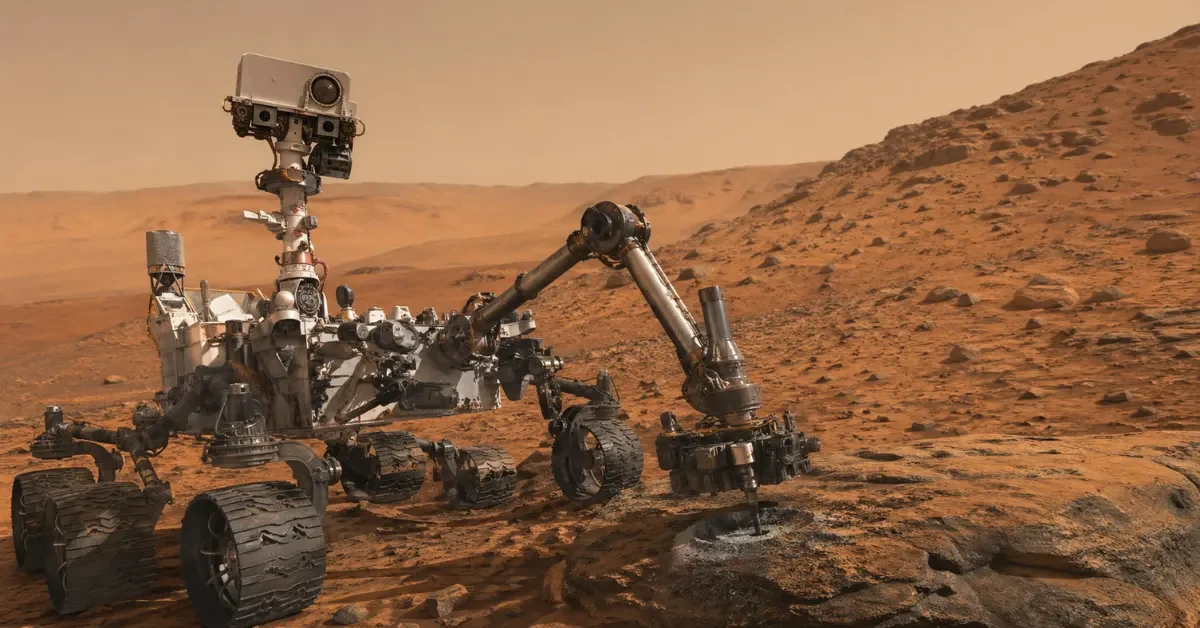
NASA’s Curiosity rover has found the most diverse collection of organic molecules yet detected on Mars after studying a rock sample drilled in 2020, strengthening the case that ancient Mars once had chemistry suitable for life. NASA’s Jet Propulsion Laboratory said researchers identified 21 carbon-containing molecules in the sample, including seven that had never been seen on Mars before.
The discovery is significant because organic molecules are considered building blocks of life, even though they can form through both biological and non-biological processes. Both NASA and other coverage of the findings stressed that the new results do not prove life ever existed on Mars, but they do add to evidence that the planet once had conditions that could have supported it.
What the rover found
The sample, called “Mary Anning 3,” came from a clay-rich area on Mount Sharp that NASA said was shaped by lakes and streams billions of years ago. According to NASA, clay minerals in that region are especially good at preserving organic compounds, helping the molecules survive despite long exposure to Mars’ harsh surface environment.
Among the newly identified compounds was a nitrogen heterocycle, a ring-shaped molecule containing carbon and nitrogen that NASA described as a possible predecessor to RNA and DNA. NASA also reported the detection of benzothiophene, a carbon- and sulfur-bearing molecule that has previously been found in many meteorites.
The Times of India reported that Curiosity detected the compounds by heating rock samples with its Sample Analysis at Mars, or SAM, instruments to release gases for study. The report said the finding adds support to the idea that ancient Mars may have had chemicals capable of helping life emerge, even though the molecules alone cannot confirm past or present life.
Why the sample matters
NASA said scientists cannot yet determine whether the molecules were created through geologic activity or biological processes, and either explanation remains possible. Still, the agency said the discovery renewed confirmation that ancient Mars had the right chemistry to support life and showed that organic compounds can remain preserved in Martian rocks for billions of years.
The new paper also builds on an earlier Curiosity result involving the largest organic molecules previously found on Mars: the long-chain hydrocarbons decane, undecane, and dodecane. Together, those findings expand the picture of how complex Martian chemistry may have been in the planet’s distant past.
How scientists tested it
NASA said the Mary Anning 3 sample was the first Martian sample exposed to tetramethylammonium hydroxide, or TMAH, using SAM’s wet chemistry method. That process can break apart larger molecules that would otherwise be difficult to detect, giving scientists a better look at the chemistry preserved inside the rock.
To check how that chemistry works, the study team also tested the same method on a piece of the Murchison meteorite on Earth. NASA said that the experiment produced some of the same molecules seen in the Martian sample, including benzothiophene, showing that the compounds in Mary Anning 3 could have come from the breakdown of even more complex molecules relevant to life.
What comes next
The findings are expected to shape future Mars research and sample analysis efforts. The Times of India reported that the discovery could influence missions designed to return Martian samples for closer study, while NASA said the Curiosity team has already used its second and final TMAH cup on another set of ancient Martian features for a future peer-reviewed paper.
NASA also said the chemistry work done by Curiosity is helping prepare instruments for future missions, including the Mars Organic Molecular Analyzer for the European Space Agency’s Rosalind Franklin rover and the Dragonfly Mass Spectrometer for NASA’s Dragonfly mission to Titan. For now, Curiosity’s latest results do not answer whether Mars ever hosted life, but they do show that the planet preserved a richer range of organic chemistry than scientists had confirmed before.
