

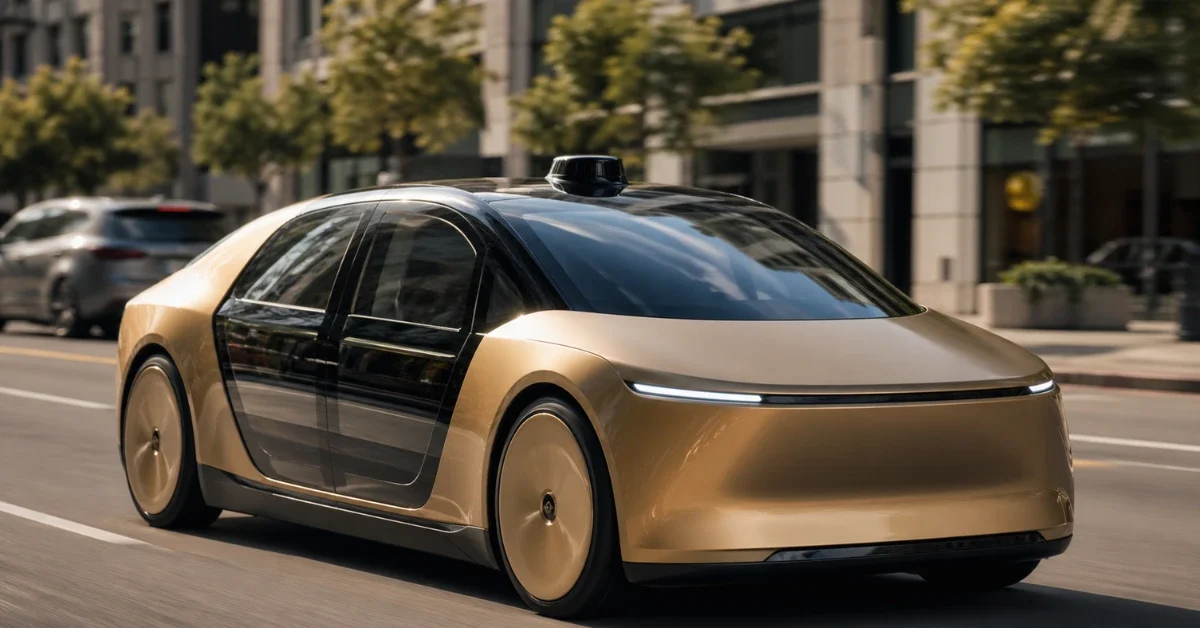
Tesla has officially launched the manufacturing phase for its long-awaited autonomous vehicle. Tesla Cybercab production is now underway at the company’s Giga Texas facility. Chief Executive Officer Elon Musk confirmed the major milestone during Tesla’s first-quarter earnings call for 2026, where the automaker reported profits reaching $477 million. Musk further celebrated the launch on his social media platform, X, sharing a brief promotional video featuring a driverless Cybercab navigating factory floors and city streets. He also posted footage showing multiple gold-colored Cybercabs driving together in formation.
The S-Curve Manufacturing Strategy
While the first production model rolled off the assembly line in February, continuous mass manufacturing only commenced this month. The Cybercab features a unique two-door, two-seat design built entirely without a steering wheel or pedals. The company is concurrently developing a separate version equipped with traditional manual controls.
During the recent earnings discussion, Musk urged investors to keep their immediate expectations in check. He described the ramp-up process as a traditional S-curve, common when introducing an entirely new supply chain. Initial production rates for both the Cybercab and the Tesla Semi will start slowly. As the year progresses, manufacturing volume is expected to accelerate significantly toward exponential growth. Despite this anticipated surge in factory output, substantial revenue from the robotaxi program is not expected to materialize until at least 2027. Musk originally unveiled the vehicle in the fall of 2024.
Bypassing Federal Production Limits
A major advantage for the new vehicle is its regulatory pathway. Competing autonomous vehicle companies, such as Alphabet’s Waymo, typically rely on special federal exemptions to deploy vehicles lacking traditional controls. The National Highway Traffic Safety Administration caps these exemptions at just 2,500 vehicles per manufacturer annually.
Tesla has bypassed this strict limitation. Vice President of Vehicle Engineering Lars Moravy confirmed the Cybercab is exempt from the annual production cap. The vehicle was engineered to comply with all existing Federal Motor Vehicle Safety Standards. By meeting these basic requirements, Tesla can self-certify the vehicle in the same manner used for mass-market passenger cars like the Toyota Camry. Recent drone footage captured at the Giga Texas plant shows finished Cybercabs sporting official federal compliance stickers. These labels confirm that the autonomous cars meet mandatory bumper, theft prevention, and safety regulations without needing special governmental waivers.
Ride-Hailing Expansion and Software Hurdles
The newly built Cybercabs will serve as the foundation of Tesla’s dedicated ride-hailing network. The company began offering an invitation-only robotaxi service to early access users in Austin last June. Since then, operations have expanded into Dallas and Houston. Tesla recently told investors that the network is scheduled to reach Miami, Orlando, and Las Vegas before the middle of this year.
The ultimate success of the program relies on unfinished autonomous driving software. Musk stated that unsupervised Full Self-Driving capabilities should reach customer vehicles by the fourth quarter of this year, with plans to operate in roughly a dozen states by year-end. He emphasized that the company is taking a cautious approach to this broader rollout.
Currently, the supervised version of the software faces notable challenges. Safety statistics show that the supervised robotaxi fleet experiences an average of one crash every 57,000 miles. By comparison, the human driving benchmark sits at one incident per 229,000 miles. Musk acknowledged the software has limitations, noting that vehicles occasionally become overly cautious, freezing in place or getting stuck in repetitive driving loops instead of progressing.
Leadership Departures and Market Outlook
As Tesla pushes forward with manufacturing, the Cybercab team has experienced significant leadership turnover. Several key program managers who guided the vehicle into production have departed since February. Vehicle program manager Victor Nechita left shortly after the first unit was built. Thomas Dmytryk, a director overseeing over-the-air updates, exited after an eleven-year tenure. Assembly leader Mark Lupkey also left the company in March, leaving the robotaxi program without any of its original founding managers.
These internal shifts arrive during a challenging period for the automaker. Tesla’s stock price has declined by approximately 17 percent since the start of the year. The company is playing catch-up in the broader commercial autonomous market, entering the space several years after Waymo launched commercial robotaxi services in 2021. Nevertheless, Wedbush analyst Dan Ives noted that the successful expansion of the Full Self-Driving platform holds the potential to fundamentally change Tesla’s long-term financial margins.
