

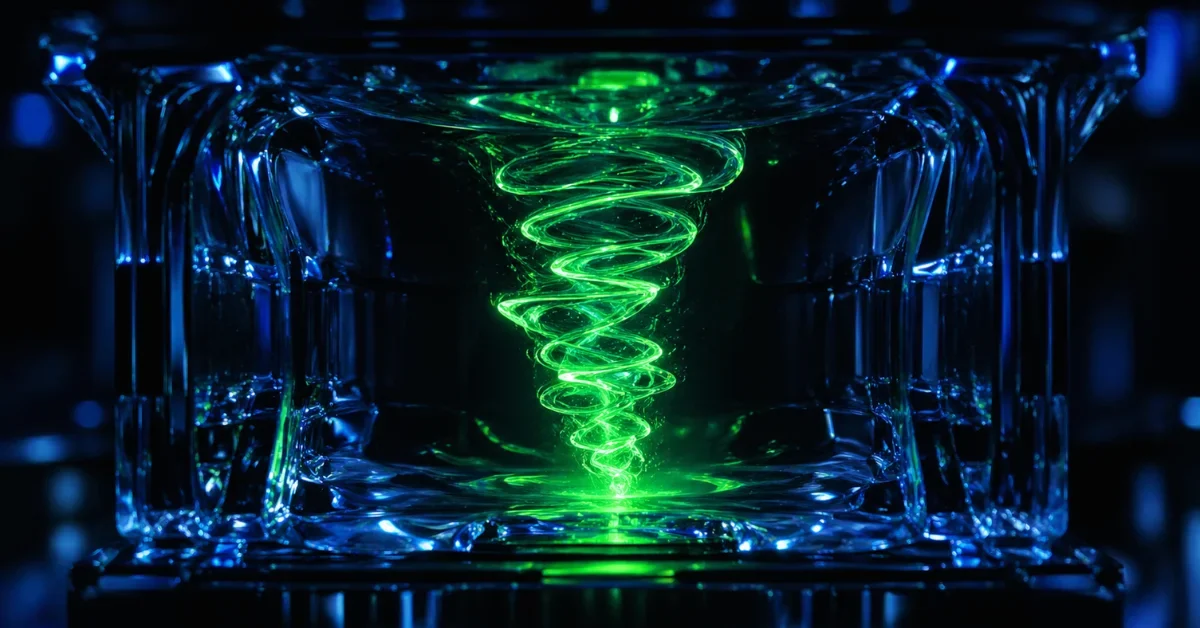
An international team of scientists has successfully created tiny, swirling beams of light known as optical tornadoes. By using a straightforward setup based on liquid crystals, researchers have found a reliable way to twist light into miniature whirlwinds. This scientific milestone paves the way for major advancements in optical communication and quantum technology.
Instead of relying on expensive and complicated nanotechnology, the research team utilized self-organizing structures within liquid crystals to achieve this feat. The collaborative project involved physicists from the University of Warsaw, the Military University of Technology, and the Institut Pascal CNRS at Université Clermont Auvergne. Together, their findings represent a massive step forward in building miniature light sources with highly intricate shapes.
Understanding the Light Vortex
An optical tornado essentially functions as an optical vortex. In this specialized state, the light wave twists around its own central axis, causing its phase to change in a continuous, spiral pattern. Additionally, the direction in which the electric field oscillates—known as polarization—also begins to rotate.
These structured light formations hold immense potential for controlling microscopic objects and powering advanced communication systems. Historically, generating such complex light states has been a difficult task, requiring large-scale experimental setups or incredibly difficult-to-manufacture nanostructures. The new approach offers a far more accessible alternative.
Liquid Crystals and Toron Structures
To bypass the need for complex engineering, the research team turned its attention to liquid crystals. This unique material bridges the gap between a liquid and a solid. While the material can flow easily like a liquid, its internal molecules arrange themselves in a highly ordered manner, maintaining a consistent orientation similar to a solid crystal.
Within these specialized liquid crystal environments, distinct structural defects called torons naturally form. These structures behave like tightly coiled spirals, similar in shape to DNA, that eventually close into a ring to resemble a doughnut. These microscopic doughnut-shaped formations act as natural traps for light. By leveraging these self-organizing torons, the scientists successfully confined the light particles, or photons, in a highly controlled space. The core inspiration for this method stems from atomic physics, where optical traps are used to confine light in the same way traditional systems confine electrons in different energy states.
Designing a Synthetic Magnetic Field
A critical component of this experiment was creating a method to manipulate the trapped photons. While light does not react to actual magnetic fields in the way electrons do, the researchers achieved a nearly identical effect by generating a synthetic magnetic field. This was accomplished through spatially variable birefringence, a scientific process that takes advantage of the differences in how various light polarizations travel through a specific material.
This synthetic field causes the light to bend, mimicking the way electrons behave when moving in circular cyclotron orbits. To amplify this bending effect, the researchers placed the toron inside an optical microcavity. This tiny cavity consists of highly reflective mirrors that bounce the light back and forth, keeping it securely confined for extended periods. Furthermore, the scientists discovered they could actively control the size of the optical trap and alter the properties of the swirling light by applying an external electric voltage.
Achieving the Ground State Breakthrough
The most significant milestone in this research is the specific energy state in which these light vortices were achieved. In traditional optical systems, light that carries a swirling momentum only appears in excited, higher-energy states. However, the theoretical models developed by the collaborative team demonstrated that this effect could actually be achieved in the ground state.
The ground state is the lowest-energy state possible, making it the most stable environment where energy can accumulate with the lowest amount of loss. Because light naturally defaults to this state, capturing an optical tornado at this level makes it significantly easier to generate a laser effect.
To verify this stability, the scientists introduced a special laser dye into the liquid crystal system. The results confirmed their theories perfectly. The emitted light not only rotated in a vortex but also functioned exactly like a laser beam. It remained fully coherent while displaying a clearly defined energy level and emission direction.
Shaping the Future of Photonics
The innovative approach taken by the researchers draws unexpected parallels with advanced physics theories. In some ways, the manipulated photons behaved less like traditional light waves and more like quarks, the fundamental charged particles that make up protons.
By proving that self-organizing materials can effectively replace complex nanotechnology, the scientific community now has a more efficient method for manipulating light at a microscopic level. This breakthrough offers a clear path toward developing simpler, highly scalable photonic devices. Ultimately, the optical tornadoes generated in these simple liquid crystal traps could soon become a foundational technology for next-generation quantum networks and optical communication systems.
