

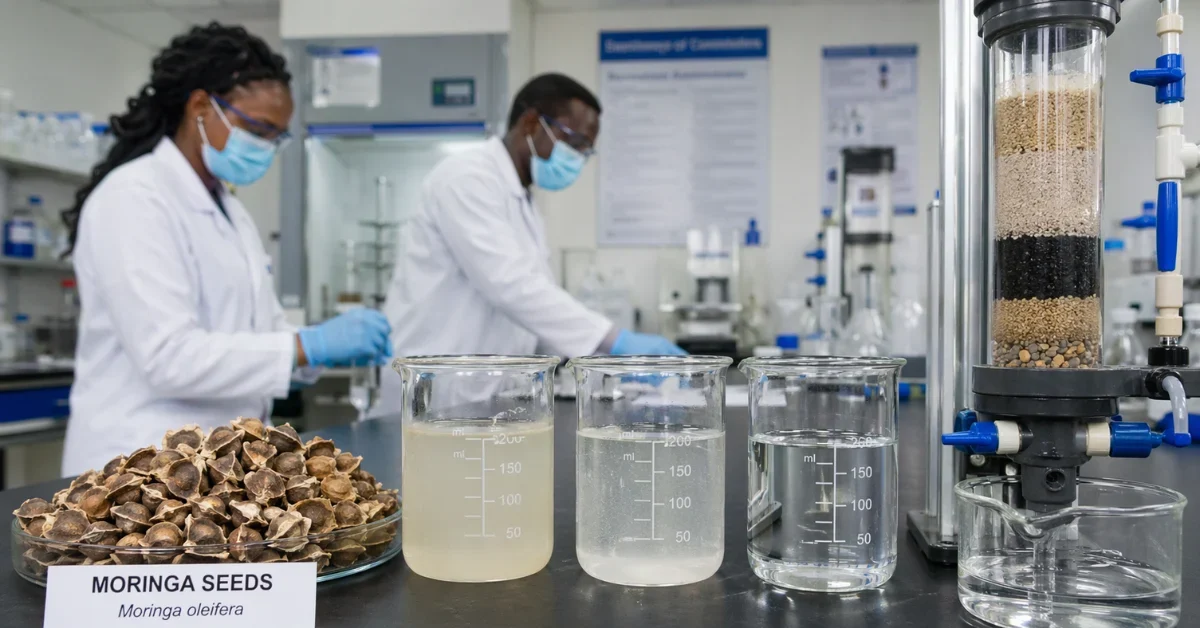
Moringa seeds may offer a low-cost way to remove microplastics from drinking water, according to research from São Paulo State University in Brazil published in ACS Omega. The study found that a saline extract made from Moringa oleifera seeds performed similarly to aluminum sulfate, a standard chemical coagulant used in water treatment plants. In some more alkaline water conditions, the moringa extract performed better than the chemical treatment, suggesting it could be a useful option for small communities and rural areas.
The findings center on a common water treatment challenge: microplastics are small and often carry a negative electrical charge, which makes them harder to capture during filtration. Researchers found that moringa seed extract helped neutralize that charge, causing the plastic particles to clump together into larger clusters that could then be filtered out more easily. That coagulation step is important because it prepares the particles for removal in sand filtration systems commonly used in water treatment.
How the Study Worked
The research focused on in-line filtration, a treatment method in which water is first dosed with a coagulant and then passed through a sand filter. According to the study description, this method is best suited to low-turbidity water, meaning relatively clear water that needs fewer early treatment steps. The team compared moringa seed saline extract with aluminum sulfate under the same conditions to see how both performed in removing microplastics.
To run the tests, the researchers added polyvinyl chloride, or PVC, microplastics to tap water. They then exposed those plastic particles to ultraviolet radiation to simulate aging and make the test conditions closer to what happens in the natural environment. The treated water was processed through a Jar Test system, which mimics water treatment on a small scale, and the results were then compared across the two coagulants.
Researchers used scanning electron microscopy to count microplastic particles before and after treatment. They also examined the size of the clumps formed during coagulation with high-speed camera and laser measurements. Both treatments showed similar levels of microplastic removal, and one report on the paper said both removed more than 98% of PVC microplastics under laboratory conditions, with moringa reaching as high as 99.4% under optimal conditions.
Why Moringa Stands Out
One reason the study has drawn attention is that moringa is a plant-based material already known in some regions for water purification uses. The leaves and seeds are widely consumed as food, and scientists have studied the seeds for years because of their possible role in water purification. Reports on the study also describe moringa as a sustainable alternative to aluminum- and iron-based coagulants, which have raised regulatory and health concerns because they are not biodegradable and may leave residual toxicity.
The study also pointed to a practical advantage. A simplified in-line filtration approach worked effectively without the longer flocculation step used in direct filtration, and one analysis of the paper said that could lower costs and energy use if the method is adopted more broadly. The same analysis reported that moringa performed well across a wider pH range, while alum was more sensitive to water chemistry and showed weaker performance at higher pH.
Limits and Next Tests
The research also identified a drawback. Adriano Gonçalves dos Reis, who led the study, said the main issue observed so far with the moringa approach was an increase in dissolved organic matter, and removing that could make the process more expensive. Even so, he said the method could still be efficient and cost-effective on a small scale, especially for rural properties and small communities.
The work has not stopped at lab testing. The researchers are now testing moringa seed extract on water collected from the Paraíba do Sul River, which supplies São José dos Campos, and early reports say the method has so far shown effectiveness in treating natural water as well. Other reports on the study said the next step is to apply the technique directly in river conditions in São José dos Campos to measure how well it performs outside the laboratory.
For now, the study presents moringa seeds as a promising natural option for microplastics removal in drinking water treatment. The findings do not suggest the technology is ready to replace conventional systems everywhere, but they do show that a common plant could match a standard chemical treatment under tested conditions and even exceed it in some cases.
