

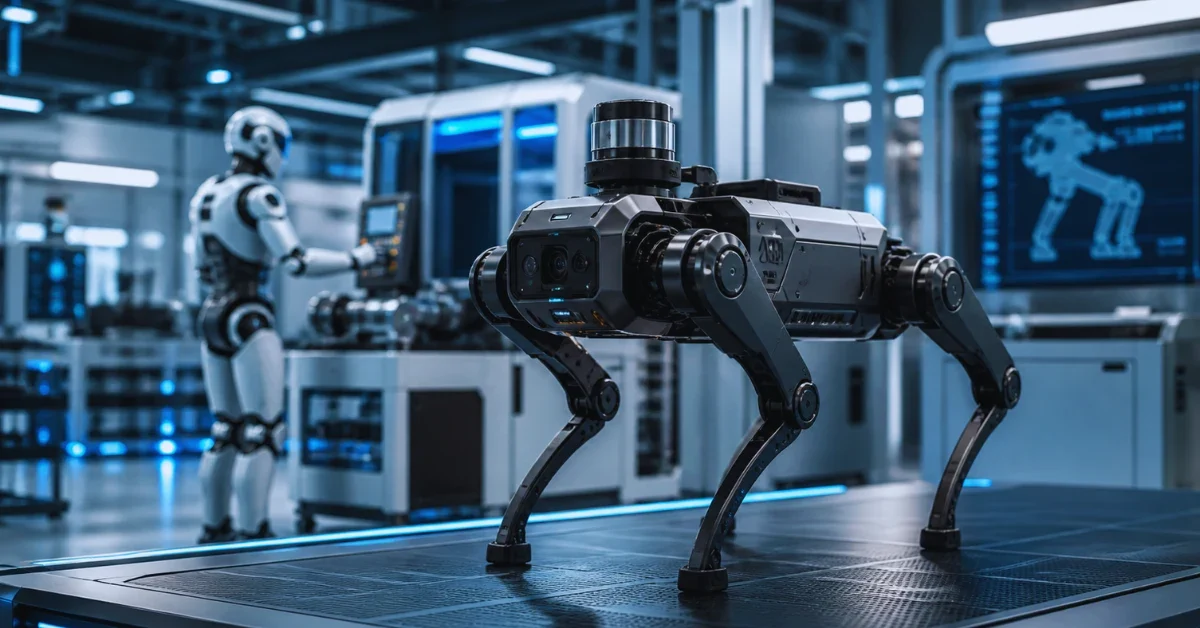
Generative AI previously sparked a productivity revolution by automating document creation and decision-making tasks. Now, the technology industry is entering a new phase where artificial intelligence delivers tangible results in the physical world. Physical AI is rapidly emerging as the next major investment theme, combining autonomous systems, advanced manufacturing equipment, and sophisticated robotics.
This shift moves the battleground of artificial intelligence from on-screen chatbots to logistics warehouses, hazardous industrial sites, and everyday households. Major technology corporations like Meta and vast state-owned enterprises in China are aggressively pouring capital into these smart machines. As labour shortages, cost pressures, and strict safety regulations increase globally, the demand for intelligent automation is completely reshaping how businesses operate.
Market Growth and Global Development Strategies
The financial trajectory for this sector is steep. According to market research firm MarketsandMarkets, the global physical AI market is projected to soar from $1.5 billion this year to $15.2 billion by the year 2032. Early revenue generation is expected to come primarily from smart factory segments, logistics automation, and industrial robotics.
Different regions are adopting distinct strategies to capture this growing market. The United States heavily emphasises a platform-centred approach to physical AI. For example, Nvidia recently unveiled a general-purpose robotics AI model and a digital twin system for training robots in virtual environments during its GTC event. Global industrial robot companies like ABB, FANUC, and KUKA have already adopted this platform.
Conversely, China relies on its massive domestic market and strong manufacturing infrastructure to vertically integrate hardware, control technology, and artificial intelligence models. At the recent AWE home appliance expo in Shanghai, companies such as Haier, TCL, and Unitree demonstrated robots that successfully learned complex human activities like boxing and dancing. South Korean corporations are also heavily investing in these technologies, deploying robots in hazardous automated facilities to offset labour shortages in roles requiring simple manual work.
Meta Acquires Assured Robot Intelligence
Meta is deepening its financial and strategic stake in the physical AI race. The social networking giant recently acquired Assured Robot Intelligence, a San Diego-based startup with a team of about 20 employees. This specialised company focuses on developing artificial intelligence models designed to power humanoid robots.
Assured Robot Intelligence focuses specifically on high-precision dexterity and manipulation in robotics. These essential elements dictate a machine’s ability to physically interact with real-world objects in complex, dynamic environments. Mastering dexterity is crucial for making robots practical and useful in both industrial settings and domestic households. The startup was founded by world-class academic roboticists Xiaolong Wang, a University of California, San Diego faculty member and former Nvidia researcher, and Lerrel Pinto, a computer science professor at New York University.
This acquisition fits into Meta’s broader push toward advanced hardware and intelligent machines. In 2025, Meta officially established a dedicated robotics group within its Reality Labs division. The company has since tapped new leadership and expanded its hardware team under a separate division known as Meta Superintelligence Labs.
China Automates Power Grids With 8,500 Robots
While Meta focuses on software intelligence, China is executing large-scale physical deployments. The state-owned State Grid Corporation of China is currently accelerating the use of robotics within its national power grid. The organisation plans to invest approximately $1 billion to procure roughly 8,500 robots, with the full rollout scaling through 2026.
This massive deployment features a diverse mix of machine types. Quadruped robots, commonly known as robot dogs, will conduct inspections across challenging terrain and large substations. Wheeled machines equipped with robotic arms will manage controlled maintenance tasks requiring precision. Experimental humanoid robots will also join the fleet, with domestic hardware manufacturers such as Deep Robotics, Unitree Robotics, and UBTech Robotics building these systems.
Enhancing Human-Machine Collaboration
These machines handle high-risk and routine operations across vast geographic areas. Grid robots utilise thermal imaging and various sensors to monitor equipment conditions and identify faults invisible to the human eye. They regularly inspect transmission lines in hard-to-access mountainous regions, securely transmitting real-time data to central control rooms for predictive maintenance.
Despite this massive automation initiative, physical AI is not expected to completely replace human workers. These machines exist to complement existing workforces by absorbing dangerous tasks and improving inspection consistency. Human technicians maintain overall control and remain entirely essential for complex system repairs, high-level decision-making, and emergency management. As physical AI expands into comprehensive industrial infrastructure, this hybrid model of human-machine collaboration is setting the standard for the future of global automation.
