

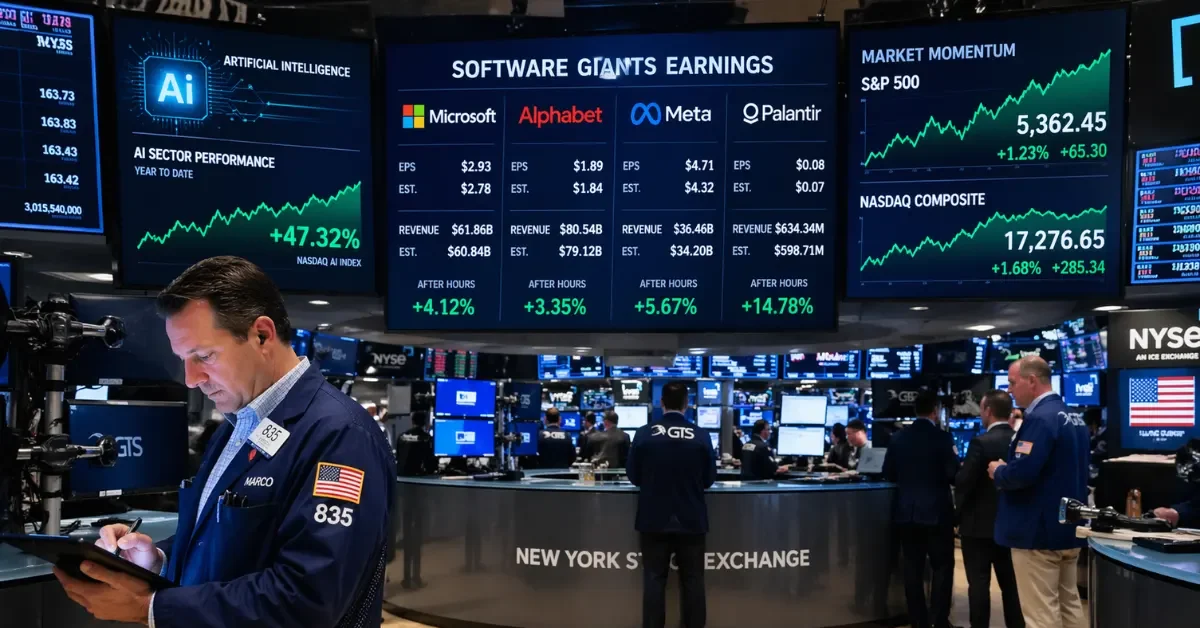
Wall Street’s AI stocks are climbing again, and the latest bullish call came from JPMorgan, which raised its 2026 year-end target for the S&P 500 to 7,600 from 7,200 as it pointed to renewed AI momentum and stronger earnings expectations. The bank said markets pushed to new highs after geopolitical tensions eased, with the Magnificent Seven and AI-related names leading the advance.
That rebound has helped revive risk appetite, but it has not ended the debate over whether better AI models could weaken parts of the software industry. Software stocks have recovered sharply in recent days, yet the iShares Expanded Tech-Software Sector ETF is still down 19% for 2026, and a separate report said the software and services index was down about 16% since the start of the year while the broader S&P 500 was up 3.2%.
AI trade regains steam
JPMorgan said investor interest in AI stocks has not been this strong since the first half of 2025, and it linked the renewed excitement in part to Anthropic’s latest model news. The firm added that 66% of S&P 500 AI names had outperformed since April 7, which it described as evidence of rapidly improving AI models and services.
The bank also argued that some earlier concerns about AI-driven job losses in sensitive areas such as software engineering have eased for now as hiring resumes. At the same time, it warned that geopolitical risks have not disappeared and that the sharp market rally could still give way to a short-term consolidation phase.
Software earnings face a harder test
The challenge for software companies is that stronger revenue may no longer be enough on its own to calm investors worried about long-term disruption from AI. A Reuters report published by Global Banking & Finance said Salesforce is expected to post first-quarter revenue growth of 12.5% to $9.83 billion, its fastest growth in 13 quarters, but profit growth is likely to slow to a near three-year low as costs rise.
That same report said ServiceNow is expected to deliver slightly faster quarterly revenue growth of 21.1%, while Workday is expected to post revenue growth of 12.4%. ServiceNow was also described as the company set to kick off earnings for major software-as-a-service firms, with Workday and Salesforce likely to follow in May.
Software executives have tried to reassure investors that proprietary data, years of enterprise experience, and in-house AI products can help keep customers loyal even as new tools move into legal, marketing, and customer-service work. Salesforce CEO Marc Benioff was among the leaders cited as making that case. At the same time, Bernstein analysts said many incumbents still have an opportunity to succeed because enterprise AI rollouts are likely to take many years.
Still, some investors remain unconvinced that one or two earnings reports can settle the bigger question. Madison Investments portfolio manager Joe Maginot said the core issue is not just the next quarter, but how the industry evolves over the next several years.
Analysts warn the rally may be fragile
Recent gains in software shares have been strong, but some strategists say they look more like a relief rally than a clear turning point. Business Insider reported that Piper Sandler called the move a big mean-reversion rally from oversold conditions, while Bank of America said the gains could reflect bottom fishing.
Bank of America said software has reclaimed its 200-day moving average as selling pressure eases, but it also said there is still no clear bottom pattern. Piper Sandler made a similar point, saying the group has recovered its 50-day moving average but still has months of technical damage to repair.
That caution matters because the sector was at the center of the market’s earlier AI panic trade. Investors had worried that new AI tools could dethrone established software leaders, and the selloff spread beyond software into areas such as wealth management and insurance.
Why the market is still split
A CIO analysis said those sharp swings show how quickly AI headlines can change investor views of value and risk, even before real-world outcomes are fully proven. The same analysis argued that AI is best viewed as a force multiplier that speeds up experts rather than a full replacement for professional judgment.
That view fits with other signs that adoption remains broad but uneven. The CIO article said a survey of roughly 6,000 executives in the U.S. and Europe found that nearly nine in 10 firms reported no significant productivity gains from AI over the past three years, and it said McKinsey’s latest global survey found about 88% of organizations use AI in at least one business function even though only a minority have scaled it across the enterprise or seen material enterprise-wide financial impact.
For investors, that leaves a mixed picture: AI enthusiasm is lifting markets and helping sentiment recover, but software companies still need to prove that AI can expand revenue and protect customer relationships without crushing margins. Until that evidence becomes clearer, the sector may keep swinging between optimism about AI growth and anxiety over how much of that growth traditional software firms will actually capture.
