
By using this site, you agree to our Privacy Policy and Terms of Use.
Accept
VellaTimesVellaTimesVellaTimes
  • News
    NewsShow More
    A brightly glowing interstellar comet venting streams of gas and dust as it travels through the dark vacuum of deep space.
    Interstellar Comet 3I/ATLAS Reveals Strange Chemistry
    April 19, 2026
    A futuristic digital interface showing secure interconnected nodes in a modern corporate office, representing enterprise AI agents and secure governance.
    Enterprise AI Agents Reshape Workflows Amid Security Push
    April 19, 2026
    A silver driverless Tesla Model Y driving down a sunlit suburban neighborhood street.
    Tesla Robotaxi Service Expands to Dallas and Houston
    April 19, 2026
    Hyper-realistic news-style image of the Rosalind Franklin Mars rover in a spacecraft preparation setting with a Falcon Heavy rocket in the background.
    Rosalind Franklin Rover Set for SpaceX Mars Launch
    April 19, 2026
    Modern video production workstation and broadcast control room screens illustrating AI-assisted filmmaking and live production workflows.
    AI Filmmaking in 2026 Reshapes Production Workflows
    April 19, 2026
  • Technology
    TechnologyShow More
    A silver driverless Tesla Model Y driving down a sunlit suburban neighborhood street.
    Tesla Robotaxi Service Expands to Dallas and Houston
    April 19, 2026
    An iPhone and MacBook on a modern desk displaying glowing blue and purple artificial intelligence graphics, representing the new Gemini-powered voice assistant integration.
    Gemini-Powered Siri: Apple Updates and New Mac App
    April 19, 2026
    Modern data center with Nvidia branding on a screen, server racks, and market-style display graphics in the background.
    Nvidia Faces New Threats as AI Demand Stays Strong
    April 19, 2026
    Customers interacting with modern smartphones on illuminated display tables inside a brightly lit Apple retail store in China.
    Apple China Smartphone Sales: Strong 2026 Market Growth
    April 18, 2026
    A modern, sleek corporate boardroom with glass walls and an empty executive chair, representing leadership transitions in a technology company.
    OpenAI Leadership Changes: Executive Roles and Leaves
    April 18, 2026
  • AI
    AIShow More
    A futuristic digital interface showing secure interconnected nodes in a modern corporate office, representing enterprise AI agents and secure governance.
    Enterprise AI Agents Reshape Workflows Amid Security Push
    April 19, 2026
    Modern video production workstation and broadcast control room screens illustrating AI-assisted filmmaking and live production workflows.
    AI Filmmaking in 2026 Reshapes Production Workflows
    April 19, 2026
    A laptop on a desk showing Google Chrome in split-screen mode with a webpage on one side and an AI assistant panel on the other.
    Google Chrome AI Mode Adds Skills, Side-by-Side Tools
    April 19, 2026
    A modern computer monitor displaying glowing code and AI data visualizations in a high-tech corporate office setting.
    OpenAI Agents SDK and Codex Updates Target Enterprise AI Dominance
    April 18, 2026
    A modern tech office computer monitor displaying glowing software code and financial growth charts, representing AI software development and business growth.
    AI Coding Startup Cursor Seeks $2 Billion Funding at $50 Billion Valuation
    April 18, 2026
  • Science
    ScienceShow More
    A brightly glowing interstellar comet venting streams of gas and dust as it travels through the dark vacuum of deep space.
    Interstellar Comet 3I/ATLAS Reveals Strange Chemistry
    April 19, 2026
    Hyper-realistic news-style image of the Rosalind Franklin Mars rover in a spacecraft preparation setting with a Falcon Heavy rocket in the background.
    Rosalind Franklin Rover Set for SpaceX Mars Launch
    April 19, 2026
    A futuristic quantum computing lab with advanced hardware, rising stock market displays, and a cybersecurity-themed digital interface.
    Quantum Computing News: AI, Stocks, and Cybersecurity
    April 19, 2026
    A microscopic view of a glowing bacterium rupturing and releasing tiny genetic particles to surrounding cells in a dark environment.
    Kamikaze Bacteria: How Exploding Cells Spread Resistance
    April 18, 2026
    Abstract representation of the expanding universe featuring glowing spacetime ripples and distant galaxies illustrating the Hubble tension.
    Hubble Tension Confirmed: Universe Expansion Rate Mystery
    April 18, 2026
  • World
    WorldShow More
    Allu Arjun Commitment to Ethical Brand Partnerships
    Exploring Allu Arjun’s Commitment to Ethical Brand Partnerships
    December 18, 2023
    Orry aka Orhan Awatramani
    Orhan Awatramani ‘Orry’ Biography, Lifestyle and Rise to Fame
    December 8, 2023
    Alia Bhatt Latest Deepake Video Victim
    Alia Bhatt becomes latest victim of Deepfake Videos, Obscene Video goes Viral
    November 28, 2023
    Napoleon Movie Review
    Napoleon Movie Review: A Historical Epic by Ridley Scott Reviewed
    November 25, 2023
  • Bookmarks
Search
Category
  • News
  • Technology
  • AI
  • Science
  • World
Company
  • About Us
  • Contact Us
  • Fact Checking Policy
  • Terms & Conditions
  • Privacy Policy
  • Copyright Policy
Resources
  • Home
  • Web Stories
  • Bookmarks
  • Interests
  • Disclaimer
  • Sitemap
© 2022 VellaTimes • All Rights Reserved.
Reading: Ancient Chinese Fossils Push Back the Timeline of Complex Life on Earth
Share
Notification Show More
Font ResizerAa
VellaTimesVellaTimes
Font ResizerAa
  • News
  • Technology
  • AI
  • Science
  • World
Search
  • Explore
    • News
    • Technology
    • AI
    • Science
    • World
  • Useful Links
    • About Us
    • Contact Us
    • Fact Checking Policy
    • Terms & Conditions
    • Privacy Policy
    • Copyright Policy
  • Home
  • Web Stories
  • Bookmarks
  • Interests
  • Disclaimer
  • Sitemap
© 2022 VellaTimes • All Rights Reserved.
News

Ancient Chinese Fossils Push Back the Timeline of Complex Life on Earth

Nisha Pradhan
Last updated: 05/04/2026
Nisha Pradhan
Share
6 Min Read
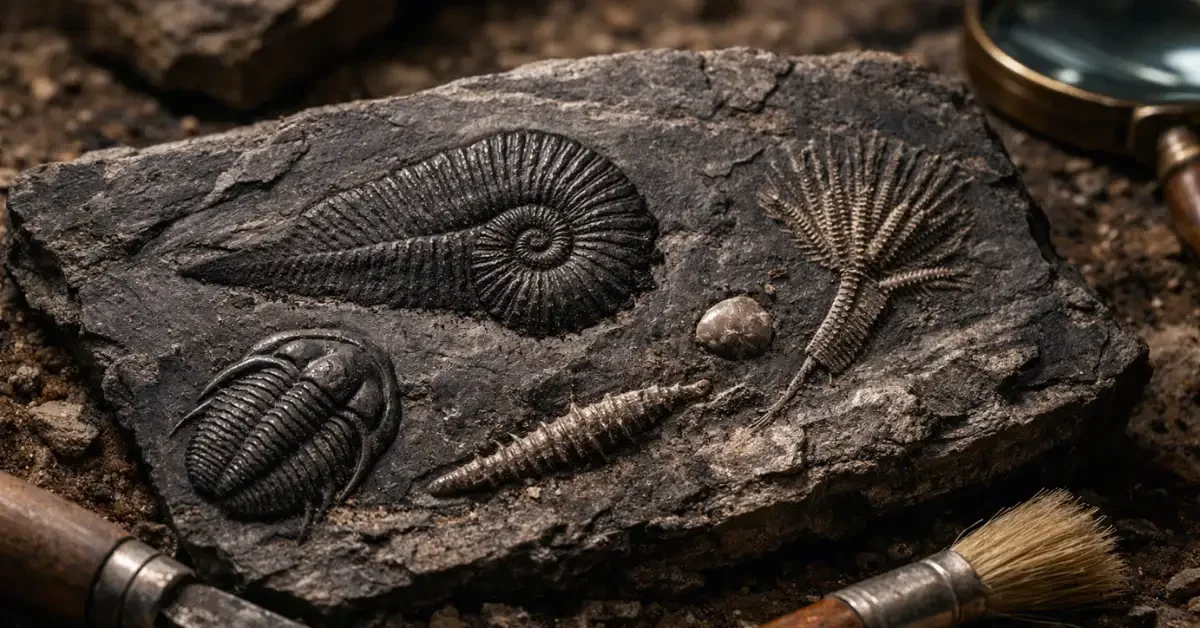
Close-up of a dark ancient marine fossil embedded in rock, representing the Jiangchuan Biota discovery in China.

Paleontologists have uncovered an extraordinary collection of over 700 ancient fossils in southwestern China, significantly altering the known timeline of complex life by millions of years. The groundbreaking discovery reveals that intricate, three-dimensional animals were already thriving at the end of the Ediacaran period. This shifts the scientific consensus, proving that advanced marine ecosystems existed well before the famous evolutionary event known as the Cambrian explosion.

Contents
A Groundbreaking Discovery in Yunnan ProvinceRewriting the Evolution of Marine EcosystemsBridging the Gap Between Two ErasClues to the Origins of Vertebrates

A Groundbreaking Discovery in Yunnan Province

The fossilized remains, collectively referred to as the Jiangchuan Biota, were discovered in China’s Yunnan province. Researchers from Oxford University’s Museum of Natural History and Department of Earth Sciences, alongside colleagues from Yunnan University, detailed their findings in a study published in the journal Science. This massive haul of small, soft-bodied organisms provides scientists with their initial substantial insight into a pivotal moment in Earth’s history. It captures the crucial transition from basic plant life and rudimentary animals to the intricate organisms that eventually gave rise to human beings.

Scientists date the Jiangchuan Biota to the late Ediacaran period, though exact age estimates present a slight disagreement across different sources. While reports from news outlets like Reuters estimate the fossils are between 546 and 539 million years old, releases from Oxford University place their age between 554 and 539 million years old. Regardless of the exact timeframe, the findings prove that significant animal diversification occurred at least 4 million years earlier than previously recorded.

Rewriting the Evolution of Marine Ecosystems

For decades, experts believed that the rapid rise in animal diversity and complexity began around 535 million years ago during the Cambrian explosion. Before this discovery, the late Ediacaran period was largely characterized by simple, peculiar creatures that inhabited the ancient oceans in two dimensions. According to researchers, these early life forms remained largely at the same vertical level on the seafloor.

However, the newly analyzed fossils represent the remnants of more advanced animals capable of living and feeding in three dimensions. These creatures could actively move up and down within the water column. These complex characteristics and behaviors were previously thought to have emerged only during the subsequent Cambrian period, which witnessed a notable increase in identifiable forms of animal life.

The exceptional preservation of the Jiangchuan Biota allowed researchers to identify these advanced traits. The organisms were compressed during fossilization, leaving behind a dark, two-dimensional carbonaceous film. This preservation process successfully captured delicate anatomical features, including digestive systems and specialized structures used for feeding and movement. Many of the resulting fossils appear incredibly strange and would be difficult for untrained observers to recognize as animals.

Bridging the Gap Between Two Eras

The fossil site offers a unique snapshot of a major ecological transition. It features a diverse community that includes entirely new, undescribed animal forms alongside groups traditionally associated with the Cambrian period. Associate Professor Luke Parry of Oxford University’s Department of Earth Sciences noted that when the team first saw the specimens, it was clear the discovery was totally unique and unexpected. Parry described the find as a transitional community where the weird world of the Ediacaran gave way to the Cambrian, a period when animals became easier to place in modern groups.

According to the research team, this discovery effectively closes a major gap in the earliest phases of animal diversification. Lead author Dr. Gaorong Li explained that the presence of complex animals in the Ediacaran period proves they evolved much earlier than fossil evidence previously demonstrated.

Clues to the Origins of Vertebrates

Among the unearthed specimens are early members of lineages that eventually gave rise to modern animal groups, including vertebrates. The researchers successfully identified distant relatives of starfish and sea cucumbers, a biological group known as ambulacrarians. Dr. Frankie Dunn of Oxford University’s Museum of Natural History emphasized the excitement surrounding this specific find and noted that the team is looking for more.

Finding ambulacrarians in the Jiangchuan Biota carries massive implications for the broader evolutionary tree. According to Dr. Dunn, the discovery of these fossils means that chordates—animals with a backbone—must have also existed during this ancient timeframe. By pushing back the timeline of complex life for these foundational species, scientists are gaining a clearer, more accurate picture of how early organisms set the stage for the diverse biological networks that dominate the planet today.

TAGGED: animal evolution, Cambrian explosion, Chinese fossils, Ediacaran Period, Jiangchuan Biota, marine ecosystems, Paleontology, Yunnan province
Share This Article
Facebook Twitter Whatsapp Whatsapp Telegram Copy Link
By Nisha Pradhan
I am a passionate content creator with a deep love for travel, music, and food. Using my unique blend of these interests, I genuinely enjoy crafting high-quality travel, lifestyle, and entertainment-related news content.
Leave a comment

Leave a Reply Cancel reply

Your email address will not be published. Required fields are marked *


Most Read

Alia Bhatt becomes latest victim of Deepfake Videos, Obscene Video goes Viral

November 28, 2023

OpenAI Workforce Expansion: Staff to Double by 2026

March 22, 2026

Applied Materials forecast boosts shares on AI demand

February 15, 2026

Nvidia halts H200 production for China, shifts to Vera Rubin

March 5, 2026

Chrome Auto Browse arrives with Gemini AI in Google Chrome

January 30, 2026

Scientists Discover “Impossible” New Critical Point in Water

March 30, 2026

Related News

A brightly glowing interstellar comet venting streams of gas and dust as it travels through the dark vacuum of deep space.
News

Interstellar Comet 3I/ATLAS Reveals Strange Chemistry

Nisha Pradhan Nisha Pradhan April 19, 2026
A futuristic digital interface showing secure interconnected nodes in a modern corporate office, representing enterprise AI agents and secure governance.
News

Enterprise AI Agents Reshape Workflows Amid Security Push

Sameer Katoch Sameer Katoch April 19, 2026
A silver driverless Tesla Model Y driving down a sunlit suburban neighborhood street.
News

Tesla Robotaxi Service Expands to Dallas and Houston

Rakesh Paul Rakesh Paul April 19, 2026

About Us

VellaTimesVellaTimesVellaTimes

VellaTimes is a leading news portal that covers the latest trending news in technology, lifestyle, entertainment, automobiles, travel, and sports.

Explore

  • News
  • Technology
  • AI
  • Science
  • World

Useful Links

  • About Us
  • Contact Us
  • Fact Checking Policy
  • Terms & Conditions
  • Privacy Policy
  • Copyright Policy

Subscribe Us

Subscribe to our newsletter for the Latest News and Top Stories!

© 2022 VellaTimes • All Rights Reserved.
  • Home
  • Web Stories
  • Bookmarks
  • Interests
  • Disclaimer
  • Sitemap
adbanner
AdBlocker Detected
Our site is an advertising supported site. Please whitelist us to support our work.
Okay, I'll Whitelist