

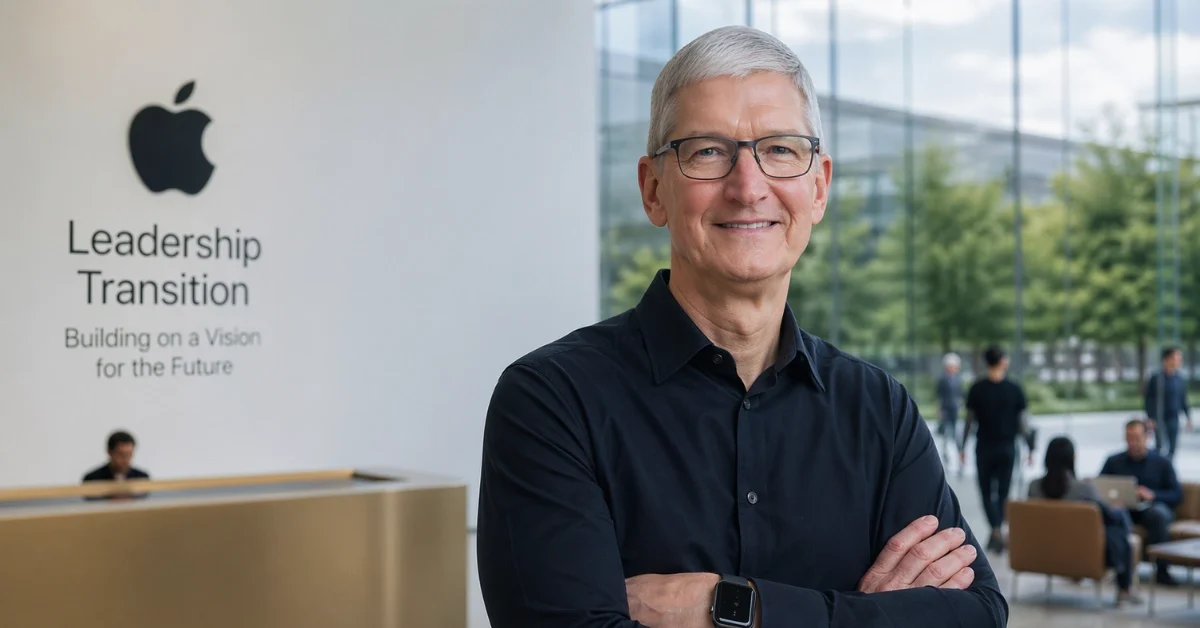
Apple’s decision to hand the CEO role to John Ternus marks a major leadership change as the company faces growing pressure to sharpen its artificial intelligence strategy and prove it can still set the pace in consumer technology. Tim Cook is stepping aside after a long run at the top, and the transition comes at a moment when Apple is being pushed to respond to stronger AI competition and investor questions about what comes next.
Ternus is moving into the top job as a longtime hardware executive, a choice that signals Apple’s continued belief in product design and devices even as the wider tech industry shifts deeper into the AI era. Reports from Reuters and Business Insider both frame the change around the same core issue: Apple now needs leadership that can protect its strengths in hardware and integration while also moving faster in artificial intelligence.
Leadership Transition
Reuters reported that Apple selected hardware veteran John Ternus to succeed Cook as CEO, a move that places a product-focused executive in charge during a period of rapid change in the industry. Business Insider also described Ternus as a “product guy” from Apple’s hardware engineering side rather than the operations background that defined Cook’s rise.
That distinction matters because Apple is entering a new phase in which investors and analysts are watching for more than steady execution. Business Insider said Ternus is inheriting pressure to fix Apple’s AI position, keep talent in place, and show the company can still launch the next big product.
Cook’s tenure set a high bar. Business Insider noted that Apple’s stock climbed nearly 2,000% during his time as CEO, which means Ternus will be measured not only against competitors but also against one of the company’s most successful eras.
AI Challenge Grows
The biggest question surrounding Apple’s next chapter is how it will compete in AI without giving up the tight control that has long defined the company. Reuters said Apple’s control-focused ecosystem, once a major strength, may now act as a constraint in the AI era because AI development often rewards openness, speed, and broader collaboration.
Reuters also said Ternus will need to balance AI openness with Apple’s tradition of tight integration across hardware and software. That challenge goes to the heart of Apple’s identity: the company has built its brand around seamless products and a closely managed ecosystem, but the AI market is moving quickly and often in ways that do not fit that model.
Business Insider described Apple as being under pressure to prove it can still innovate and stay competitive in AI. The report said the past two years have brought hurdles for the company, and that Ternus will be expected to help right what it called Apple’s AI ship.
Why Hardware Still Matters
Even with AI at the center of the discussion, Apple’s board appears to be betting that hardware remains the company’s strongest foundation. Reuters identified Ternus as a hardware veteran, and Business Insider said his appointment points to a leader shaped by product development rather than operations.
That choice suggests Apple may believe its edge still comes from building devices, chips, and software as one system instead of chasing AI in the same way as rivals. Reuters’ analysis said Apple’s core strengths include tight integration, which means Ternus may try to push AI forward without abandoning the company’s product-first approach.
At the same time, that strategy carries risk. If Apple moves too slowly, rivals that are already building faster and more open AI systems could widen the gap before Apple’s own approach fully takes shape. Reuters and Business Insider both point to this tension as one of the defining tests of the post-Cook era.
Pressure From Investors
The leadership change is also being viewed through the lens of investor expectations. Business Insider reported that analysts see Apple needing a bolder vision as it moves beyond reliance on the iPhone and deeper into AI-driven computing.
That means Ternus is taking over at a time when stability alone may not be enough. He will be expected to defend Apple’s premium position, guide its next round of products, and show that a company known for disciplined execution can also move decisively in one of the fastest-changing periods the tech industry has seen in years.
The transition does not erase Apple’s strengths, but it does change the questions around the company. Under Ternus, the focus is likely to center on whether Apple can turn its hardware expertise and tightly connected ecosystem into an AI strategy strong enough to keep pace with a new generation of competition.
