

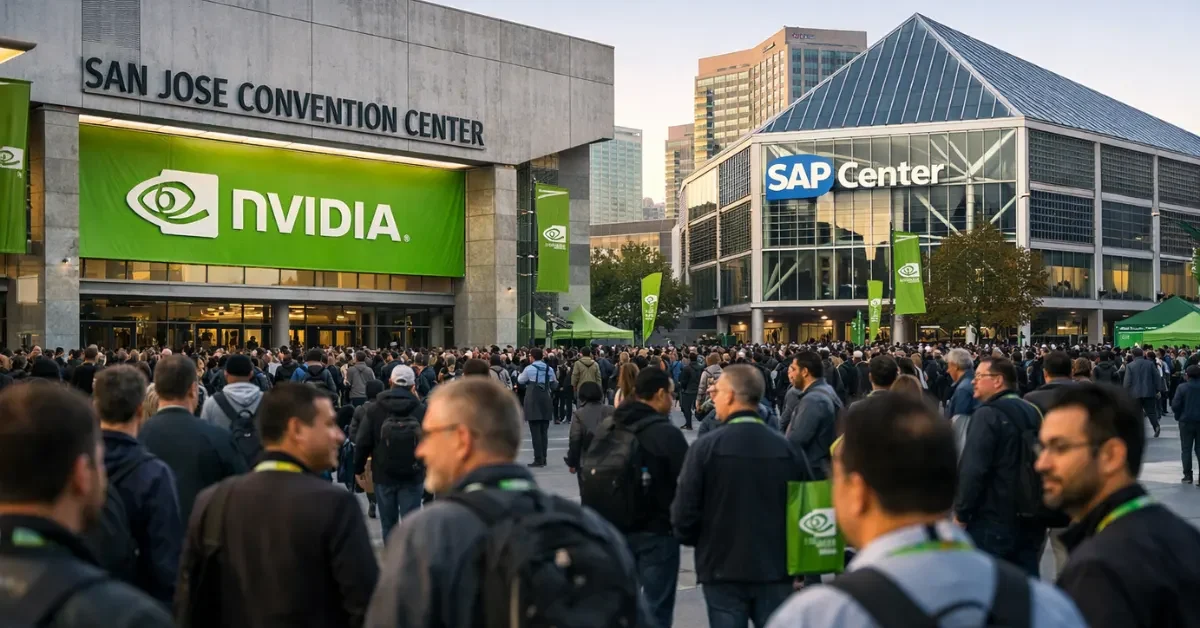
Nvidia GTC 2026 opened in San Jose with technical workshops on multimodal AI agents, robotics workflows, and accelerated networking as the company builds toward CEO Jensen Huang’s keynote at the SAP Center on Monday at 11 a.m. PT. Nvidia says the event is drawing about 30,000 attendees from 190 countries across 10 venues in downtown San Jose, underscoring how central the conference has become to the fast-moving AI market.
The conference agenda puts Nvidia GTC 2026 at the center of several of the industry’s biggest themes, including AI infrastructure, physical AI, agentic AI, inference, and open models. TechCrunch described GTC as Nvidia’s flagship annual developer conference, a stage the company often uses to introduce products, highlight partnerships, and outline its view of the future of computing and AI.
Keynote sets the tone
The Monday keynote is expected to be the main event of the opening day, and Nvidia says it will cover the full stack, including chips, software, models, and applications. The company also said the keynote will stream for free on its website, allowing viewers to watch remotely as Huang lays out Nvidia’s next moves.
Before Huang speaks, Nvidia plans an 8 a.m. PT preshow featuring investors, founders, and executives discussing accelerated computing, AI infrastructure, open models, agentic AI, and physical AI. Nvidia listed speakers and participants from companies including Palantir, Cadence, IBM, Morgan Stanley, Caterpillar, Dell, CoreWeave, Cohere, Perplexity, Mistral AI, LangChain, Waabi, and others for those sessions.
What the event covers
Beyond the keynote, Nvidia says GTC 2026 includes more than 700 sessions, over 70 hands-on training labs, 150 researcher posters, and onsite certification exams at no extra cost. The company also highlighted additional sessions later in the week, including a discussion on AI in climate and energy research and another on music and AI.
The official agenda shows Nvidia trying to connect its hardware business with the broader software and application layers that drive enterprise AI adoption. That matches TechCrunch’s view that the conference is not just about chips, but also about how Nvidia wants to shape AI use across industries such as healthcare, robotics, and autonomous vehicles.
Industry watches for announcements
Some of the strongest interest around Nvidia GTC 2026 is tied to what Nvidia may announce as competition rises across the AI market. TechCrunch reported rumors that Nvidia could introduce an open source platform for enterprise AI agents called NemoClaw and could also unveil a new chip aimed at accelerating AI inference, though those details had not been confirmed in the article.
TechCrunch also said Nvidia already commands an estimated 80% share of the AI training market, while competition in inference is growing from custom chips developed by companies such as Google and Amazon. TechBuzz similarly framed the event as an important test for Nvidia as it works to protect its strong position in AI accelerators while facing fresh pressure from rivals and supply chain challenges.
That competitive backdrop helps explain why this year’s conference is drawing such close attention from investors, developers, and enterprise buyers. TechBuzz said the industry is watching for signs related to next-generation architecture, enterprise AI tools, and possible expansion in areas such as automotive or robotics.
Schedule details differ
The clearest event details come from Nvidia’s own conference blog, which says GTC runs from March 16 to March 19 in San Jose, California. TechCrunch described the gathering as a broader three-day event next week centered on the Monday keynote.
Another source, TechBuzz, said GTC 2026 had already kicked off earlier in San Jose and described rolling announcements through March 20. Because the published timelines are not fully aligned, the safest reading is that the keynote anchors the biggest public moment of the week while coverage and related activities extend around it.
For Nvidia, that makes GTC 2026 more than a developer conference. It is a showcase for how the company wants to lead the next phase of AI, from infrastructure and inference to software tools, research, and real-world deployment.
