

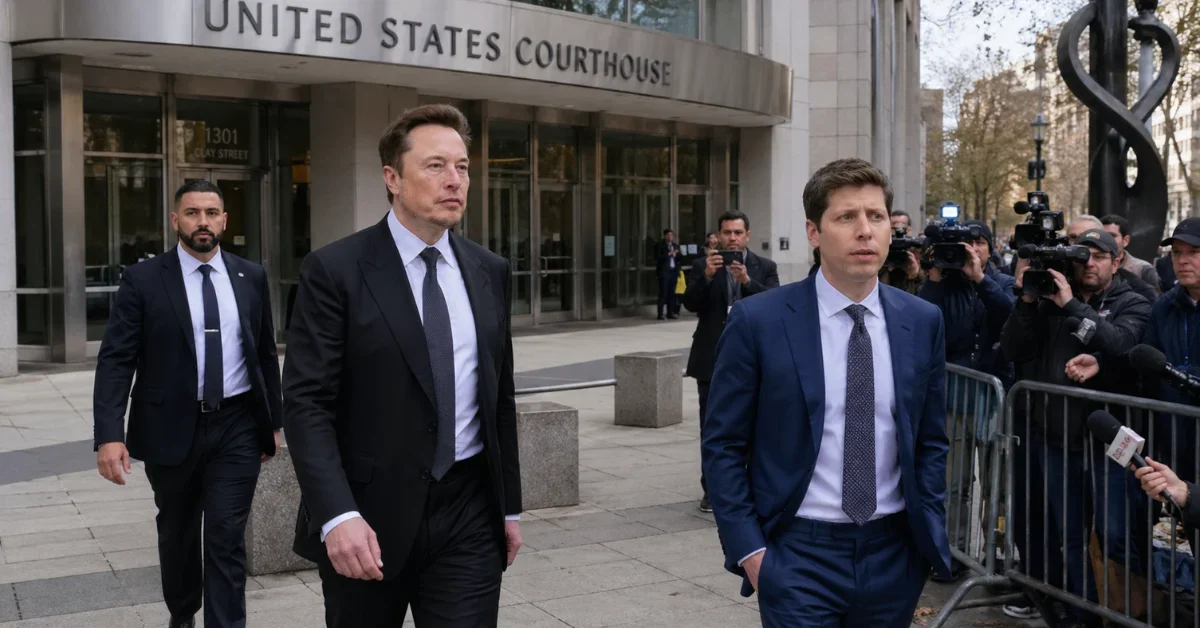
Opening statements began Tuesday in a federal courtroom in Oakland, California, where Elon Musk and OpenAI chief executive Sam Altman faced off over whether the company abandoned its original nonprofit mission. The OpenAI trial centers on Musk’s claim that the ChatGPT maker shifted from a mission to benefit humanity to a profit-driven business. Several reports said the case could have major consequences for the artificial intelligence industry and for OpenAI’s future business structure.
The courtroom fight also highlights the deep personal and business split between Musk and Altman. Musk once helped to back OpenAI and now competes with it through his xAI lab, whose Grok chatbot rivals ChatGPT. Musk argues that he was misled about OpenAI’s purpose when he supported the organization in its early years. OpenAI, meanwhile, says Musk’s lawsuit is driven by ego, jealousy, and a desire to slow a competitor after failing to gain control of the company.
What Musk is asking for
Musk’s lawsuit seeks to force OpenAI back to a nonprofit model and remove Altman and OpenAI president Greg Brockman from leadership roles. Reuters reported that Musk is seeking $150 billion in damages, with any proceeds going to OpenAI’s charitable arm. Other reports, including AFP-based coverage, said Musk had sought as much as $134 billion but later gave up any personal claim and pledged that any award would go to OpenAI’s nonprofit. Microsoft, one of OpenAI’s biggest investors and also a defendant in the case, has denied colluding with OpenAI and says its partnership began only after Musk left.
Musk has said he provided about $38 million in seed funding to OpenAI. He claims Altman and Brockman betrayed both him and the public by turning the organization into what Reuters described as a “wealth machine” for themselves and investors. In opening arguments reported by Le Monde, Musk’s lawyer Steven Molo told the court that the defendants had “stolen a charity.” OpenAI’s lead lawyer, William Savitt, said the nonprofit remains in control of the organization and that Altman and Brockman are confident the facts will support their position.
Early courtroom tension
Tension surfaced even before jurors were seated. OpenAI’s lawyers raised concerns about Musk’s posts on X, including one in which he called Altman “Scam Altman.” U.S. District Judge Yvonne Gonzalez Rogers said she did not want to issue a gag order, but urged Musk to control his use of social media during the trial. Reuters reported that Musk agreed to minimize his social media activity, and Altman agreed to do the same.
The judge is expected to play the central role in the outcome. Multiple reports said Gonzalez Rogers will be guided by an advisory jury’s findings and plans to decide key issues by late May. Reuters also said she wants jurors to begin deliberating on liability by May 12, after which any remedies would be argued before the judge. Musk, Altman, and Microsoft chief executive Satya Nadella are among the witnesses expected to testify.
How the dispute grew
Court filings described in several reports say Altman persuaded Musk in 2015 to help launch OpenAI as a nonprofit lab whose technology “would belong to the world.” Musk later left, and OpenAI created a commercial subsidiary in 2019 as the costs of developing advanced AI rose sharply. OpenAI and its supporters argue that outside investment became necessary because building AI systems required enormous spending on computing power and data centers. Reuters reported that OpenAI later reworked its structure again into a public benefit corporation in which the nonprofit and investors, including Microsoft, hold stakes. AFP-based reports described the current setup as a hybrid structure that still gives the nonprofit foundation control over the for-profit arm.
Why the case matters
The trial reaches beyond a feud between two Silicon Valley figures. Several reports said it raises a broader question about whether artificial intelligence should serve society as a whole or mainly enrich a small group of executives and investors. Reuters said the case could complicate OpenAI’s plans for a potential initial public offering by putting its leadership and corporate structure under fresh scrutiny. With OpenAI valued at more than $850 billion in one Reuters account and described by Le Monde as an AI superpower preparing for a major IPO, the outcome now carries weight far beyond one courtroom in Oakland.
