

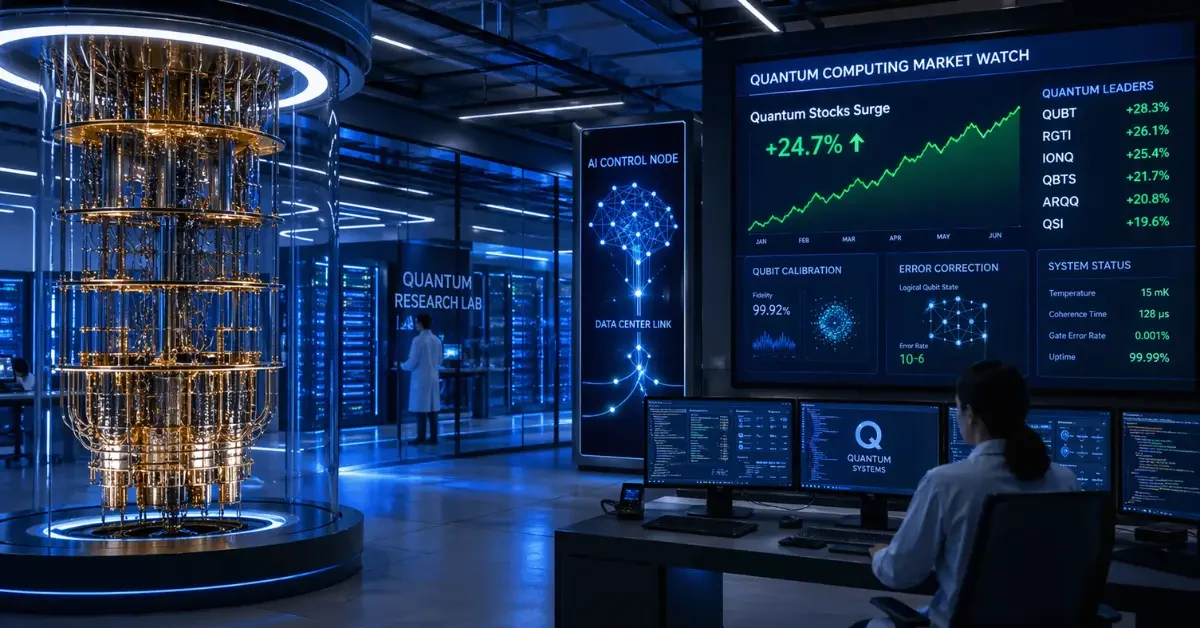
NVIDIA’s new Ising AI models put quantum computing back in the market spotlight on Tuesday, helping lift several quantum stocks after the company unveiled an open-source model family built for the sector. The launch tied together two fast-moving themes for investors and tech companies alike: artificial intelligence and the race to make quantum computing useful in real-world settings.
The Ising family is aimed at two major quantum computing bottlenecks, calibration and decoding, which sit between today’s hardware and fault-tolerant computing. NVIDIA said the models are meant to help researchers and enterprises build more reliable quantum systems that can support practical applications. That focus on reliability matters because qubits are highly sensitive and error-prone, which has limited the broader deployment of quantum machines.
What Nvidia Launched
NVIDIA said Ising is a family of open-source AI models for quantum processor calibration and real-time error-correction decoding. The company also said the models work with its CUDA-Q quantum software platform and its NVQLink QPU-GPU interconnect, and that they have been released on GitHub, Hugging Face, and build.nvidia.com.
The company described calibration as the manual process of tuning a quantum processing unit so its qubits behave consistently. It described decoding as the step that turns redundant measurements from an error-corrected logical qubit into a correction signal fast enough to keep up as new errors appear on the processor. In simpler terms, Nvidia is using AI to automate and speed up work that has slowed the path toward more dependable quantum systems.
NVIDIA’s Ising Calibration model is designed to automate quantum processor tuning and reduce that process from days to hours. The Ising Decoding family includes two versions of a 3D convolutional neural network, with 0.9 million and 1.8 million parameters, tuned for speed and accuracy. NVIDIA said its decoder was benchmarked at 2.5 times faster and three times more accurate than pyMatching, while using ten times less training data.
Why Stocks Jumped
Investors reacted quickly to the announcement. Business Insider reported that Xanadu Quantum Technologies rose 28%, while IonQ and D-Wave Quantum each climbed 13%, and Rigetti Computing gained 9% during Tuesday’s session. The move made quantum companies some of the market’s top gainers that day.
Part of the excitement came from the idea that Nvidia’s entry gives more weight to the broader quantum computing story. Bernstein analysts told clients that quantum processor units are likely to become the next important co-processor in data centers, working alongside CPUs and GPUs. They said CPUs will remain central for general-purpose computing, GPUs will continue to lead highly parallel AI workloads, and QPUs could become important for problems that are too complex or costly for classical processors to solve efficiently.
That said, the investment case remains early and speculative. Real-world applications are still some time away, even as interest grows from tech giants and governments. The market reaction showed optimism, but it did not change the fact that the industry is still working through basic reliability challenges.
Nvidia’s Strategy
NVIDIA is taking a different route from companies building quantum hardware directly. The company is focusing on the AI layer that can make quantum systems usable, rather than trying to build quantum hardware itself. While Ising is open-source, the broader stack around it is not, and the deployment tooling is built around Nvidia hardware.
That approach fits Nvidia’s wider push into full-stack AI infrastructure across multiple industries. The company has followed a similar pattern with other model families by opening the models while keeping the surrounding platform proprietary. In practice, that lets Nvidia deepen its role in quantum computing without manufacturing the quantum machines themselves.
Nvidia CEO Jensen Huang framed the move in direct terms, saying, “AI is essential to making quantum computing practical.” He added that with Ising, AI becomes “the control plane — the operating system of quantum machines — transforming fragile qubits to scalable and reliable quantum-GPU systems.”
Broader Quantum Trend
The launch also lands at a time when researchers and industry groups are making bigger claims about how AI and quantum computing may reinforce each other. A recent study highlighted by The Quantum Insider said small quantum computers could handle massive datasets more efficiently than exponentially larger classical systems by cutting memory requirements for key tasks such as classification, dimension reduction, and linear system solving. The report also said the findings were based on simulations and theoretical proofs, with practical impact still dependent on future hardware advances, error correction, and real-world validation.
At the same time, the AI Summit said the convergence of AGI and quantum computing is reshaping cybersecurity and forcing organizations to think more seriously about digital risk, governance, and long-term planning. It said advanced AI models are already being explored for simulating, managing, and securing quantum-era infrastructure, while quantum computing could also speed up AI development and deployment. Against that backdrop, Nvidia’s Ising release looks less like a one-off product update and more like part of a wider push to use AI as the software layer that helps quantum computing mature.
