

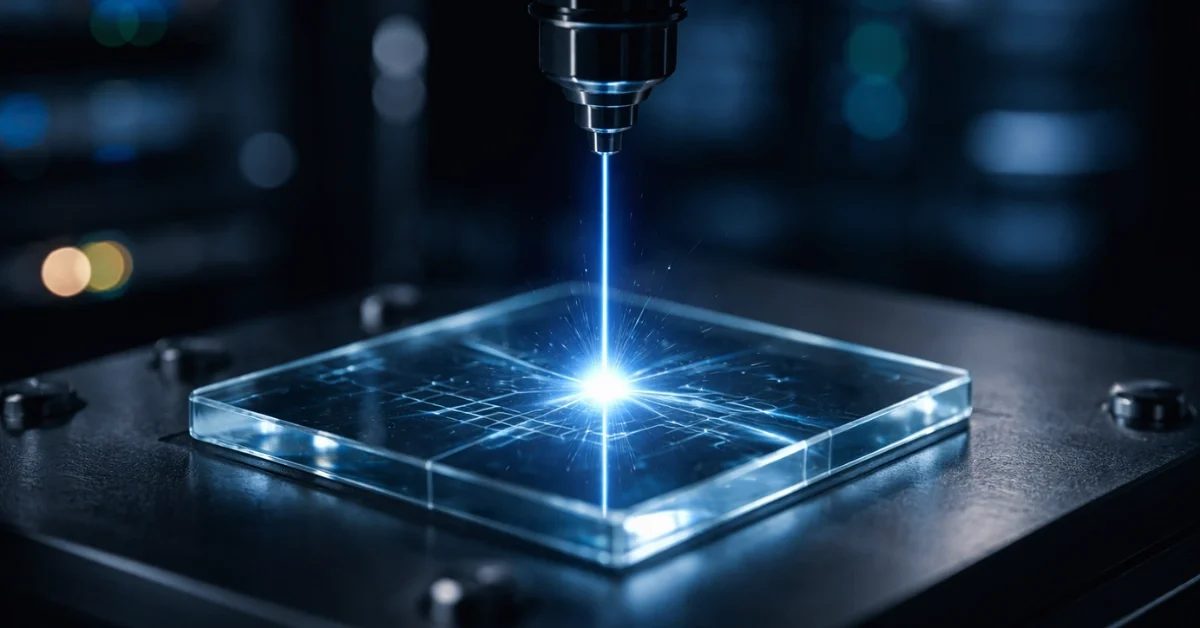
Microsoft researchers have achieved a significant milestone in archival technology by successfully storing digital data on ordinary borosilicate glass—the same durable material used in kitchen cookware and oven doors. The breakthrough, detailed in a new study published in the journal Nature, moves the company’s “Project Silica” closer to a commercial reality where vital information could be preserved safely for more than 10,000 years.
This development addresses a critical problem facing the digital world: the fragility of modern storage. While hard drives and magnetic tapes typically degrade within five to ten years, necessitating frequent and expensive data migration, Microsoft’s glass-based solution offers a virtually permanent alternative. By shifting from expensive, specialized fused silica to widely available borosilicate glass, the team has removed a major financial barrier to mass adoption.
From Science Fiction to Science Fact
Project Silica relies on femtosecond lasers—ultra-fast beams of light—to etch data into glass. These lasers create tiny three-dimensional deformations known as “voxels” inside the material. Unlike traditional storage methods that write data on the surface of a magnetic platter or tape, this technique buries information safely within the glass structure itself.
The latest research introduces a new writing method called “phase voxels.” While previous iterations used polarization-based writing that required multiple laser pulses, the new technique changes the physical phase of the glass using only a single pulse. This innovation simplifies the writing process and drastically reduces the time needed to encode data.
Richard Black, a partner research manager at Microsoft, emphasized the importance of this efficiency in a statement regarding the study. He noted that the team has unlocked the science for parallel high-speed writing and developed techniques to verify that data remains intact for millennia.
Capacity and Performance
In their demonstration, the researchers successfully encoded 4.8 terabytes of data onto a single piece of glass measuring just 12 square centimeters and 2 millimeters thick. This capacity is roughly equivalent to 2 million printed books or about 200 4K movies. The data was written across 301 distinct layers within the glass.
While the durability is unmatched, the writing speed currently trails behind consumer technology. The system writes data at approximately 3.13 megabytes per second, significantly slower than modern solid-state drives. However, the researchers argue that speed is less critical for archival storage, where the primary goal is longevity and data integrity rather than instant access.
Once written, the data is read using a computer-controlled microscope. The new system utilizes a streamlined reader with a single camera, replacing complex multi-camera setups used in earlier prototypes. A machine learning algorithm then decodes the images back into digital files.
A Solution for “Bit Rot”
The fragility of current digital storage creates a phenomenon known as “bit rot,” where data gradually becomes unreadable as the physical medium decays. Archives and data centers currently spend vast resources copying data to new tapes every few years to prevent loss.
Glass storage offers a sustainable alternative. The material is resistant to electromagnetic pulses, extreme temperatures, boiling water, and surface scratches. Because the data is physically engraved into the glass, it requires no energy to maintain once written, unlike servers that need constant power and cooling.
Melissa Terras, a professor of digital heritage at the University of Edinburgh, described the development as thrilling for the long-term management of digital information. Speaking on the significance of the research, she highlighted the value of an inert medium that requires no special upkeep, though she noted that the economic infrastructure to support such long-term preservation is still developing.
Future Applications
Despite the use of everyday materials, this technology is not intended for home computers. Microsoft envisions Project Silica as a cloud-based solution for Azure data centers. It targets industries with massive archival needs, such as financial institutions, medical organizations, and entertainment studios.
The project has previously demonstrated its potential by storing the classic Warner Bros. film Superman on a piece of glass. With the move to cost-effective borosilicate glass, the team is now focused on refining the technology to make it a practical standard for preserving humanity’s digital heritage for thousands of years.
