
By using this site, you agree to our Privacy Policy and Terms of Use.
Accept
VellaTimesVellaTimesVellaTimes
  • News
    NewsShow More
    Close-up of a silver espresso machine extracting a fresh shot of coffee into a glass cup in a softly lit cafe setting.
    Espresso Extraction Science: The Finer Grind Flaw
    May 18, 2026
    A smartphone resting on a wooden desk displaying an AI-powered Amazon search bar in a modern home office setting.
    Amazon Alexa for Shopping Replaces Rufus AI Assistant
    May 18, 2026
    Wide news-style image showing an OpenAI office scene with screens displaying audio waveforms and voice technology graphics
    OpenAI acquires Weights.gg to boost voice AI tools
    May 18, 2026
    Federal agents standing outside a modern university biology laboratory building at dusk during an active investigation.
    US Arrests Chinese Scientists for Smuggling Biological Materials
    May 18, 2026
    A dramatically lit modern corporate courtroom with futuristic technology elements, representing a high-stakes artificial intelligence legal trial.
    Elon Musk OpenAI Lawsuit Exposes Clashes Over AI Safety
    May 18, 2026
  • Technology
    TechnologyShow More
    Wide news-style image showing an OpenAI office scene with screens displaying audio waveforms and voice technology graphics
    OpenAI acquires Weights.gg to boost voice AI tools
    May 18, 2026
    A polished silicon wafer rests on a surface inside a modern semiconductor manufacturing facility.
    Samsung Strike Threatens Global AI Chip Production
    May 18, 2026
    A glowing computer screen displaying the text GPT-5.5 Instant in a modern, high-tech office environment with soft blue and purple lighting.
    GPT-5.5 Instant: OpenAI’s New Default ChatGPT Model
    May 10, 2026
    Wide view of a modern AI data center with server racks, glowing fiber-optic cables, and semiconductor hardware in the foreground.
    AI Infrastructure Spending Drives Nvidia, AMD Shares
    May 10, 2026
    A glowing computer monitor displaying lines of code and digital network graphics in a modern tech office setting.
    Airbnb AI Coding: 60% of New Software Now Generated by AI
    May 9, 2026
  • AI
    AIShow More
    A smartphone resting on a wooden desk displaying an AI-powered Amazon search bar in a modern home office setting.
    Amazon Alexa for Shopping Replaces Rufus AI Assistant
    May 18, 2026
    A dramatically lit modern corporate courtroom with futuristic technology elements, representing a high-stakes artificial intelligence legal trial.
    Elon Musk OpenAI Lawsuit Exposes Clashes Over AI Safety
    May 18, 2026
    A high-tech global map visualization showing glowing digital connections across different continents, representing the worldwide adoption of artificial intelligence.
    Global AI Adoption in 2026: Trends and Growing Divide
    May 10, 2026
    A modern smartphone displaying an artificial intelligence chat interface used for online shopping and product comparison.
    Alibaba Qwen AI Taobao Integration Launches Agentic Shopping
    May 10, 2026
    A split-screen illustration showing a high-tech modern office using advanced AI tools contrasted against an older, dimly lit workspace.
    Global AI Adoption Surges But Rich-Poor Divide Widens
    May 9, 2026
  • Science
    ScienceShow More
    Close-up of a silver espresso machine extracting a fresh shot of coffee into a glass cup in a softly lit cafe setting.
    Espresso Extraction Science: The Finer Grind Flaw
    May 18, 2026
    Federal agents standing outside a modern university biology laboratory building at dusk during an active investigation.
    US Arrests Chinese Scientists for Smuggling Biological Materials
    May 18, 2026
    Header image of a quantum communication lab setup with fiber-optic equipment, a telecom quantum dot device, and interferometer components used for long-distance quantum key distribution.
    Quantum Key Distribution Reaches 120 km With Quantum Dots
    May 10, 2026
    Abstract geometric representation of glowing quantum paraparticles interacting within a three-dimensional mathematical grid in deep blue and gold tones.
    Quantum Paraparticles Exist: New Math Challenges Physics
    May 10, 2026
    A large expedition cruise ship is navigating rough ocean waters under a cloudy sky.
    Global Authorities Respond to Andes Hantavirus Outbreak on MV Hondius Cruise Ship
    May 9, 2026
  • World
    WorldShow More
    Allu Arjun Commitment to Ethical Brand Partnerships
    Exploring Allu Arjun’s Commitment to Ethical Brand Partnerships
    December 18, 2023
    Orry aka Orhan Awatramani
    Orhan Awatramani ‘Orry’ Biography, Lifestyle and Rise to Fame
    December 8, 2023
    Alia Bhatt Latest Deepake Video Victim
    Alia Bhatt becomes latest victim of Deepfake Videos, Obscene Video goes Viral
    November 28, 2023
    Napoleon Movie Review
    Napoleon Movie Review: A Historical Epic by Ridley Scott Reviewed
    November 25, 2023
  • Bookmarks
Search
Category
  • News
  • Technology
  • AI
  • Science
  • World
Company
  • About Us
  • Contact Us
  • Fact Checking Policy
  • Terms & Conditions
  • Privacy Policy
  • Copyright Policy
Resources
  • Home
  • Web Stories
  • Bookmarks
  • Interests
  • Disclaimer
  • Sitemap
© 2022 VellaTimes • All Rights Reserved.
Reading: Kamikaze Bacteria: How Exploding Cells Spread Resistance
Share
Notification Show More
Font ResizerAa
VellaTimesVellaTimes
Font ResizerAa
  • News
  • Technology
  • AI
  • Science
  • World
Search
  • Explore
    • News
    • Technology
    • AI
    • Science
    • World
  • Useful Links
    • About Us
    • Contact Us
    • Fact Checking Policy
    • Terms & Conditions
    • Privacy Policy
    • Copyright Policy
  • Home
  • Web Stories
  • Bookmarks
  • Interests
  • Disclaimer
  • Sitemap
© 2022 VellaTimes • All Rights Reserved.
News

Kamikaze Bacteria: How Exploding Cells Spread Resistance

Nisha Pradhan
Last updated: 18/04/2026
Nisha Pradhan
Share
7 Min Read
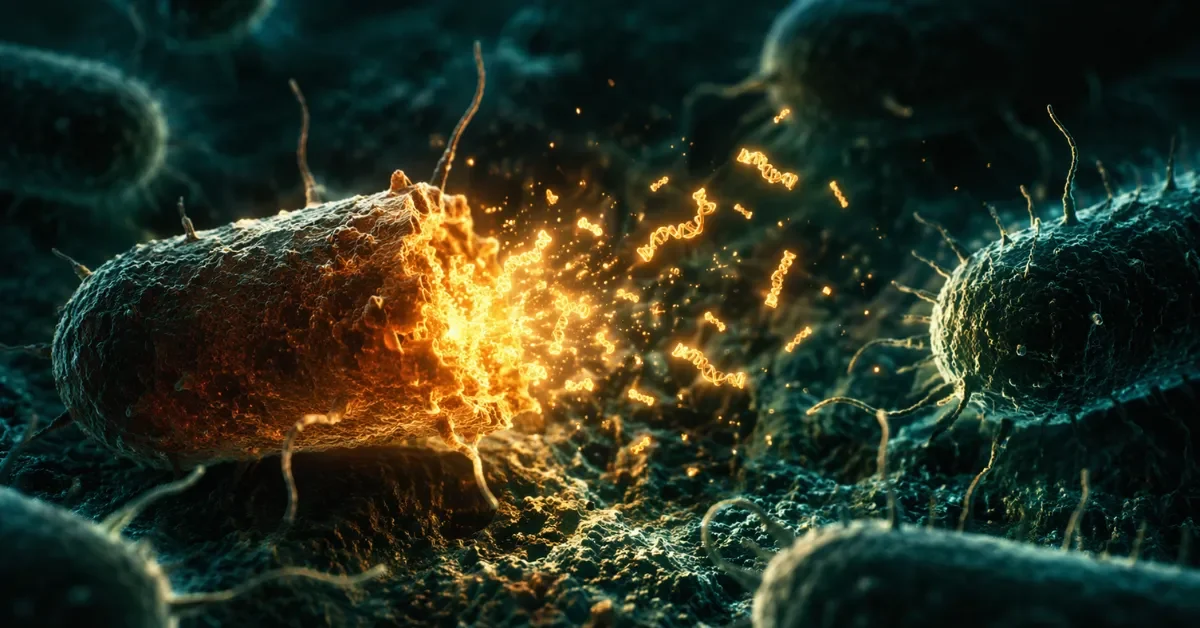
A microscopic view of a glowing bacterium rupturing and releasing tiny genetic particles to surrounding cells in a dark environment.

A groundbreaking discovery has revealed that some microorganisms are acting as kamikaze bacteria, intentionally destroying themselves to help their colonies survive. Researchers have found that these microscopic cells rupture and release genetic material, which often includes genes that make them resistant to modern medications. This self-destructive behavior actively accelerates one of the most pressing threats in modern medicine: the rapid spread of antibiotic resistance.

The new findings, published in the journal Nature Microbiology on April 16, come from a team of scientists at the John Innes Centre in the United Kingdom. Working alongside researchers from the University of York and the Rowland Institute at Harvard, the group identified a highly sophisticated mechanism that allows bacteria to intentionally explode. By sacrificing themselves, these single-celled organisms disperse tiny, DNA-packed delivery vehicles to surrounding cells.

Ancient Viruses Turned Genetic Couriers

When these bacteria collapse, they release structures known as gene transfer agents (GTAs). These tiny particles look and act very much like bacteriophages, which are viruses that naturally infect bacteria. However, these particular structures are no longer dangerous invaders. Over the course of evolutionary history, the bacteria managed to domesticate these ancient viral remnants and bring them entirely under their own control.

Instead of harming the host cell like a typical virus would, these gene transfer agents have been completely repurposed. The bacteria now use them as highly effective genetic messengers. Before the cell ruptures, these particles scoop up fragments of the dying bacterium’s DNA. Once released into the surrounding environment, they deliver this genetic cargo to neighboring bacteria.

This remarkable evolutionary twist allows beneficial traits to spread rapidly through a microbial population. If the exploding cell carried genes that confer resistance to certain drugs, those survival traits can be instantly shared with nearby bacteria, even if they are not directly related.

The LypABC Control Switch

For years, scientists did not fully understand how these gene transfer agents escaped from their host cells. The research team solved this mystery by using a deep sequencing screening method on a model bacterium known as Caulobacter crescentus. They discovered a specific cluster of three genes, named LypABC, which serves as a central control hub for the self-destruction process.

This three-gene system acts as a precise molecular switch that dictates exactly when the cell will undergo lysis, the technical term for breaking open. The researchers found that when the LypABC genes were removed from the bacteria, the cells were completely unable to rupture and release their genetic couriers. Conversely, when the system was overactivated, a massive number of cells underwent the fatal explosion process.

Interestingly, the LypABC system bears a striking structural resemblance to a bacterial immune system normally used to fight off viral infections. Dr. Emma Banks, the lead author of the study, noted the unique nature of this discovery. “What’s particularly interesting is that LypABC looks like an immune system, yet bacteria are using it to release GTA particles,” she said. “It suggests that immune systems can be repurposed to help bacteria share DNA — a process that can contribute to the spread of antibiotic resistance.”

The researchers also identified a separate regulatory protein that keeps this extreme activity under strict control. This regulation is essential for the survival of the bacterial colony. An uncontrolled or highly active LypABC system would become completely toxic and wipe out too many cells at once.

The Threat of Horizontal Gene Transfer

The discovery sheds new light on horizontal gene transfer, a process that allows bacteria to swap genetic material directly with one another rather than waiting for traits to pass down through reproduction. Horizontal gene transfer typically happens through three main avenues: transformation, which is the direct absorption of DNA fragments from the surrounding environment; conjugation, which involves the transfer of material through physical contact between two cells; and transduction, which relies on virus-mediated transport.

These self-sacrificing bacteria make this third method incredibly efficient. By deliberately destroying themselves, they maximize the amount of gene transfer agents released into their surroundings, increasing the likelihood that other cells will absorb the resistance genes.

This silent engine of genetic exchange has massive implications for global public health. The World Health Organization and the medical journal The Lancet currently classify antimicrobial resistance as a top-tier threat to humanity. According to their estimates, infections driven by antibiotic-resistant bacteria are directly responsible for more than 1.2 million deaths around the world every single year.

By understanding the exact molecular triggers behind this self-destructive behavior, the medical community may find new ways to fight back against drug-resistant superbugs. If scientists can figure out how the LypABC system is naturally activated and find a way to block this molecular switch, it could significantly slow down the speed at which resistant bacteria share their most dangerous traits. The next phase of research will focus on identifying the specific environmental signals that trigger this kamikaze behavior, paving the way for targeted treatments in the future.

TAGGED: Antibiotic Resistance, Gene Transfer Agents, Horizontal Gene Transfer, John Innes Centre, Kamikaze Bacteria, Nature Microbiology, Superbugs
Share This Article
Facebook Twitter Whatsapp Whatsapp Telegram Copy Link
By Nisha Pradhan
I am a passionate content creator with a deep love for travel, music, and food. Using my unique blend of these interests, I genuinely enjoy crafting high-quality travel, lifestyle, and entertainment-related news content.
Leave a comment

Leave a Reply Cancel reply

Your email address will not be published. Required fields are marked *


Most Read

Poco M8 5G price in India: sale starts Jan 13

January 14, 2026

OpenAI Acquires Tech Show TBPN to Boost Media Strategy

April 4, 2026

Grok market share rises in US amid sexualized image backlash

February 15, 2026

Fish oil supplements may backfire without ALOX15

February 14, 2026

Orhan Awatramani ‘Orry’ Biography, Lifestyle and Rise to Fame

December 8, 2023

Zorevunersen Dramatically Reduces Dravet Syndrome Seizures

March 6, 2026

Related News

Close-up of a silver espresso machine extracting a fresh shot of coffee into a glass cup in a softly lit cafe setting.
News

Espresso Extraction Science: The Finer Grind Flaw

Nisha Pradhan Nisha Pradhan May 18, 2026
A smartphone resting on a wooden desk displaying an AI-powered Amazon search bar in a modern home office setting.
News

Amazon Alexa for Shopping Replaces Rufus AI Assistant

Sameer Katoch Sameer Katoch May 18, 2026
Wide news-style image showing an OpenAI office scene with screens displaying audio waveforms and voice technology graphics
News

OpenAI acquires Weights.gg to boost voice AI tools

Rakesh Paul Rakesh Paul May 18, 2026

About Us

VellaTimesVellaTimesVellaTimes

VellaTimes is a leading news portal that covers the latest trending news in technology, lifestyle, entertainment, automobiles, travel, and sports.

Explore

  • News
  • Technology
  • AI
  • Science
  • World

Useful Links

  • About Us
  • Contact Us
  • Fact Checking Policy
  • Terms & Conditions
  • Privacy Policy
  • Copyright Policy

Subscribe Us

Subscribe to our newsletter for the Latest News and Top Stories!

© 2022 VellaTimes • All Rights Reserved.
  • Home
  • Web Stories
  • Bookmarks
  • Interests
  • Disclaimer
  • Sitemap
adbanner
AdBlocker Detected
Our site is an advertising supported site. Please whitelist us to support our work.
Okay, I'll Whitelist