

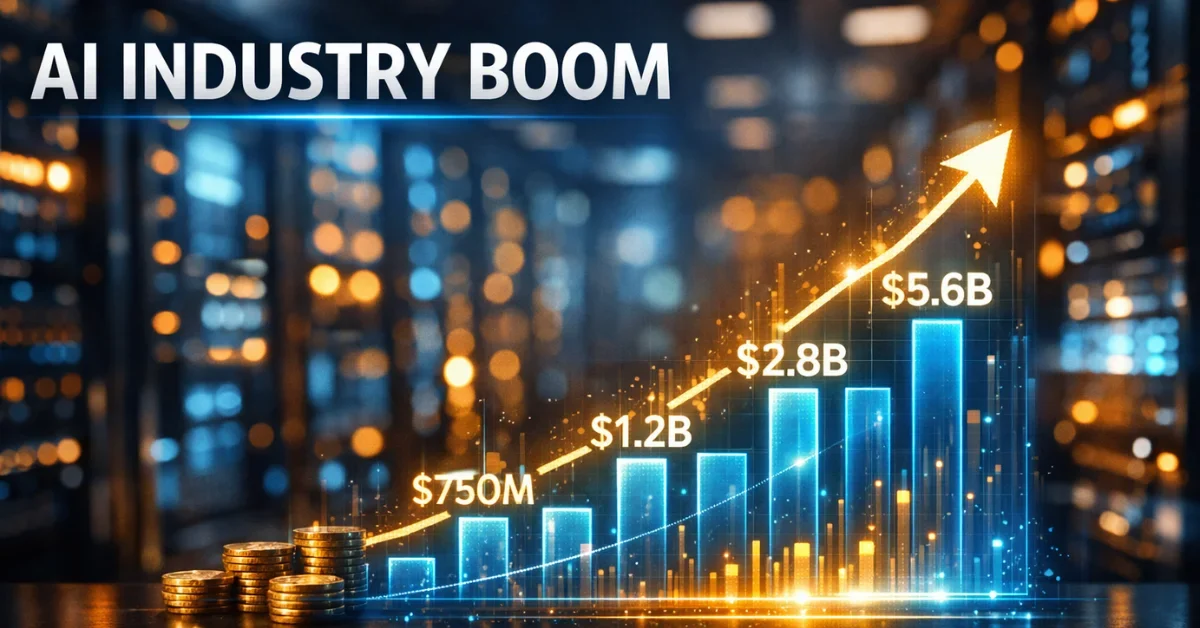
OpenAI has successfully closed a historic $122 billion funding round, catapulting its post-money valuation to $852 billion and intensifying the global AI funding race. The massive investment is earmarked for scaling the company’s computing infrastructure and expanding access to artificial intelligence tools for individuals, developers, and businesses.
While OpenAI expands its market dominance with 900 million weekly active users on ChatGPT and approximately $2 billion in monthly revenue, the company faces mounting challenges. Chief Executive Officer Sam Altman is now under significant pressure to justify the record valuation and deliver sustained growth amid escalating competition from deep-pocketed rivals like Google DeepMind and rapidly growing challengers such as Anthropic. The AI funding race is shifting from simply acquiring computing power to optimizing operational efficiency, defining the next phase of the industry.
The Financial Stakes of the AI Infrastructure Race
The latest funding round brings together major technology partners and global investors, reflecting the immense capital required to build modern infrastructure. The investment was co-led by SoftBank, alongside substantial commitments from Amazon, Nvidia, and Microsoft. Notably, Amazon committed $50 billion, while Nvidia and SoftBank each contributed $30 billion. For the first time, OpenAI also raised over $3 billion from individual investors through banking channels.
The capital will accelerate OpenAI’s expansion across cloud platforms, global data center capacity, and chip partnerships with companies like AMD and Broadcom. OpenAI has recently transferred some of its computing capacity to partner Microsoft, a move that signals a shift from single-point expansion to a more diversified deployment strategy.
Despite reaching $1 billion in quarterly revenue by the end of 2024 and maintaining a dominant consumer position, OpenAI remains unprofitable. Forecasts suggest the company could see losses of up to $14 billion in 2026 as it prepares for an initial public offering and experiments with advertising to build a viable revenue model.
In contrast, Google DeepMind continues to leverage the financial strength of its parent company. According to a recent biography of DeepMind Chief Executive Officer Demis Hassabis by Sebastian Mallaby, the laboratory’s acquisition by Google provided it with a crucial advantage: the freedom to conduct innovative research without the immediate pressure to monetize. Google utilizes the least amount of debt for its expansion among major tech firms, allowing it to sustainably challenge OpenAI’s market position.
Anthropic Capitalizes on Pentagon Feud and Enterprise Market
As OpenAI secures unprecedented capital, rival firm Anthropic is experiencing explosive growth fueled by a public dispute with the United States military. Between January and February 2026, reports emerged that Anthropic refused to allow the Department of War to use its models for autonomous weapons operations or mass surveillance.
While the Pentagon threatened to label Anthropic a supply chain risk, the firm’s strict boundaries resonated with the public. Consumer transaction data revealed that paid subscriptions for Anthropic’s Claude more than doubled this year, with a sharp increase following a public statement by Chief Executive Officer Dario Amodei in late February. The company also boosted its profile by running highly effective Super Bowl commercials that mocked ChatGPT’s decision to introduce advertising.
Beyond consumer growth, Anthropic is fiercely challenging OpenAI in the corporate sector. Anthropic now commands a 32% share of the enterprise large language model interface market, surpassing OpenAI’s 25%. Additionally, its Claude Code product has become a vital tool for corporate programming, automatically generating 4% of global public code commits on GitHub and capturing business from eight of the Fortune 10 companies. Anthropic’s enterprise customer share now stands at 80%, prompting OpenAI executives to declare a red alert and consolidate products like ChatGPT and Codex into a unified desktop application focused on coding.
Technical Leaks and Growing Public Backlash
The rapid expansion of artificial intelligence companies has not been without significant hurdles. On March 31, a packaging error caused Anthropic’s Claude Code to accidentally leak approximately 512,000 lines of source code. The incident inadvertently revealed several unreleased features, exposing potential engineering risks within the company’s autonomous agent system.
Simultaneously, public dissent regarding the rapid advancement of superintelligence is growing louder. In March, roughly 200 protesters organized by the group Stop the AI Race marched through San Francisco, stopping at the headquarters of OpenAI, Anthropic, and xAI. Led by former safety researcher Michael Trazzi, the demonstrators demanded a pause on development due to potential job losses, environmental impacts, and existential threats.
Several prominent researchers, including Stuart Russell and Yoshua Bengio, have warned that advanced systems pose a 10% to 15% existential threat to humanity. While experts acknowledge that completely halting development is virtually impossible, they are increasingly calling for the implementation of strict safety verifications and technical solutions. Researcher Subbarao Kambhampati emphasized the critical need for safeguards on agentic systems that can execute real-world actions independently. The industry now faces mounting pressure to balance record-breaking financial growth with safety, efficiency, and responsible deployment.
