

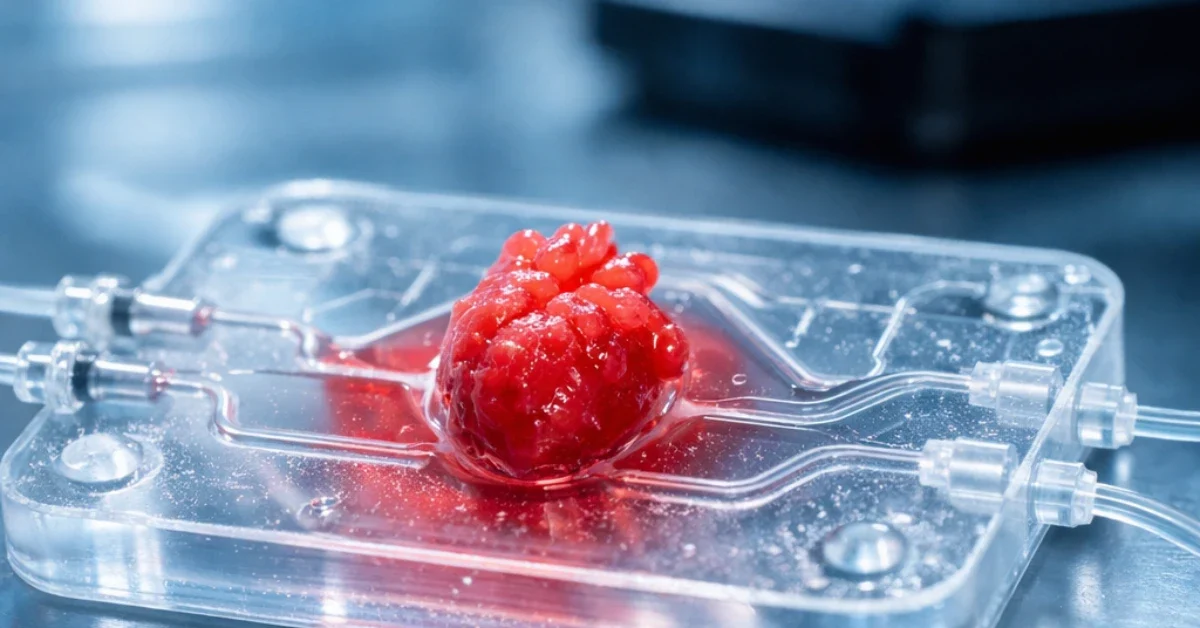
Scientists have developed a new 3D “heart-on-a-chip” that beats spontaneously and mimics the mechanical stresses of a living heart, marking a significant leap forward in the fight against cardiovascular disease. The breakthrough, led by researchers at the University of Montreal and other Canadian institutions, promises to transform how potential heart drugs are tested and reduce the pharmaceutical industry’s reliance on animal models.
The innovation comes as global health experts gather to showcase similar advances, with the United Arab Emirates (UAE) unveiling its own “Organ-on-Chip” initiatives at the World Health Expo 2026 in Dubai. Together, these developments signal a major shift toward safer, faster, and more accurate medical research.
A “Living” Chip with Dual-Sensing Technology
The newly developed device is a significant improvement over previous models due to its unique “dual-sensing” system. While earlier versions of heart-on-a-chip technology could not track activity at high resolutions, this new platform monitors heart function on two levels simultaneously: the overall tissue and the individual cells.
To create the device, the Canadian research team used cardiac muscle cells and connective tissue cells taken from rats. They suspended these cells in a nutrient-rich gel and placed them on a flexible silicon chip. The result was an engineered tissue that not only beats on its own but also mobilizes calcium to trigger muscle contractions—just like a real heart.
The chip employs two distinct types of sensors to capture this activity:
- Elastic Pillars: The heart tissue is positioned between two flexible pillars. As the tissue beats, the pillars bend. Measuring this deformation allows scientists to calculate the overall contractile strength of the muscle.
- Microscopic Hydrogel Droplets: Inside the tissue, researchers embedded tiny hydrogel beads, each about 50 micrometers in diameter. These microsensors deform in response to local mechanical stress, providing real-time data on cellular-level activity.
Testing Drugs Without Risking Patients
One of the greatest challenges in medicine is predicting how a human heart will react to a new drug. Traditional animal testing often fails to accurately replicate human biology, and clinical trials on people carry significant risks.
The new heart-on-a-chip offers a safer alternative. To prove its effectiveness, the researchers exposed the chip to two common compounds with known effects. First, they applied norepinephrine, a drug used to treat low blood pressure. As expected, the chip showed increased heart activity, mimicking the body’s “fight or flight” response. Next, they used blebbistatin, a substance known to relax muscles, which successfully reduced the tissue’s contractions.
The chip’s ability to respond predictably to these substances demonstrates its potential for screening new medications before they ever reach human trials.
Global Momentum: UAE Unveils “Project Falcon”
The push for organ-on-chip technology is gaining traction worldwide. At the World Health Expo (WHX) 2026 in Dubai, the Emirates Drug Establishment (EDE) unveiled its own cutting-edge program, known as “Project Falcon.” This initiative combines organ-on-chip technology with artificial intelligence (AI) and laboratory automation to accelerate drug discovery.
According to Dr. Shaikha Al Mazrouei, a director at the EDE, the project aims to create highly accurate human-based models that replicate the physiological environment of the human body. Unlike the Canadian study, which utilized rat cells for its initial proof-of-concept, the UAE’s initiative emphasizes the use of real human samples to test drug responses.
The technology has broad potential applications beyond heart disease, including:
- Precision Medicine: Optimizing gene therapies and identifying tumor antigens.
- Cosmetics: Testing products for skin sensitivity and toxicity without harming animals.
- Disease Modeling: Creating models for tumors and immune responses.
The Future of Personalized Medicine
The ultimate goal for researchers globally is personalized medicine. The Canadian team plans to eventually build heart-on-a-chip models using cells derived from patients with specific heart conditions, such as arrhythmias or dilated cardiomyopathy. This would allow doctors to test various treatments on a patient’s own cells in the lab to determine the most effective medication before prescribing it.
As these technologies mature, they promise to improve the success rates of new drugs, lower development costs, and provide a deeper understanding of the world’s leading cause of death.
