

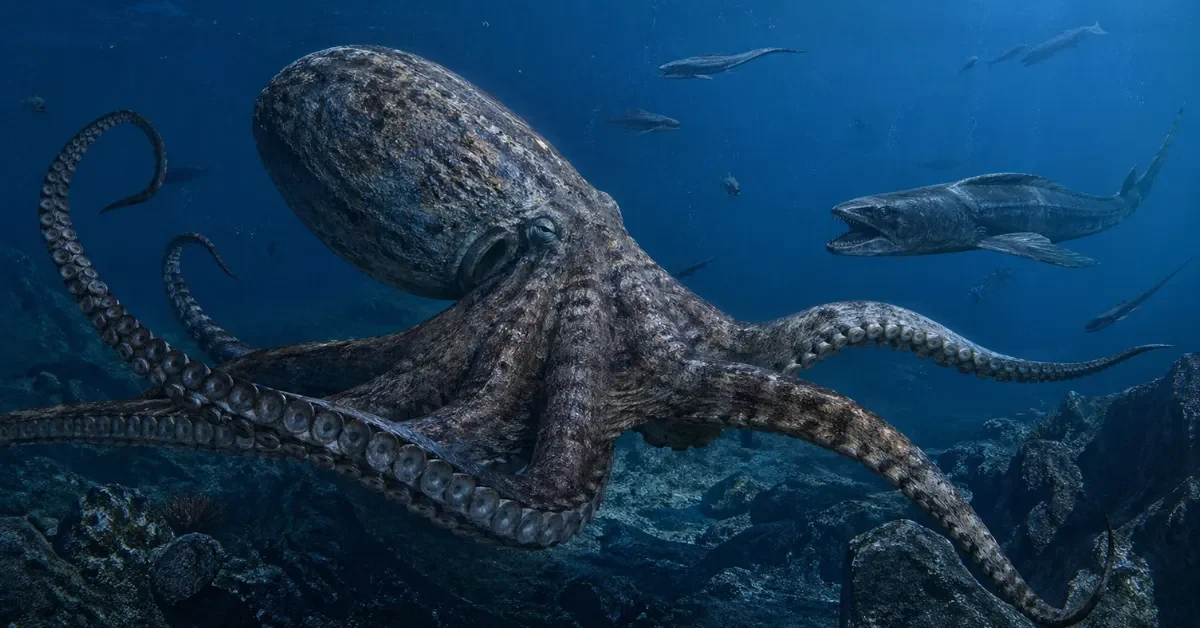
A new study says a real-life “Cretaceous kraken” may have hunted the oceans during the age of dinosaurs, with fossil jaws pointing to giant octopuses that ranked among the top predators of the Late Cretaceous. The research, led by scientists from Japan’s Hokkaido University and published in Science on April 23, challenges the idea that the seas were ruled only by large vertebrate hunters such as marine reptiles. Reports on the findings describe a giant ancient octopus with a body plan that included eight arms and a long body, and they say the biggest individuals may have stretched to about 60 feet, while Reuters gave the upper estimate as 61 feet, or 18.6 meters.
The Cretaceous kraken study is drawing attention because octopuses rarely leave much behind in the fossil record. Their bodies are soft and usually decay before fossilization can happen, so researchers focused on beaks, the hard jaw structures that can survive for millions of years. According to the reports, the fossils used in the study came from Japan and Canada’s Vancouver Island and dated to roughly 100 million to 72 million years ago, though Reuters said the species Nanaimoteuthis haggarti lived about 86 million to 72 million years ago.
Fossils Recast the Picture
The study centered on a fresh look at fossilized beaks that had not been fully understood before. The Guardian reported that researchers reexamined 15 large fossil beaks that had previously been identified as belonging to vampire squids, then concluded they were actually tied to an ancient octopus lineage. The same report said the team also found 12 more octopus beaks hidden inside Cretaceous rocks by using digital imaging methods.
People similarly reported that scientists studied dozens of jaw fossils and said the remains belonged to extinct finned octopuses known as Cirrata. Washington Post coverage said the researchers studied the jaws of 15 ancient octopus fossils from Japan and Vancouver Island, adding to the evidence that these animals were far larger and more formidable than once believed. Taken together, the reports show that the new analysis relied on the hard parts of an animal that are usually almost invisible in the fossil record.
Size and Feeding Clues
The strongest evidence for the animals’ behavior came from the condition of the beaks themselves. The Guardian said the large fossilized beaks showed chips, scratches, rounded edges, and other wear that suggested repeated crushing of hard bones and shells. People described the same kind of damage as evidence of “repeated, forceful interactions” with prey and said the jaws may have been powerful enough to break through shell and bone.
That feeding evidence is one reason researchers now place these octopuses high in the marine food web. Reuters reported that the species Nanaimoteuthis haggarti ranged from 22 to 61 feet long, while other coverage rounded the top estimate to about 60 feet or said some species could grow as long as 19 meters. Those measurements would make the biggest animals comparable in length to a bus and large enough to rival other carnivorous hunters in ancient seas.
Ancient Seas Reconsidered
The study’s broader significance is not just about size but about who sat at the top of the ecosystem. Guardian coverage said the giant octopuses may have competed with, and possibly even preyed on, marine reptiles such as mosasaurs and plesiosaurs. Reuters likewise said the creature prowled the seas as an apex predator during the age of dinosaurs, offering the closest known real-world match to the Kraken of Norse folklore.
Dr. Yasuhiro Iba summed up the shift in thinking in a quote carried by The Guardian and repeated by People: “Our study shows that these were not simply large versions of modern octopuses.” He added, “They were giant predators at the very top of the Cretaceous marine food web,” and said the work changes the view that Cretaceous seas were dominated only by large vertebrate predators. For paleontologists, that means fossil jaws once treated as minor finds are now helping redraw the map of power in the prehistoric ocean.
