

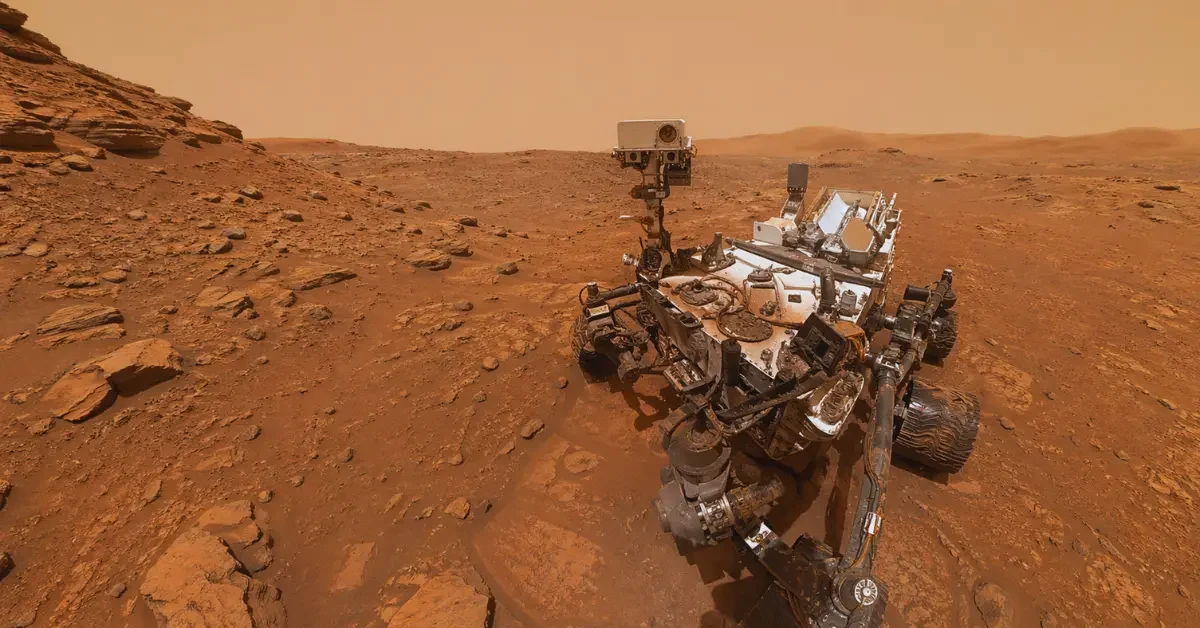
NASA’s Curiosity rover has found new organic molecules on Mars, adding fresh evidence that the planet once held chemicals linked to life, even though the discovery does not prove that life ever existed there.
The findings come from samples studied by Curiosity in Gale Crater, where the rover used its onboard Sample Analysis at Mars instrument suite to examine ancient rock and release gases for testing. Reports describe the newly identified material as a diverse mix of organic molecules, including compounds that scientists widely regard as building blocks tied to the origin of life on Earth.
What Curiosity Found
The new result stands out because some of the compounds had not been seen before on Mars, expanding the list of known Martian organics beyond the simpler molecules detected in earlier work. The Guardian reported that seven molecules were detected in an ancient dried lakebed near the Martian equator, and that five of them had not previously been recorded on the planet. Space.com, however, said Curiosity’s experiment detected more than 20 organic molecules in clay-bearing sandstone from the Knockfarrill Hill section of Glen Torridon.
That difference in reported counts does not change the broader point shared across the coverage: Curiosity found a wider chemical variety than before in ancient Martian rocks. Space.com also reported that the molecules included nitrogen- and sulfur-bearing compounds similar to raw material linked to life’s emergence on Earth.
Why Scientists Are Cautious
Scientists have been careful not to treat the discovery as proof of life. The Times of India reported that organic molecules can be created by both biological and non-biological processes, meaning their presence alone cannot confirm that living organisms once existed on Mars. The Guardian similarly said the rover’s analysis could not determine whether the compounds were tied to ancient life, delivered by meteorites, or formed through geological activity.
Even with that uncertainty, the discovery matters because it suggests ancient Mars preserved complex carbon-based chemistry for billions of years. Space.com said the variety of molecules found in the roughly 3.5-billion-year-old rocks indicates that chemical diversity survived long periods of sediment turning to rock and exposure to radiation. The Times of India added that the compounds’ survival suggests Mars may have protected them from destruction by radiation and oxidation.
How the Experiment Worked
Curiosity made the discovery with the Sample Analysis at Mars, or SAM, mini-lab carried on the rover. According to Space.com, the rover used a chemical called tetramethylammonium hydroxide, or TMAH, to detect organic molecules in clay-rich sandstone, marking the first time that this kind of chemical experiment had been performed on another planet. The study was led by Amy Williams of the University of Florida and published in Nature Communications, according to Space.com.
The work also builds on Curiosity’s longer mission to study whether Mars once offered habitable conditions. Space.com said the rover has been exploring Gale Crater and Mount Sharp since landing on Mars on Aug. 6, 2012, and that scientists view Glen Torridon as a place that may once have supported conditions favorable to ancient life. The Times of India likewise framed the discovery as support for the idea that Mars once had chemistry that could have helped life emerge.
What Comes Next
The findings are expected to shape future Mars research, especially missions aimed at studying samples with more advanced laboratory tools. The Times of India said the results could influence future sample-return work and noted that NASA and its international partners already have plans related to the Mars Sample Return program. It also reported that the discovery adds to data from Perseverance, which is exploring Jezero Crater and collecting samples.
Space.com reported that researchers see the TMAH experiment as a pathfinder for future life-detection instruments, including versions flying on the Rosalind Franklin rover and the Dragonfly mission’s mass spectrometer. For now, the most important takeaway is narrower but still significant: Curiosity has shown that ancient Martian rocks still hold a richer organic record than scientists knew before, even if the source of that chemistry remains unresolved.
