
By using this site, you agree to our Privacy Policy and Terms of Use.
Accept
VellaTimesVellaTimesVellaTimes
  • News
    NewsShow More
    A stressed university student looks at a laptop screen displaying a red digital cybersecurity warning in a dimly lit room.
    Canvas Cyberattack: Millions of Students Face Data Breach During Finals Week
    May 9, 2026
    Hyper-realistic news-style image of AI server racks and shipping crates inside a logistics warehouse, representing an investigation into chip shipments through Thailand.
    Nvidia Chips Smuggled to Alibaba Via Thailand Probe
    May 8, 2026
    The MV Hondius expedition cruise ship anchored in the Atlantic Ocean under overcast skies.
    Hantavirus Cruise Ship Outbreak: 3 Dead Off Cape Verde
    May 5, 2026
    A sleek quadruped robot dog and a humanoid robot operating inside a modern, highly automated industrial facility.
    Physical AI: Meta and China Lead Global Robotics Investment
    May 5, 2026
    A close-up view of a high-tech silicon wafer and modern microchips on a metallic surface inside a brightly lit semiconductor manufacturing facility.
    Apple Chip Manufacturing: Intel and Samsung Explored
    May 5, 2026
  • Technology
    TechnologyShow More
    A stressed university student looks at a laptop screen displaying a red digital cybersecurity warning in a dimly lit room.
    Canvas Cyberattack: Millions of Students Face Data Breach During Finals Week
    May 9, 2026
    Hyper-realistic news-style image of AI server racks and shipping crates inside a logistics warehouse, representing an investigation into chip shipments through Thailand.
    Nvidia Chips Smuggled to Alibaba Via Thailand Probe
    May 8, 2026
    A close-up view of a high-tech silicon wafer and modern microchips on a metallic surface inside a brightly lit semiconductor manufacturing facility.
    Apple Chip Manufacturing: Intel and Samsung Explored
    May 5, 2026
    The interior of a modern federal courthouse with sunlight streaming onto wooden benches.
    OpenAI Trial: Elon Musk Warns Execs Before Court Battle
    May 5, 2026
    A glowing digital medical tablet displaying artificial intelligence graphics in a modern hospital emergency room.
    AI Outperforms Doctors in Harvard Trial of Emergency Triage Diagnoses
    May 3, 2026
  • AI
    AIShow More
    A sleek quadruped robot dog and a humanoid robot operating inside a modern, highly automated industrial facility.
    Physical AI: Meta and China Lead Global Robotics Investment
    May 5, 2026
    A frustrated professional is looking at a laptop screen displaying a server error message in a modern office setting.
    ChatGPT Global Outage: OpenAI Investigates Access Issues
    May 5, 2026
    A sleek and modern stage at a corporate technology launch event with glowing digital displays.
    OpenAI GPT-5.5 Launch Party and the Goblin Problem
    May 3, 2026
    Hyper-realistic news-style image of a modern AI data center with server racks and a digital display labeled DeepSeek V4, shown in cool blue lighting.
    DeepSeek V4 launch puts Huawei AI chips in spotlight
    May 1, 2026
    News-style image of Elon Musk seated in a courtroom during a legal dispute involving OpenAI.
    Elon Musk OpenAI Trial Puts Nonprofit Mission on Trial
    May 1, 2026
  • Science
    ScienceShow More
    The MV Hondius expedition cruise ship anchored in the Atlantic Ocean under overcast skies.
    Hantavirus Cruise Ship Outbreak: 3 Dead Off Cape Verde
    May 5, 2026
    A glowing meteor streaks across a dark, star-filled night sky with a bright waning moon illuminating a remote natural landscape below.
    Eta Aquarid Meteor Shower 2026: How to Watch the Peak
    May 5, 2026
    A glowing quantum clock fragmenting into light particles against a dark cosmic background with swirling entangled atoms and spacetime waves, representing quantum physics breakthroughs in time and the universe.
    Quantum Physics Breakthroughs Reshaping How We Understand Time and the Universe
    May 3, 2026
    A glowing antimatter atom passing through a hexagonal graphene sheet and splitting into a quantum wave interference pattern in a high-tech laboratory setting.
    Scientists Observe Positronium Wave Behavior in Lab
    May 1, 2026
    The NASA Curiosity rover is using its robotic arm to drill into a red sandstone rock on the dusty surface of Mars.
    Mars Organic Molecules: Curiosity Rover Makes Historic Find
    May 1, 2026
  • World
    WorldShow More
    Allu Arjun Commitment to Ethical Brand Partnerships
    Exploring Allu Arjun’s Commitment to Ethical Brand Partnerships
    December 18, 2023
    Orry aka Orhan Awatramani
    Orhan Awatramani ‘Orry’ Biography, Lifestyle and Rise to Fame
    December 8, 2023
    Alia Bhatt Latest Deepake Video Victim
    Alia Bhatt becomes latest victim of Deepfake Videos, Obscene Video goes Viral
    November 28, 2023
    Napoleon Movie Review
    Napoleon Movie Review: A Historical Epic by Ridley Scott Reviewed
    November 25, 2023
  • Bookmarks
Search
Category
  • News
  • Technology
  • AI
  • Science
  • World
Company
  • About Us
  • Contact Us
  • Fact Checking Policy
  • Terms & Conditions
  • Privacy Policy
  • Copyright Policy
Resources
  • Home
  • Web Stories
  • Bookmarks
  • Interests
  • Disclaimer
  • Sitemap
© 2022 VellaTimes • All Rights Reserved.
Reading: Google search monopoly appeal sparks data-sharing battle
Share
Notification Show More
Font ResizerAa
VellaTimesVellaTimes
Font ResizerAa
  • News
  • Technology
  • AI
  • Science
  • World
Search
  • Explore
    • News
    • Technology
    • AI
    • Science
    • World
  • Useful Links
    • About Us
    • Contact Us
    • Fact Checking Policy
    • Terms & Conditions
    • Privacy Policy
    • Copyright Policy
  • Home
  • Web Stories
  • Bookmarks
  • Interests
  • Disclaimer
  • Sitemap
© 2022 VellaTimes • All Rights Reserved.
Technology

Google search monopoly appeal sparks data-sharing battle

Rakesh Paul
Last updated: 18/01/2026
Rakesh Paul
Share
9 Min Read
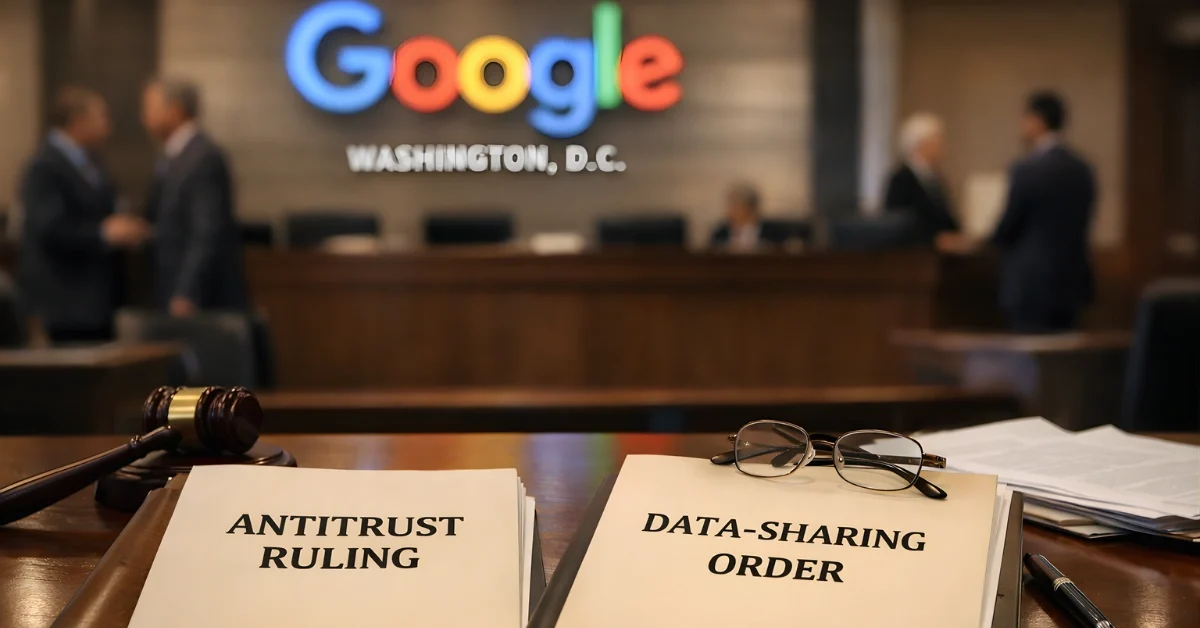
Courtroom-style scene with Google logo and legal documents about an antitrust data-sharing order on a table.

Alphabet’s Google has filed an appeal against a US federal court ruling that found it illegally maintained a monopoly in online search and search advertising, while also asking the judge to pause an order forcing it to share key search data with rivals, including AI firms such as ChatGPT-maker OpenAI. The company argues that handing over this information before the appeal is decided would expose trade secrets, endanger user privacy, and unfairly benefit competitors.

Contents
How the antitrust fight beganWhat the data-sharing order requiresWhy Google wants the order pausedWhat comes next in the legal fight

The Google search monopoly appeal centers on a 2024 decision by US District Judge Amit Mehta in Washington, who concluded that Google used unlawful tactics to keep its dominant position in general search services and search text advertising. The court found that Google’s powerful market share—about 90 percent in general search and roughly 95 percent of search text ads on smartphones—was reinforced by multibillion‑dollar distribution deals that shut out rivals.

How the antitrust fight began

The search case began in 2020, when the US Justice Department and a group of states sued Google during Donald Trump’s first term, accusing the company of illegally monopolizing online search through restrictive contracts. The case went to trial in the fall of 2023, making it one of the most closely watched antitrust battles in the technology industry.

In August 2024, Judge Mehta ruled that Google had illegally locked up the search market by paying device makers and browser companies, including Apple and Android phone manufacturers such as Samsung, to set Google as the default search engine. The judge found that these exclusive or near‑exclusive default deals, which cost Google more than 20 billion dollars a year, made it “financially impractical” for partners to switch to competing search providers.

After a second, remedies-focused trial in spring 2025, the court rejected the government’s most aggressive proposals, including demands that Google be forced to sell its Chrome browser or stop all default search payments entirely. Instead, Judge Mehta opted for behavioral remedies designed to loosen Google’s grip on distribution while leaving the company structurally intact.

What the data-sharing order requires

The most controversial remedy requires Google to share some of its valuable search data and provide syndication services to qualified competitors, so they can display Google’s results under their own brands for a period of time. The order is aimed at helping smaller search engines and AI-driven services overcome what the court called a “scale gap” between their systems and Google’s enormous databases.

According to the ruling, the data-sharing mandates focus in particular on a “super query log” system known inside Google as Glue, which records detailed information about user searches and how people interact with the results. Regulators see access to this type of query and interaction data as crucial for allowing rivals to improve their own algorithms and products fast enough to compete.

At the same time, the court built in some limits to these requirements to address privacy and business concerns. Judge Mehta narrowed the information Google must share to what he viewed as most closely tied to its anticompetitive conduct and specifically excluded advertising data from the sharing obligations.

Beyond data, the ruling also changes how Google can buy and keep default positions on devices and browsers. Google can still pay to be the default search engine and to preload apps, including its Gemini AI chatbot, but those contracts must now be limited to one year and regularly rebid, giving other providers more chances to compete for those placements.

Why Google wants the order paused

Google’s latest filings do not ask the court to pause all the remedies; instead, the company is focused on blocking the immediate enforcement of data-sharing and syndication requirements while its appeal moves forward. Google has said it is prepared to comply with other parts of the order, such as the one‑year limit on certain contracts and new privacy and security safeguards.

In its arguments, Google contends that being forced to turn over data from its search systems to competitors now would risk exposing trade secrets, with no way to “unring the bell” if it later wins on appeal. The company also says that sharing this information “would risk Americans’ privacy and discourage competitors from building their own products,” ultimately threatening the kind of innovation that keeps US technology in a leading position.

Google further argues that Judge Mehta’s August 2024 liability decision misread how people use online search. In a public statement, Lee‑Anne Mulholland, Google’s vice president of regulatory affairs, said the ruling “ignored the reality that people use Google because they want to, not because they’re forced to,” and failed to recognize the “rapid pace of innovation and intense competition” the company faces from established firms and well-funded startups.

The company points to testimony from browser makers like Apple and Mozilla, who told the court that they choose Google as the default because they believe it delivers the best experience for users. Google also highlights growing competition from generative AI services and new search tools, including those run by companies such as OpenAI, which the data-sharing mandate is designed to benefit.

What comes next in the legal fight

Google has filed a formal notice of appeal to a federal appellate court, challenging both Judge Mehta’s finding that it holds illegal monopolies and the specific remedies he imposed. This step opens the door to what could be years of additional litigation over the future shape of the search market and the limits of antitrust remedies involving data.

While that appeal proceeds, Judge Mehta must decide whether to grant Google’s request to put the data-sharing and syndication requirements on hold. Google’s filings stress that once sensitive internal data is handed to rivals, the company cannot fully recover from the competitive and privacy harms if the order is later overturned.

US antitrust enforcers also face their own decision point. The Justice Department and the coalition of states that brought the case have until early February to decide whether they will appeal the judge’s refusal to impose stronger structural remedies, such as forcing Google to divest Chrome or more sharply limiting its default search payments.

For now, Google remains under a set of behavioral rules that restrict the length and design of its default search and app preload deals, even as it fights to avoid opening its data vaults to competitors. The coming months will determine whether the courts see data-sharing as a necessary tool to curb a search monopoly or an overreach that threatens privacy and innovation.

TAGGED: antitrust, Artificial Intelligence, competition law, data sharing, default search deals, Google, online search, OpenAI, tech regulation
Share This Article
Facebook Twitter Whatsapp Whatsapp Telegram Copy Link
By Rakesh Paul
I'm the Co-Founder of VellaTimes and an experienced digital marketer. With substantial experience in the blogging industry, I love crafting insightful and engaging news articles on technology, sports, and automobiles.
Leave a comment

Leave a Reply Cancel reply

Your email address will not be published. Required fields are marked *


Most Read

Physical AI Adoption: Market Growth and Enterprise Trends

April 13, 2026

US Proposes Global AI Chip Export Rules Impacting Nvidia and AMD

March 8, 2026

Mahindra Thar 5-Door SUV Launching in 2024: What to Expect from the Off-Road SUV

December 23, 2023

AWS Graviton Chips: Meta Signs Multibillion-Dollar Deal

April 25, 2026

ChatGPT Outage: Thousands Report Errors as OpenAI Scrambles to Restore Service

March 5, 2026

Intel Terafab Project: Tech Giant Joins Musk Vision

April 7, 2026

Related News

A stressed university student looks at a laptop screen displaying a red digital cybersecurity warning in a dimly lit room.
News

Canvas Cyberattack: Millions of Students Face Data Breach During Finals Week

Rakesh Paul Rakesh Paul May 9, 2026
Hyper-realistic news-style image of AI server racks and shipping crates inside a logistics warehouse, representing an investigation into chip shipments through Thailand.
News

Nvidia Chips Smuggled to Alibaba Via Thailand Probe

Rakesh Paul Rakesh Paul May 8, 2026
A close-up view of a high-tech silicon wafer and modern microchips on a metallic surface inside a brightly lit semiconductor manufacturing facility.
News

Apple Chip Manufacturing: Intel and Samsung Explored

Rakesh Paul Rakesh Paul May 5, 2026

About Us

VellaTimesVellaTimesVellaTimes

VellaTimes is a leading news portal that covers the latest trending news in technology, lifestyle, entertainment, automobiles, travel, and sports.

Explore

  • News
  • Technology
  • AI
  • Science
  • World

Useful Links

  • About Us
  • Contact Us
  • Fact Checking Policy
  • Terms & Conditions
  • Privacy Policy
  • Copyright Policy

Subscribe Us

Subscribe to our newsletter for the Latest News and Top Stories!

© 2022 VellaTimes • All Rights Reserved.
  • Home
  • Web Stories
  • Bookmarks
  • Interests
  • Disclaimer
  • Sitemap
adbanner
AdBlocker Detected
Our site is an advertising supported site. Please whitelist us to support our work.
Okay, I'll Whitelist