

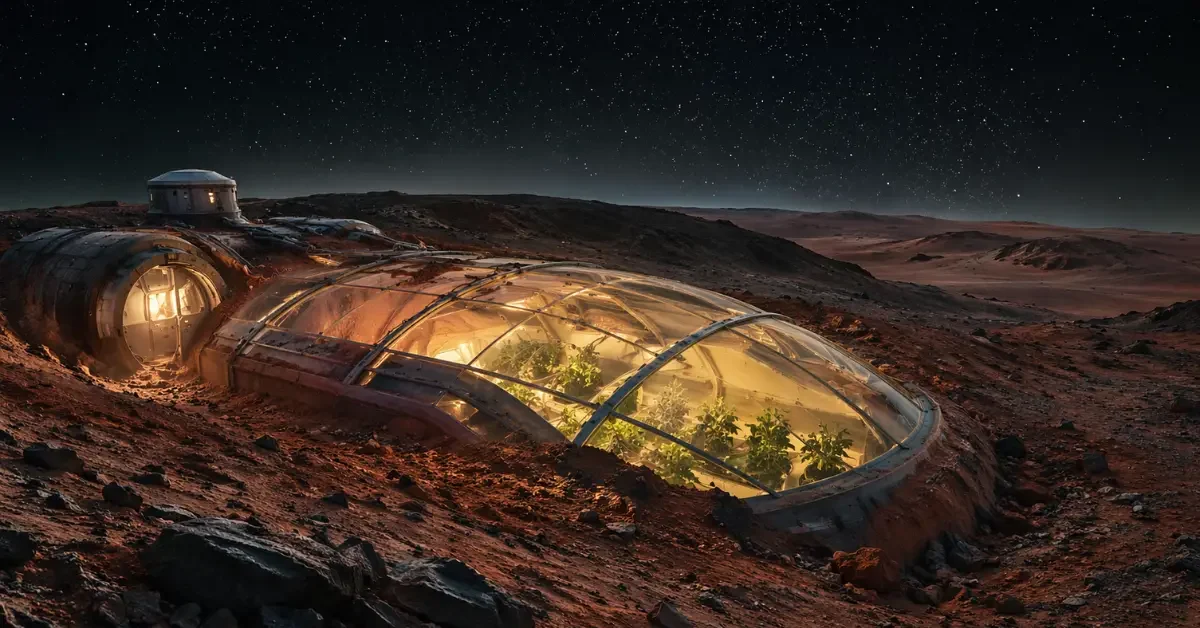
The harsh environment of the Red Planet has long made the idea of survival on Mars seem impossible. With freezing temperatures, intense radiation, toxic soil, and a thin carbon dioxide atmosphere, the planet is extremely hostile. However, recent scientific studies reveal that certain resilient Earth organisms can endure these extreme conditions. Furthermore, researchers are developing practical strategies to keep human explorers alive and healthy on future missions.
From ancient bacteria and hardy lichens to microscopic water bears, scientists are discovering that life is far more adaptable than previously thought. Laboratory simulations mimicking Martian conditions show that these life-forms not only survive but sometimes even thrive. At the same time, space agencies are addressing the engineering challenges of human habitation, proving that colonizing our neighboring planet is technically manageable.
Microbes and Fungi Defy the Odds
In groundbreaking experiments, researchers exposed lichens—a symbiotic partnership between fungi and algae—to simulated Martian environments. Two species, Diploschistes muscorum and Cetraria aculeata, faced X-ray radiation, severe temperature shifts, and low atmospheric pressure. Within a five-hour test, the fungal components remained metabolically active and successfully triggered defense mechanisms.
Bacteria that naturally live on or inside the human body also demonstrate remarkable resilience. Scientists placed four common disease-causing microbes in a simulated Martian environment featuring toxic salts and deadly ultraviolet radiation. Three of these species survived, with Pseudomonas aeruginosa growing steadily in the artificial Martian dirt for up to 21 days.
Ordinary baker’s yeast has also proven surprisingly tough. Researchers subjected yeast cells to shock waves reaching speeds of Mach 5.6, mimicking meteorite impacts, along with toxic perchlorate salts found in Martian soil. The yeast survived by forming special stress-response structures called ribonucleoprotein condensates to protect its cellular components.
Ancient Bacteria and Microscopic Animals
Some organisms could survive for millions of years under the right conditions. A rugged ancient bacterium known as Deinococcus radiodurans can withstand massive amounts of radiation. When dried, frozen, and buried 10 meters below the simulated Martian surface, this bacterium could theoretically survive for 280 million years. Its survival is largely due to its high levels of manganese antioxidants and a unique genetic structure that repairs radiation damage.
Microscopic animals called tardigrades, or water bears, are also strong candidates for Martian survival. When placed in simulated Martian dirt, the creatures initially struggled due to toxic compounds. However, once researchers washed the dirt with water, the tardigrades easily survived. Scientists suggest these “Tardiguardians of the Galaxy” could eventually help astronauts grow plants in Martian greenhouses.
Strategies for Human Settlers
While microbes naturally resist extreme conditions, human survival on Mars requires advanced engineering. Space agencies have developed science-backed solutions to overcome the planet’s primary hazards. To reduce radiation exposure, future habitats will likely be buried under several meters of dirt or built inside natural underground lava tubes.
Breathing and water access are also solvable problems. NASA’s MOXIE instrument aboard the Perseverance rover successfully converted Martian carbon dioxide into breathable oxygen. For hydration, explorers will extract water from widespread ice deposits located near the planet’s poles and mid-latitudes. Closed-loop life support systems will then continuously recycle this water for drinking and agriculture.
To stay warm and keep equipment running during massive dust storms, NASA has successfully tested compact nuclear fission reactors. When combined with solar panels and batteries, these systems can provide reliable, continuous electricity. Health impacts from the lower gravity—about 38 percent of Earth’s—will require strict exercise routines, medications, or even artificial gravity habitats.
The Risk of Planetary Contamination
The discovery that Earth life can survive on Mars raises serious concerns about planetary contamination. If microbes catch a ride on spacecraft, they could permanently contaminate the Red Planet. To understand this risk, researchers created the Mars Microbial Survival model. The model shows that while ultraviolet sunlight quickly sterilizes the outside of a spacecraft, bacteria hidden inside unheated internal components could survive for up to 25 Martian years.
This forward contamination could complicate the search for native Martian life. If scientists find biological signs on the planet, they must be certain the organisms did not originate from Earth. Because of this, researchers emphasize the importance of strict planetary protection protocols before any future robotic or crewed missions launch into space.
