
By using this site, you agree to our Privacy Policy and Terms of Use.
Accept
VellaTimesVellaTimesVellaTimes
  • News
    NewsShow More
    Close-up of a silver espresso machine extracting a fresh shot of coffee into a glass cup in a softly lit cafe setting.
    Espresso Extraction Science: The Finer Grind Flaw
    May 18, 2026
    A smartphone resting on a wooden desk displaying an AI-powered Amazon search bar in a modern home office setting.
    Amazon Alexa for Shopping Replaces Rufus AI Assistant
    May 18, 2026
    Wide news-style image showing an OpenAI office scene with screens displaying audio waveforms and voice technology graphics
    OpenAI acquires Weights.gg to boost voice AI tools
    May 18, 2026
    Federal agents standing outside a modern university biology laboratory building at dusk during an active investigation.
    US Arrests Chinese Scientists for Smuggling Biological Materials
    May 18, 2026
    A dramatically lit modern corporate courtroom with futuristic technology elements, representing a high-stakes artificial intelligence legal trial.
    Elon Musk OpenAI Lawsuit Exposes Clashes Over AI Safety
    May 18, 2026
  • Technology
    TechnologyShow More
    Wide news-style image showing an OpenAI office scene with screens displaying audio waveforms and voice technology graphics
    OpenAI acquires Weights.gg to boost voice AI tools
    May 18, 2026
    A polished silicon wafer rests on a surface inside a modern semiconductor manufacturing facility.
    Samsung Strike Threatens Global AI Chip Production
    May 18, 2026
    A glowing computer screen displaying the text GPT-5.5 Instant in a modern, high-tech office environment with soft blue and purple lighting.
    GPT-5.5 Instant: OpenAI’s New Default ChatGPT Model
    May 10, 2026
    Wide view of a modern AI data center with server racks, glowing fiber-optic cables, and semiconductor hardware in the foreground.
    AI Infrastructure Spending Drives Nvidia, AMD Shares
    May 10, 2026
    A glowing computer monitor displaying lines of code and digital network graphics in a modern tech office setting.
    Airbnb AI Coding: 60% of New Software Now Generated by AI
    May 9, 2026
  • AI
    AIShow More
    A smartphone resting on a wooden desk displaying an AI-powered Amazon search bar in a modern home office setting.
    Amazon Alexa for Shopping Replaces Rufus AI Assistant
    May 18, 2026
    A dramatically lit modern corporate courtroom with futuristic technology elements, representing a high-stakes artificial intelligence legal trial.
    Elon Musk OpenAI Lawsuit Exposes Clashes Over AI Safety
    May 18, 2026
    A high-tech global map visualization showing glowing digital connections across different continents, representing the worldwide adoption of artificial intelligence.
    Global AI Adoption in 2026: Trends and Growing Divide
    May 10, 2026
    A modern smartphone displaying an artificial intelligence chat interface used for online shopping and product comparison.
    Alibaba Qwen AI Taobao Integration Launches Agentic Shopping
    May 10, 2026
    A split-screen illustration showing a high-tech modern office using advanced AI tools contrasted against an older, dimly lit workspace.
    Global AI Adoption Surges But Rich-Poor Divide Widens
    May 9, 2026
  • Science
    ScienceShow More
    Close-up of a silver espresso machine extracting a fresh shot of coffee into a glass cup in a softly lit cafe setting.
    Espresso Extraction Science: The Finer Grind Flaw
    May 18, 2026
    Federal agents standing outside a modern university biology laboratory building at dusk during an active investigation.
    US Arrests Chinese Scientists for Smuggling Biological Materials
    May 18, 2026
    Header image of a quantum communication lab setup with fiber-optic equipment, a telecom quantum dot device, and interferometer components used for long-distance quantum key distribution.
    Quantum Key Distribution Reaches 120 km With Quantum Dots
    May 10, 2026
    Abstract geometric representation of glowing quantum paraparticles interacting within a three-dimensional mathematical grid in deep blue and gold tones.
    Quantum Paraparticles Exist: New Math Challenges Physics
    May 10, 2026
    A large expedition cruise ship is navigating rough ocean waters under a cloudy sky.
    Global Authorities Respond to Andes Hantavirus Outbreak on MV Hondius Cruise Ship
    May 9, 2026
  • World
    WorldShow More
    Allu Arjun Commitment to Ethical Brand Partnerships
    Exploring Allu Arjun’s Commitment to Ethical Brand Partnerships
    December 18, 2023
    Orry aka Orhan Awatramani
    Orhan Awatramani ‘Orry’ Biography, Lifestyle and Rise to Fame
    December 8, 2023
    Alia Bhatt Latest Deepake Video Victim
    Alia Bhatt becomes latest victim of Deepfake Videos, Obscene Video goes Viral
    November 28, 2023
    Napoleon Movie Review
    Napoleon Movie Review: A Historical Epic by Ridley Scott Reviewed
    November 25, 2023
  • Bookmarks
Search
Category
  • News
  • Technology
  • AI
  • Science
  • World
Company
  • About Us
  • Contact Us
  • Fact Checking Policy
  • Terms & Conditions
  • Privacy Policy
  • Copyright Policy
Resources
  • Home
  • Web Stories
  • Bookmarks
  • Interests
  • Disclaimer
  • Sitemap
© 2022 VellaTimes • All Rights Reserved.
Reading: MIT Researchers Unveil Ultrasound Tool to Decode Mysteries of Consciousness
Share
Notification Show More
Font ResizerAa
VellaTimesVellaTimes
Font ResizerAa
  • News
  • Technology
  • AI
  • Science
  • World
Search
  • Explore
    • News
    • Technology
    • AI
    • Science
    • World
  • Useful Links
    • About Us
    • Contact Us
    • Fact Checking Policy
    • Terms & Conditions
    • Privacy Policy
    • Copyright Policy
  • Home
  • Web Stories
  • Bookmarks
  • Interests
  • Disclaimer
  • Sitemap
© 2022 VellaTimes • All Rights Reserved.
News

MIT Researchers Unveil Ultrasound Tool to Decode Mysteries of Consciousness

Nisha Pradhan
Last updated: 05/02/2026
Nisha Pradhan
Share
8 Min Read
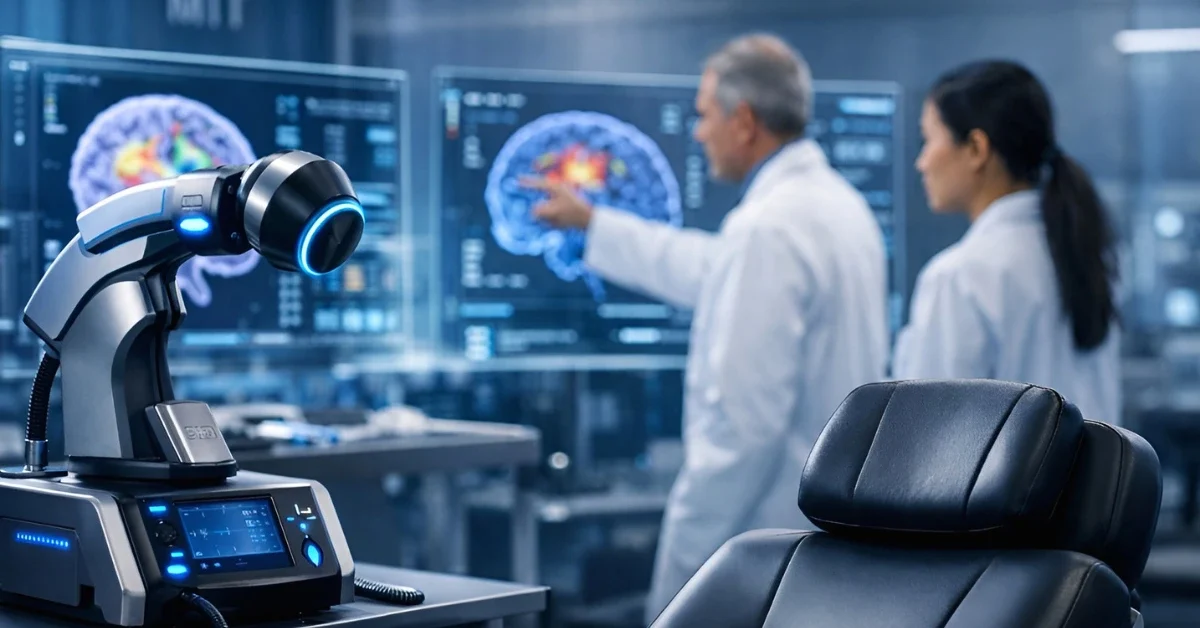
A high-tech transcranial focused ultrasound device in a modern neuroscience laboratory at MIT, with researchers analyzing brain data in the background.

Scientists may finally have a way to solve one of the greatest puzzles in human history: how the physical brain creates thoughts, feelings, and awareness. Researchers at the Massachusetts Institute of Technology (MIT) have unveiled a detailed roadmap for using a powerful technology called transcranial focused ultrasound to study consciousness. This noninvasive tool could allow neuroscientists to move beyond simply observing the brain to actively testing how it works, potentially answering age-old questions about the nature of the human mind.

The new approach focuses on transcranial focused ultrasound, a technology that uses acoustic waves to stimulate specific areas of the brain. Unlike other methods that can only reach the surface of the brain or require surgery, this tool can target deep brain structures with millimeter-level precision. In a paper published in the journal Neuroscience and Biobehavioral Reviews, the research team explains how this technology could transform neuroscience by enabling controlled experiments that test cause-and-effect relationships in the brain.

Solving the “Hard Problem” of Awareness

For decades, scientists have struggled with the “hard problem” of consciousness. While they can identify which parts of the brain are active during certain tasks, they still do not understand how biological tissue gives rise to subjective experiences like the redness of a rose or the sharpness of pain. Current study methods, such as functional magnetic resonance imaging (fMRI) or electroencephalography (EEG), mostly reveal correlations. They show that certain brain regions light up when a person feels an emotion, but they cannot prove that those regions actually cause the feeling.

Daniel Freeman, an MIT researcher and co-author of the paper, believes focused ultrasound changes this dynamic completely. He explains that the tool allows scientists to stimulate different parts of the brain in healthy subjects in ways that were previously impossible. According to Freeman, this technology can probe the neural circuits responsible for pain, vision, or complex human thought, helping to determine where these experiences truly originate.

The key advantage of transcranial focused ultrasound is its ability to reach deep into the brain without cutting the skin. It sends sound waves through the skull, concentrating them on a precise target. This allows researchers to manipulate activity in subcortical structures—regions located centimeters below the surface—while leaving surrounding tissue unaffected.

Moving From Observation to Causation

The research team includes experts from multiple institutions, including philosopher and scientist Matthias Michel from MIT, Brian Odegaard from the University of Florida, and Seung-Schik Yoo from Brigham and Women’s Hospital and Harvard Medical School. Together, they are designing experiments that will help settle long-standing debates between competing theories of consciousness.

One major theory, known as the cognitivist approach, suggests that consciousness arises from higher-level mental processes like reasoning and reflection, which are often linked to the frontal cortex of the brain. Other theories propose that awareness is rooted in sensory regions or broader brain networks. By using focused ultrasound to selectively suppress or enhance activity in these specific areas, the team hopes to identify which neural processes are essential for consciousness and which are merely secondary effects.

Matthias Michel notes that this technology provides a solution to the problem of distinguishing between a brain signal that creates a conscious experience and one that simply follows it. The team is planning initial experiments that will stimulate the visual cortex and later target higher-level regions in the frontal cortex. These studies aim to establish a clearer link between physical brain activity and what a person actually experiences.

Testing Blindsight and Deep Brain Circuits

One of the most innovative experiments proposed by the team involves recreating a phenomenon known as “blindsight” in healthy volunteers. Blindsight typically occurs in people who have suffered damage to their visual cortex; they say they cannot see anything, yet they can often correctly guess the location of objects. The researchers believe they can use focused ultrasound to temporarily create similar conditions in healthy individuals. By safely disrupting specific visual pathways, they could separate conscious awareness from unconscious processing, revealing how the two differ.

The researchers also plan to target subcortical nuclei, such as the pulvinar region of the thalamus. By stimulating these deep areas while participants perform perception tasks, scientists could see if these regions control confidence or awareness. Freeman points out that while we often assume pain or emotion comes from the brain’s outer layers, it is possible these experiences stem from deeper structures. This tool finally offers a way to test that hypothesis.

Another striking feature of focused ultrasound is that its effects can last long after the stimulation stops. Animal and human studies have shown that changes in brain activity can persist for minutes or even an hour. Freeman suggests this happens because the stimulation causes calcium to enter neurons, potentially altering how brain regions communicate with each other. This is crucial for studying consciousness, which likely relies on coordinated activity across large networks rather than isolated firing of individual neurons.

Future Medical and Scientific Implications

Beyond its theoretical value, this research could have significant practical applications in medicine. A better understanding of how the brain generates consciousness could lead to new treatments for a variety of conditions. If scientists can pinpoint the specific circuits responsible for chronic pain, mood disorders, or disorders of consciousness, they could develop targeted therapies that address the root cause.

Focused ultrasound could eventually complement or even replace more invasive treatments like surgery or heavy medication. By offering a precise way to modulate brain activity, it opens new doors for treating complex neurological and psychiatric conditions with fewer side effects. As the team prepares to begin their experiments, the scientific community watches with anticipation, hopeful that this acoustic key might finally unlock the mysteries of the human mind.

TAGGED: brain research, consciousness, Daniel Freeman, medical technology, Mental Health, MIT, neuroscience
Share This Article
Facebook Twitter Whatsapp Whatsapp Telegram Copy Link
By Nisha Pradhan
I am a passionate content creator with a deep love for travel, music, and food. Using my unique blend of these interests, I genuinely enjoy crafting high-quality travel, lifestyle, and entertainment-related news content.
Leave a comment

Leave a Reply Cancel reply

Your email address will not be published. Required fields are marked *


Most Read

AI Fruit Love Island: Viral TikTok Dating Show Explained

March 30, 2026

RAM shortage drives memory prices higher into 2028

January 19, 2026

Elon Musk OpenAI Lawsuit Exposes Clashes Over AI Safety

May 18, 2026

Meta AI Hiring Spree: Inside the Multimillion-Dollar Push

April 7, 2026

Europa sinking salty ice may feed its hidden ocean

January 27, 2026

Microsoft Unveils “Golden Cup” Scanner to Detect Sleeper Agents in AI Models

February 9, 2026

Related News

Close-up of a silver espresso machine extracting a fresh shot of coffee into a glass cup in a softly lit cafe setting.
News

Espresso Extraction Science: The Finer Grind Flaw

Nisha Pradhan Nisha Pradhan May 18, 2026
A smartphone resting on a wooden desk displaying an AI-powered Amazon search bar in a modern home office setting.
News

Amazon Alexa for Shopping Replaces Rufus AI Assistant

Sameer Katoch Sameer Katoch May 18, 2026
Wide news-style image showing an OpenAI office scene with screens displaying audio waveforms and voice technology graphics
News

OpenAI acquires Weights.gg to boost voice AI tools

Rakesh Paul Rakesh Paul May 18, 2026

About Us

VellaTimesVellaTimesVellaTimes

VellaTimes is a leading news portal that covers the latest trending news in technology, lifestyle, entertainment, automobiles, travel, and sports.

Explore

  • News
  • Technology
  • AI
  • Science
  • World

Useful Links

  • About Us
  • Contact Us
  • Fact Checking Policy
  • Terms & Conditions
  • Privacy Policy
  • Copyright Policy

Subscribe Us

Subscribe to our newsletter for the Latest News and Top Stories!

© 2022 VellaTimes • All Rights Reserved.
  • Home
  • Web Stories
  • Bookmarks
  • Interests
  • Disclaimer
  • Sitemap
adbanner
AdBlocker Detected
Our site is an advertising supported site. Please whitelist us to support our work.
Okay, I'll Whitelist