

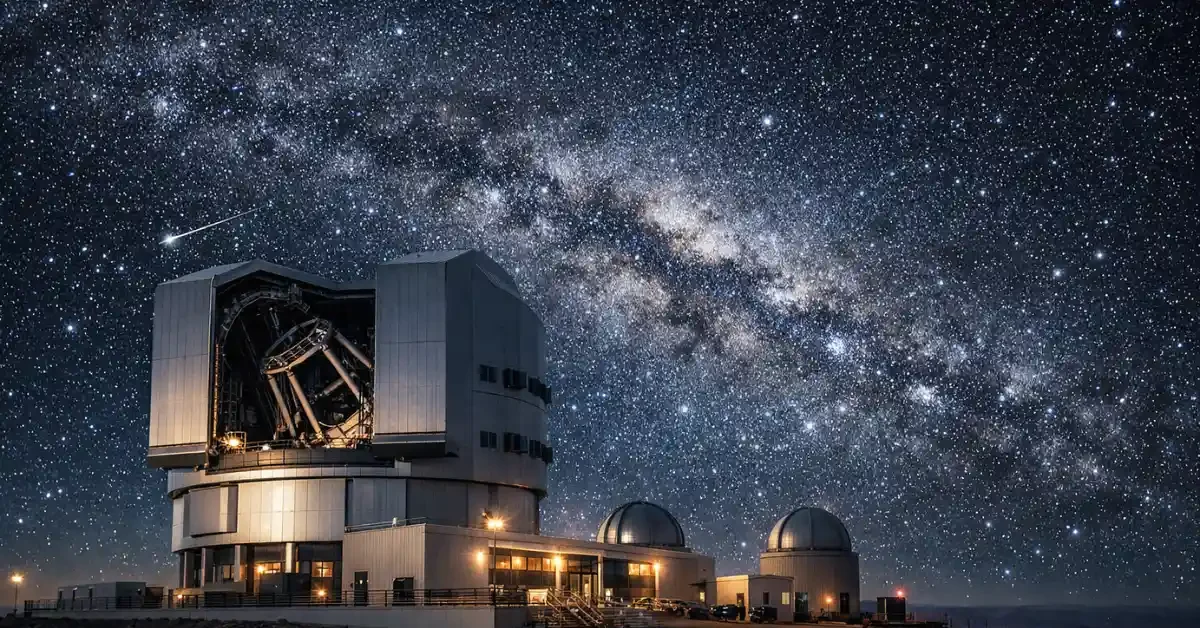
The Rubin Observatory has officially opened a real-time window into the universe, initiating a groundbreaking data stream that is changing how scientists observe the night sky. In a major milestone for astronomy, the observatory has started sending out real-time alerts, paging astronomers with an unprecedented volume of information. Scientists are now waking up to a staggering 800,000 notifications in just one night, marking the beginning of a massive and continuous survey of the sky.
These Rubin Observatory alerts represent a massive shift in astronomical research, providing continuous tracking of cosmic phenomena. The data alerts notify scientists about a wide range of dynamic events occurring across the universe, effectively acting as an automated paging system for the scientific community. By processing 800,000 alerts nightly, the observatory is fundamentally transforming how researchers monitor the ever-changing cosmos, ensuring that no significant event goes unnoticed in the surveyed sky.
Tracking Exploding Stars and New Asteroids
The sheer scale of the data allows researchers to immediately identify fast-moving and rapidly changing objects in the night sky. Among the 800,000 daily notifications, the observatory alerts scientists to newly discovered asteroids moving through space. Tracking these new asteroids in real-time gives researchers vital data on their trajectories, speed, and physical characteristics.
In addition to asteroids, the real-time data stream captures the dramatic final moments of dying stars. The observatory is actively paging astronomers with notifications about exploding stars, commonly known as supernovae. Because these volatile cosmic phenomena can brighten and fade incredibly rapidly, receiving an immediate data alert is crucial for researchers who need to study the mechanics of these massive stellar explosions before they disappear.
Beyond tracking individual exploding stars and new asteroids, the broader scope of the observatory’s project is staggering. The ongoing survey of the sky is designed to eventually reveal and catalog a billion galaxies. Gathering data on a billion galaxies requires systematic, continuous observation. By documenting the sky night after night, the survey will reveal how these massive galactic structures interact and evolve. This deep, comprehensive observation provides an unparalleled map of the sky, ensuring that researchers have the necessary data to understand the vastness of the cosmos.
A Global Network of Astronomers
Handling 800,000 notifications a night requires an extensive, highly coordinated effort from scientific institutions worldwide. The immense volume of real-time alerts means that no single facility can process or follow up on every cosmic event. Instead, the data is instantly distributed to a global network of researchers and observatories ready to analyze the incoming information.
Several major academic institutions are playing a central role in managing and interpreting this massive data alert system. Researchers at Stanford University are actively involved in studying these real-time alerts of astronomical events. Similarly, scientists at the University of Washington, specifically working through the DiRAC institute, are heavily engaged with the incoming data stream, working diligently to make sense of the nightly notifications.
The collaborative effort extends across the Atlantic, where UK scientists, including researchers from Oxford Physics, are utilizing the data to open their own real-time window into the universe. By receiving these alerts concurrently, international teams across different time zones can collaborate seamlessly, ensuring that the 800,000 nightly cosmic phenomena are monitored around the clock.
Immediate Follow-Up Observations
While the Rubin Observatory detects and flags these events, secondary observation is often necessary to gather more detailed and specific information. This week, South African telescopes are stepping in to immediately follow up on the initial alerts. Coordinated by the South African Astronomical Observatory (SAAO), these telescopes will track the specific cosmic phenomena initially flagged by the nightly data stream.
This rapid follow-up is the primary purpose of the real-time alert system. When an exploding star or a new asteroid is detected, telescopes in South Africa and other locations can quickly point their specialized instruments at the exact coordinates provided by the notification. This collaborative approach ensures that fleeting astronomical events are captured and studied in detail before they fade from view.
The launch of the Rubin Observatory alerts is a defining moment for the global scientific community. With 800,000 notifications pouring in every single night, researchers now have access to a dynamic, constantly updating map of the sky. From newly spotted asteroids and exploding stars to a massive survey revealing a billion galaxies, this real-time window into the universe promises to continuously uncover the hidden wonders of the cosmos.
