

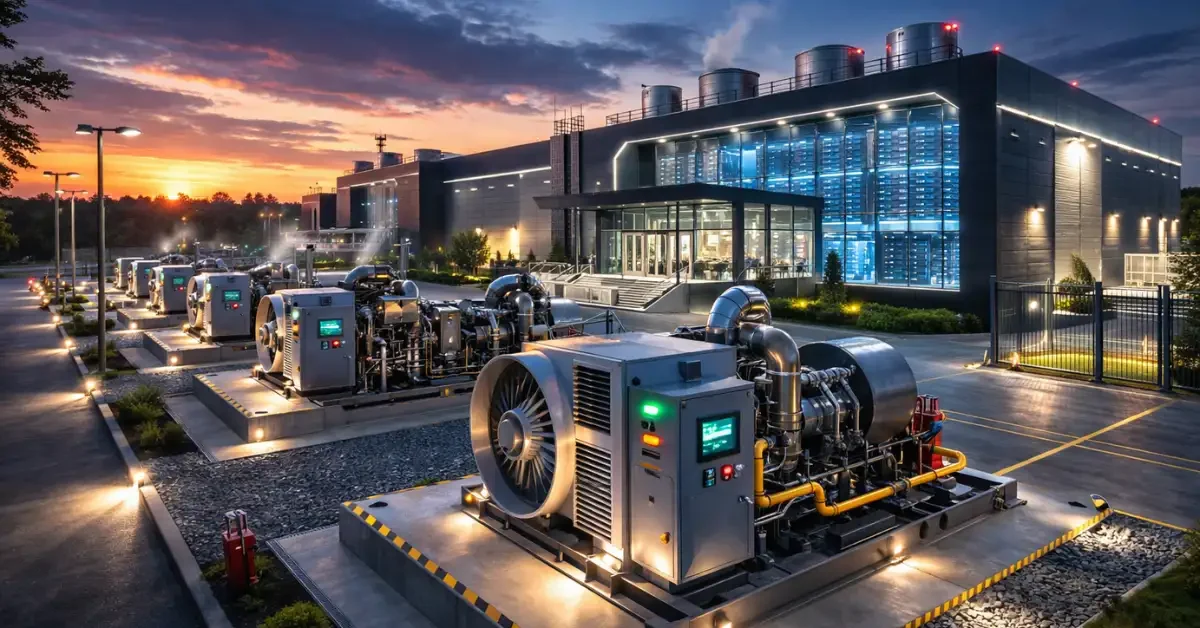
The artificial intelligence boom has hit a physical wall: electricity. As hyperscalers race to build massive data centers for companies like OpenAI, they are finding that the local power grid simply cannot keep up. Facing interconnection delays that stretch for years, tech companies are turning to a solution from the skies. They are deploying jet engines—both repurposed liners and new supersonic cores—to generate their own power on-site.
This “behind-the-meter” strategy allows data center operators to bypass utility bottlenecks completely. By installing aeroderivative gas turbines directly next to server halls, companies can secure gigawatts of power in months rather than the decade it might take to build traditional transmission infrastructure.
Repurposing Retired Airliners for Power
The aviation industry is providing a critical lifeline to the energy sector. Companies are taking engines from retired aircraft and converting them into stationary power plants.
ProEnergy, based in the United States, has found a second life for the CF6-80C2 engines that once powered the Boeing 747. By retrofitting these cores with new components, they create the PE6000, a land-based gas turbine capable of generating 48 megawatts (MW) of electricity. According to ProEnergy, this is enough to power a medium-sized data center.
The speed of deployment is the primary driver. While traditional turbine manufacturers like GE Vernova and Siemens Energy face backlogs stretching into 2029, ProEnergy can deliver these converted units by 2027. Landon Tessmer, Vice President of Commercial Operations at ProEnergy, noted that they have already sold 21 gas turbines for data center projects, totaling more than 1 gigawatt (GW).
Similarly, FTAI Aviation is launching a platform to convert CFM56 engines—the world’s most widely used engine, found on the Boeing 737—into 25MW power units. FTAI expects to begin production in 2026, targeting an output of 100 units per year. Their conversion process is remarkably fast, taking just 30 to 45 days per engine. FTAI Chairman Joe Adams described the potential of these smaller, modular units as offering an alternative to address the “unprecedented need for electricity.”
Supersonic Tech Enters the Energy Market
While some look to retired fleets, others are building entirely new engines to solve specific efficiency problems. Boom Supersonic, the company developing the Overture supersonic airliner, has entered the energy market with a turbine named “Superpower.”
Based on the “Symphony” engine core designed for Mach 1.7 flight, the Superpower turbine addresses a major flaw in legacy aeroderivative engines: heat. Traditional turbines, designed for the freezing temperatures of high altitude, lose up to 30% of their generation capacity when ambient temperatures hit 110°F. This is a critical issue in data center hubs like Texas.
Boom’s founder, Blake Scholl, claims the Superpower turbine maintains its full 42MW output even in extreme heat without requiring water for cooling. The company has already signed a massive deal with Crusoe to supply 1.21 GW of power—approximately 29 turbines—for a project supporting OpenAI.
The Rise of “Behind the Meter” Power
This shift to on-site generation is reshaping the energy landscape. Cleanview, an energy data firm, tracks at least 46 data centers operating “behind the meter” with a combined capacity of 56 GW. This approach treats power plants like server hardware. Blake Scholl likened the shift from giant utility turbines to these mid-sized jet engines to the computing industry’s move from mainframes to blade servers.
However, the rush to disconnect from the grid comes with significant environmental caveats.
Environmental Concerns and Stranded Assets
The rapid deployment of natural gas turbines is raising alarms about carbon emissions. An analysis by researchers at Cornell University suggests this build-out could add 44 million metric tons of carbon dioxide to the atmosphere by 2030.
Efficiency is a key concern. Many of these projects use “simple-cycle” turbines that burn gas without capturing waste heat, making them less efficient than the “combined-cycle” plants used by major utilities. In Texas, some developers are even using reciprocating engines—similar to car engines—because they can start and stop rapidly to match fluctuating AI workloads, despite producing more emissions than turbines.
Critics also warn of regulatory evasion. By staying behind the meter, projects like the proposed “Project Jupiter” in New Mexico can avoid state regulations that enforce climate targets. Colin Cox, an attorney with the Center for Biological Diversity, warned that if the AI bubble bursts, these gas-fired assets could become useless. “You can’t do anything with a gas turbine besides run gas through it to make it spin,” Cox stated, highlighting the risk of these massive investments becoming stranded assets.
For now, the industry views these engines as a necessary bridge. ProEnergy executives describe their turbines as a five-to-seven-year solution until grid interconnections are established. But with the AI sector’s appetite for power growing exponentially, these temporary jet engines may become a permanent fixture of the digital infrastructure.
