

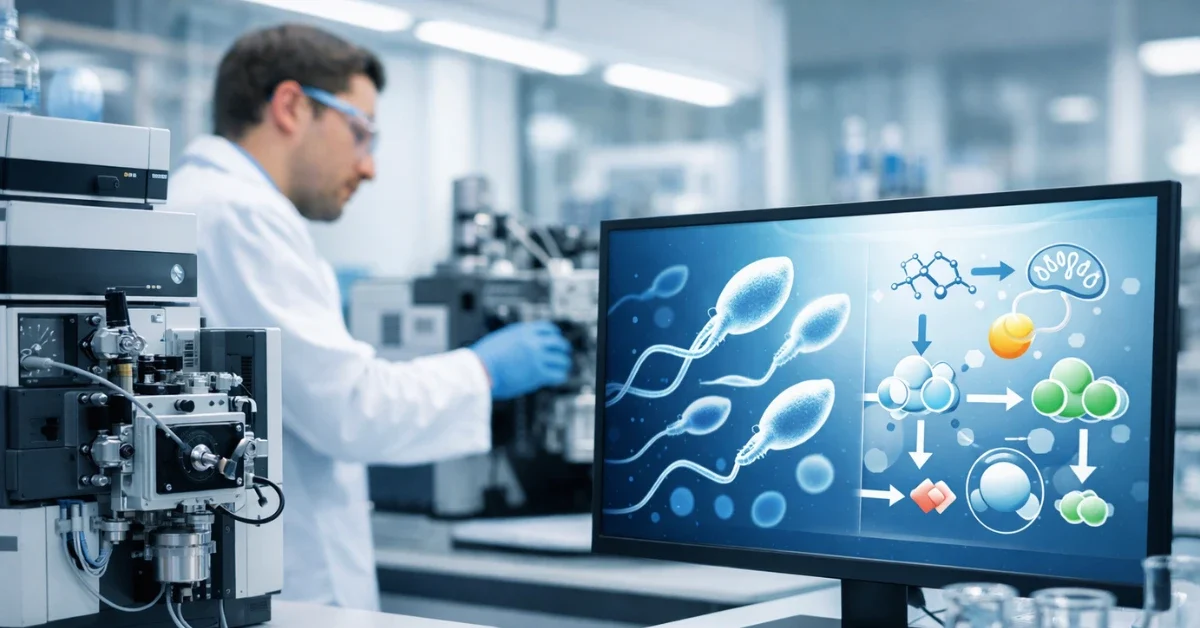
Scientists at Michigan State University say they have identified a molecular “switch” that helps sperm ramp up energy right before fertilization, a finding that could support both infertility care and the push for safe, nonhormonal male birth control options. The work tracks how sperm process glucose for a rapid jump from a low-energy state to an “overdrive” mode needed for the final stretch toward an egg.
The team reports that an enzyme called aldolase plays a key role in turning glucose into usable energy during this high-demand phase, while other enzymes help regulate how fuel flows through metabolic pathways. The researchers also describe sperm drawing on internal energy reserves as their journey begins.
What the researchers found
Michigan State University researchers say sperm metabolism is unusually focused on one outcome—fertilization—and that makes sperm a useful system for studying fast shifts from low to high energy. According to senior author Melanie Balbach, sperm stay in a low-energy state before ejaculation and then quickly change once inside the female reproductive tract.
In that environment, sperm begin swimming more forcefully and undergo changes to the outer membrane that will later interact with the egg, which increases energy demands. The researchers say their findings clarify how sperm meet that sudden energy requirement by changing how they run glucose through metabolism.
Following glucose inside sperm
To understand the energy surge, Balbach’s team developed a method to trace glucose metabolism in sperm, working with collaborators at Memorial Sloan Kettering Cancer Center and the Van Andel Institute. The approach maps glucose’s “chemical path” and shows differences between inactive sperm and sperm that have been activated.
Balbach compared the technique to tracking a brightly marked car through traffic to see how fast it moves, which routes it takes, and where it slows down. Using MSU resources including the Mass Spectrometry and Metabolomics Core, the researchers say they built a detailed picture of a multistep, high-energy process that supports fertilization competence.
Why aldolase matters
The study highlights aldolase as a key enzyme that helps sperm convert glucose into energy during activation. The reporting also describes additional enzymes acting like “traffic controllers,” directing glucose flow and influencing how efficiently energy is produced.
Alongside glucose taken up from the surrounding environment, the researchers say sperm can also tap internal fuel reserves early in their journey. Balbach says the next stage of the work will continue exploring how sperm use different fuel sources, including glucose and fructose, to keep up with energy needs.
Potential impact on fertility care and contraception
The researchers say the discovery could help improve infertility treatments and diagnostics, and it may also inform assisted reproductive technologies. Balbach notes that infertility affects about one in six people worldwide, underscoring the need for better tools and approaches.
The findings are also being discussed for their contraceptive implications, especially the prospect of nonhormonal strategies. Balbach says one possible direction is to explore whether one of the “traffic-control” enzymes could be targeted safely as a nonhormonal contraceptive for men or women.
Much of the effort to develop male contraceptives has focused on blocking sperm production, which the researchers describe as less suited to immediate, on-demand infertility and often linked to hormone-based approaches with significant side effects. By contrast, the reporting frames metabolism-focused inhibition as a potential way to temporarily reduce sperm function when desired, while aiming to minimize unwanted effects.
Balbach also connects the need for more contraceptive options to the statistic that about 50% of all pregnancies are unplanned, saying more choices could give men additional agency and ease reliance on hormone-based female birth control that is associated with side effects. She says she is interested in how the findings translate to other species, including human sperm.
A Michigan State University release dated February 14, 2026, describes the work as uncovering a molecular “switch” that supercharges sperm for a final, high-speed push toward an egg. Another outlet’s coverage similarly describes a newly uncovered sperm “switch,” pointing to aldolase and fuel-flow regulation as key pieces of the energy boost. Drug Target Review published an earlier report on October 14, 2025, describing the same general discovery and its possible links to fertility therapies and nonhormonal contraception.
