

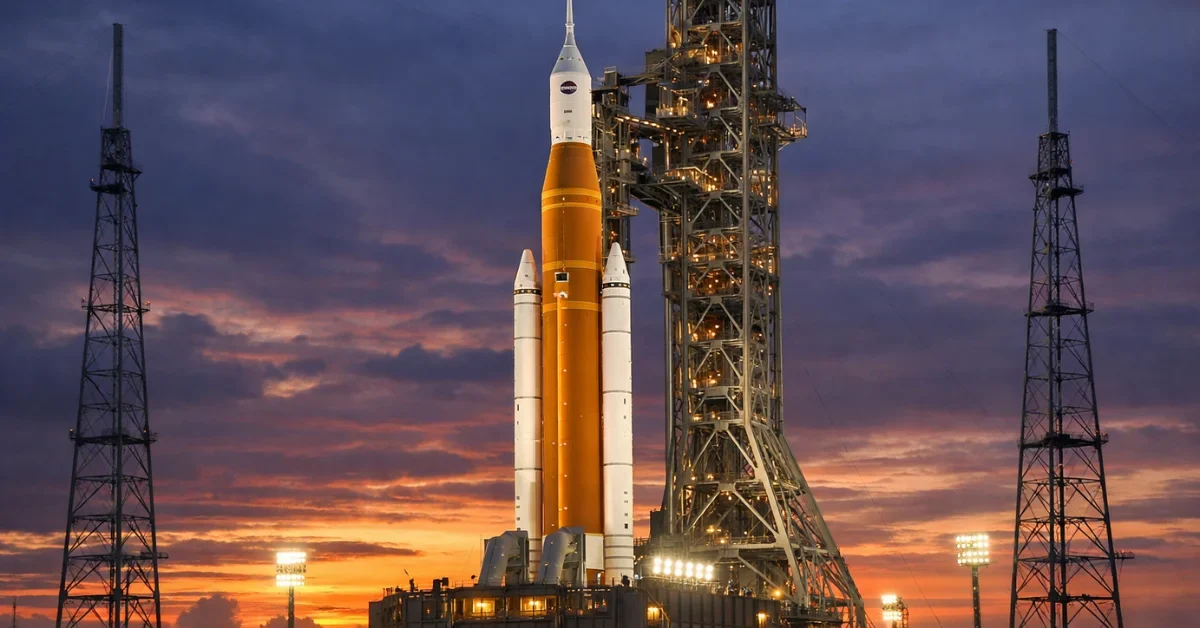
For the first time in over half a century, humanity is preparing to return to the lunar vicinity . NASA has cleared the historic Artemis II launch for Wednesday, April 1, 2026 . Teams gave the green light following flight readiness reviews, clearing the path for four astronauts to embark on a groundbreaking journey around the moon .
The Artemis II launch will lift off from Launch Complex 39B at the Kennedy Space Center in Florida . A two-hour launch window is scheduled to open at 6:24 p.m. EDT . The Space Launch System rocket will propel the Orion crew capsule into space .
Launch officials report a smooth preparation process with no major technical hurdles remaining . The weather forecast looks highly promising, with an 80 percent chance of favorable conditions . Minor concerns involve potential cumulus clouds and strong surface winds .
Lori Glaze, NASA’s acting associate administrator for the Exploration Systems Development Mission Directorate, confirmed the flight systems and crew are fully ready . Launch director Charlie Blackwell-Thompson echoed this optimism, noting a monumental event is about to unfold . If delayed, NASA has backup launch opportunities through April 6 .
A Ten-Day Journey Around the Moon
The mission is designed as a rigorous ten-day test of the Orion spacecraft’s deep-space life-support systems . Reaching an initial high-orbit position 230 miles above Earth, the crew will spend the first 24 hours ensuring all survival systems function properly .
Once complete, the spacecraft will enter a free-return trajectory . This flight path takes the crew around the moon’s far side without landing on the lunar surface . At its farthest point, the Orion capsule will reach 248,655 miles from Earth, breaking the distance record set by Apollo 13 .
The entire journey covers roughly 685,000 miles . The mission should conclude on April 10, 2026, with the spacecraft performing a high-velocity reentry before splashing down in the Pacific Ocean . A successful flight proves the viability of NASA’s moon-to-Mars technologies, paving the way for the Artemis III lunar landing .
Meet the Artemis II Crew
This mission represents a shift toward international collaboration and diversity . The crew features three astronauts from NASA and one from the Canadian Space Agency .
Commander Reid Wiseman, a U.S. Navy Captain, previously spent 165 days aboard the International Space Station and managed astronaut training as Chief of the Astronaut Office .
Victor Glover will take the role of Pilot . A U.S. Navy Captain with over 3,000 flight hours, he previously piloted the SpaceX Crew-1 mission . He will make history as the first person of color to travel beyond low Earth orbit .
Mission Specialist Christina Koch holds the record for the longest single spaceflight by a woman . The electrical engineer participated in the first all-female spacewalks and will now become the first woman to fly around the moon .
Jeremy Hansen rounds out the crew as a Mission Specialist . A Royal Canadian Air Force pilot, Hansen will be the first non-American to venture into deep space .
Overcoming Technical Hurdles
The road to the launch pad featured several engineering challenges . The mission faced setbacks involving liquid hydrogen leaks and a helium-flow issue in the rocket’s upper stage . Teams rolled the rocket back to the Vehicle Assembly Building for repairs . NASA confirms all issues were resolved during final integration, allowing a safe return to Launch Pad 39B .
Carrying History into Space
The Orion spacecraft will carry an Official Flight Kit filled with historical artifacts . The crew will transport muslin fabric from the original Wright Flyer, which flew on the Space Shuttle Discovery in 1985 . They will also carry a Legacy American Flag flown on the first and last Space Shuttle missions .
Additionally, the kit includes a 1964 photo negative from the Ranger 7 probe, capturing the first close-up lunar images . The spacecraft will also carry soil from NASA facilities housing Moon Trees, grown from seeds flown on Artemis I .
Space enthusiasts can follow the event live . NASA will provide streaming coverage on NASA+ and NASA TV starting at 12:50 p.m. EDT on launch day, with real-time updates across social media platforms .
