

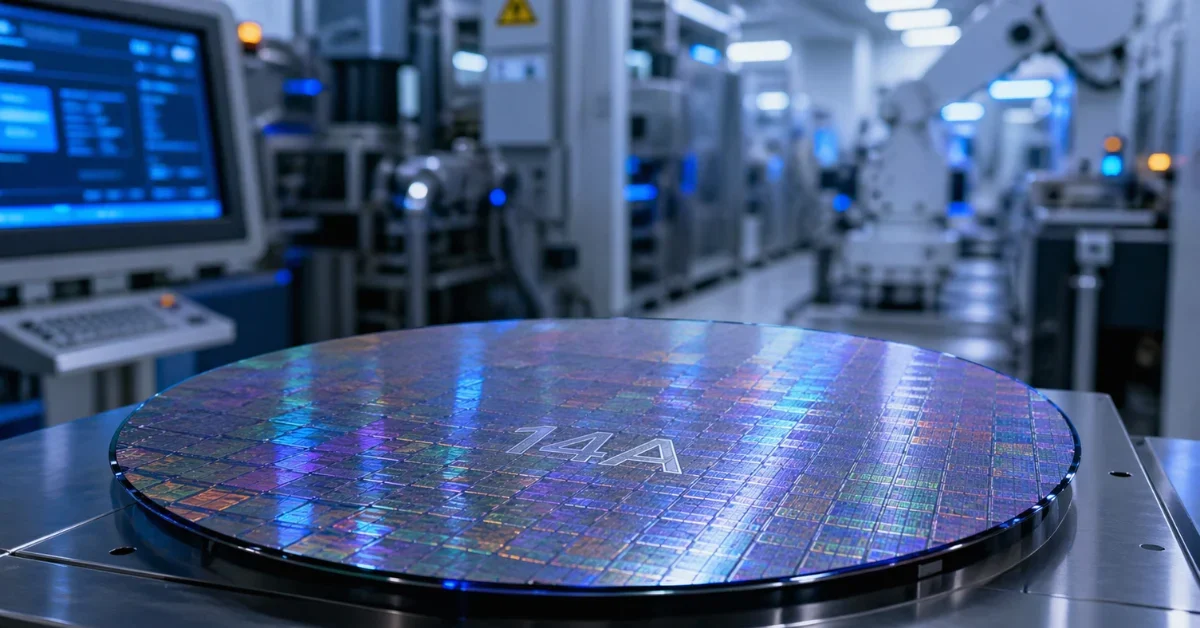
Tesla Chief Executive Officer Elon Musk has officially announced that the electric vehicle manufacturer plans to utilize Intel’s advanced 14A manufacturing process. This major development will support processor production at the highly anticipated Terafab AI chip project. By making this commitment during a Wednesday earnings conference call, Musk has positioned Tesla as the very first major external customer for this next-generation Intel technology.
The Tesla Intel 14A chip deal marks a critical milestone for Intel as it attempts to revamp its foundry operations and attract outside clients. The announcement immediately boosted investor confidence, signaling a significant breakthrough for a chipmaker that has actively sought to compete directly with industry rival Taiwan Semiconductor Manufacturing Co.
The Terafab AI Chip Project
At the center of this strategic relationship is Terafab, an expansive and advanced artificial intelligence chip complex located in Austin, Texas. According to Musk, Tesla and his aerospace company, SpaceX, will collaborate to construct two distinct, highly advanced chip factories at this sprawling facility. One factory will focus on powering electric cars and humanoid robots, while the other is specifically designed to support artificial intelligence data centers in space.
Musk envisions the Terafab project eventually scaling up to produce an unprecedented one terawatt of computing capacity annually. To put this ambition into perspective, this target represents roughly double the current computing capacity generated across the entire United States. However, achieving this massive scale will require an extraordinary financial commitment. Estimates from Bernstein suggest that building enough capacity to generate one terawatt of annual compute could demand between $5 trillion and $13 trillion in capital expenditure.
A Crucial Lifeline for Intel
Securing this agreement provides a much-needed lifeline for Intel’s manufacturing ambitions. For most of its corporate history, Intel focused almost exclusively on producing chips for its own use. However, as computing markets transitioned toward mobile phones and artificial intelligence, the company lost its manufacturing dominance to competitors like TSMC.
Under a comeback plan initiated by former CEO Pat Gelsinger, Intel spent billions to build advanced factories but struggled to secure outside customers. The situation grew increasingly tense under current CEO Lip-Bu Tan, who recently warned that the company might exit the chip manufacturing business entirely if it failed to attract external clients.
Following Musk’s public endorsement, Intel experienced a notable boost in the stock market. Reports indicate that Intel shares climbed in extended trading, though sources differ slightly on the exact figure, with Moneycontrol reporting a 3.6% rise and Benzinga citing a 3.14% increase. Despite the positive market movement, Intel declined to offer an official comment on the new partnership.
Financial Adjustments and Open Questions
To support these sweeping technological ambitions and future revenue streams, Tesla recently increased its 2026 capital spending plan. The company raised its anticipated capital expenditures from $20 billion to more than $25 billion. During its first-quarter earnings report, Tesla announced a total revenue of $22.71 billion, representing a 16% increase year-over-year. Despite the reported growth, Benzinga noted that this revenue figure missed the Street consensus estimate of $22.39 billion. Following these financial updates, Tesla stock saw slight movement, finishing up 0.28% during regular trading before dipping 0.31% to $386.30 in after-hours trading.
While the market has reacted, significant details surrounding the Terafab project remain unresolved. Important questions regarding who will finance the extremely pricey chipmaking equipment, who will ultimately operate the factory, and exactly when the facility will come online are still unknown.
Industry Analyst Reactions
Despite the lingering uncertainties, industry experts view the partnership as a substantial victory for Intel. Ben Bajarin, head of technology consultancy Creative Strategies, suggested the arrangement could be a far more significant development than many realize. Bajarin emphasized the importance of having early design partners to refine manufacturing techniques, noting that Tesla will provide necessary scale as an ideal first non-Intel customer.
Jay Goldberg, an analyst at Seaport Research Partners, echoed this sentiment. He stated that securing a real customer is currently more important for Intel than the exact timing of the project. While Goldberg acknowledged that Tesla’s chip volumes may not rival those of companies like Apple or Nvidia, he confirmed that the partnership still represents genuine, meaningful volume for Intel’s foundries.
Musk himself remains highly confident in the timeline and the technology. He noted that by the time the Terafab facility scales up, Intel’s 14A process should be fairly mature and ready for prime time. Musk emphasized that the technology is the right move, highlighting a strong, ongoing relationship between Tesla and Intel.
Expanding European Horizons
In addition to the semiconductor advancements, Tesla recently secured another major technological milestone. Ahead of its earnings report, the company won regulatory approval to roll out its Full Self-Driving software across Europe. Dutch regulators granted the clearance in April, successfully concluding years of delays and lobbying efforts.
Approvals in other European nations are expected to follow shortly. Analysts, including Tesla bull Dan Ives, believe this regulatory green light could help the automaker reverse its recent sales slump in the European market. The move provides immediate relief to vehicle owners who have waited years to access the advanced autonomous driving features.
