

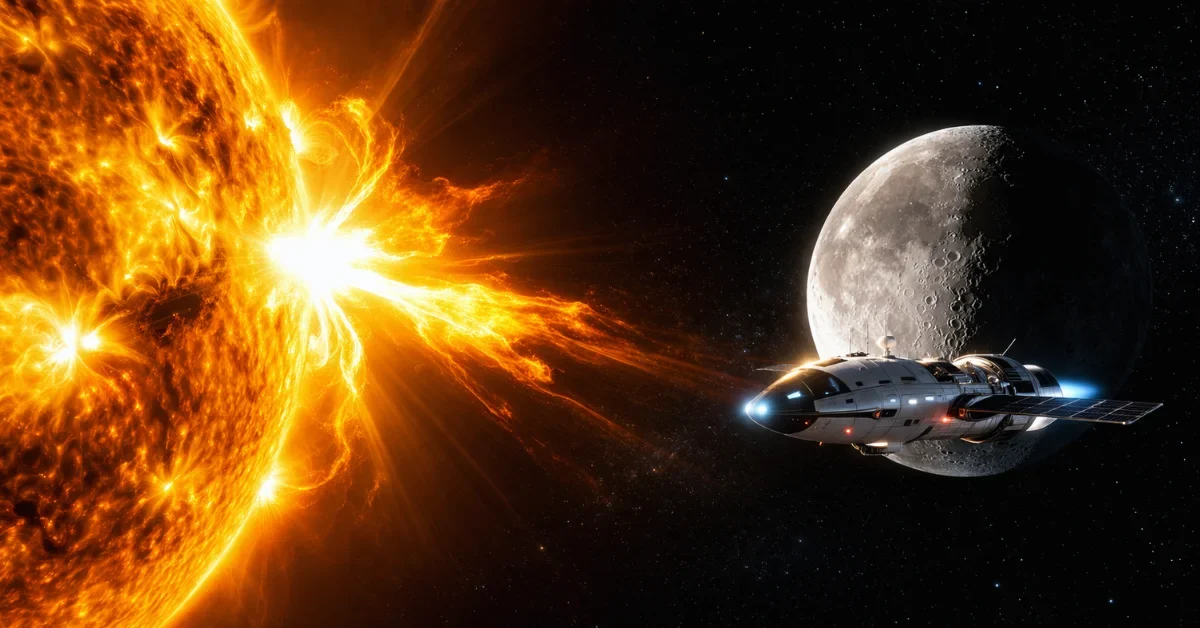
Just days before NASA sends astronauts back to the moon, the sun unleashed a powerful X-class solar flare. The eruption peaked late on March 29 or early March 30, depending on the time zone, sending a wave of intense radiation and energetic particles racing toward Earth.
This intense space weather event immediately caught the attention of experts preparing for the highly anticipated Artemis II launch. While the solar outburst triggered temporary communication disruptions on our planet, space agency officials quickly confirmed that the upcoming lunar mission remains completely on track for its scheduled liftoff.
The eruption originated from a magnetically complex sunspot group known as active region 4405, which currently holds a volatile beta-gamma magnetic configuration. NASA’s Solar Dynamics Observatory captured striking images of the event, revealing extreme ultraviolet light that highlighted extremely hot solar material in bright gold. Space weather monitoring organizations offered slightly varying measurements of the burst’s peak intensity. The National Oceanic and Atmospheric Administration’s Space Weather Prediction Center and several news outlets classified the event as an X1.4-class solar flare, while EarthSky reported it as an X1.5-class flare.
Artemis II Mission Status and Safety
NASA is preparing to launch Artemis II no earlier than April 1, 2026, at 6:24 p.m. EDT. This historic mission marks the first time astronauts will travel to the moon since 1972. The four-person crew will embark on a 10-day journey that takes them entirely beyond the protective shield of Earth’s magnetosphere.
Despite the recent surge in solar activity, mission managers are not anticipating any delays. During a press briefing at the Kennedy Space Center, official Amit Kshatriya stated that the solar event is not expected to create any meaningful impact on the mission. Forecasters currently predict an 80% chance of favorable weather conditions at the Florida launch site.
However, experts are keeping a close watch on the sky. Solar physicist Tamitha Skov noted that space agencies must pay close attention to radio bursts, as they can heavily impact satellite communications and high-frequency radio signals during critical launch windows and early orbit maneuvers.
Protecting Astronauts from Solar Radiation
Space weather poses a significant threat to deep space lunar missions. Without Earth’s magnetic field to deflect energetic particles, astronauts face higher risks of radiation exposure, which can contribute to cancer and cognitive health disorders. To manage this hazard, the Artemis II crew will test a dedicated radiation shelter protocol inside the Orion capsule.
When solar storms hit, the incoming radiation behaves differently than a sudden flash. NASA space radiation analyst Stuart George compared the incoming radiation swarm to sitting in a bathtub that is gradually filling with water. Orion is equipped with radiation sensors, and the astronauts wear personal dosimeters to monitor these exposure levels. If onboard alarms detect dangerous radiation spikes, the crew is trained to reconfigure their environment. They will move stowed equipment from storage bays to build temporary protective walls. George explained that once the astronauts add mass to the areas experiencing hotter radiation exposure, they can safely resume their normal duties.
Overall, the baseline radiation exposure for the Artemis II journey—including passing through the Van Allen Radiation Belts and encountering background cosmic rays—is expected to equal a one-month stay on the International Space Station, or roughly 5% of an astronaut’s career limit.
Impacts on Earth: Radio Blackouts and Geomagnetic Storms
Back on Earth, the X-class solar flare has already made its presence known. The powerful burst of radiation caused a strong, short-lived radio blackout across the daylight side of the globe, disrupting high-frequency communications in parts of Asia, Australia, and the Pacific.
Alongside the initial flash of radiation, the sun launched a coronal mass ejection, or CME. This cloud of charged solar material is currently racing toward Earth at an unusually high speed of approximately 1,845 kilometers per second. Forecasters predict the impact could trigger geomagnetic storms ranging from minor to severe, depending on how the solar magnetic field connects with Earth.
If the incoming solar storm reaches moderate to severe levels, it could spark brilliant displays of the northern lights far south of their usual boundaries. Experts suggest the auroras might become visible in regions including New York, Wisconsin, Washington state, and the mid-Atlantic United States, as well as European locations like London, Paris, and Berlin. Southern Australia may also witness the glowing sky display.
Tips for Viewing the Northern Lights
For the best chance of spotting the auroras, observers should seek out dark areas far from city illumination with a wide, unobstructed view of the northern horizon. The most ideal viewing window usually falls between late evening and early morning. Experts recommend allowing at least 20 minutes for your eyes to fully adjust to the darkness. Smartphone users can often capture the faint auroral glow by utilizing built-in low-light features like Night Mode or Pro Mode.
Continuous Space Weather Monitoring
To safeguard both terrestrial infrastructure and space explorers, an extensive network of probes constantly monitors the sun. NASA’s Moon to Mars Space Weather Analysis Office and the Space Radiation Analysis Group work closely with the National Oceanic and Atmospheric Administration to track solar eruptions. Their forecasts rely on data from strategically placed spacecraft, including the Solar Dynamics Observatory, the Interstellar Mapping and Acceleration Probe, and the GOES-19 satellite.
Even the Mars Perseverance rover is pitching in to help keep astronauts safe. Because Mars is currently on the opposite side of the sun from Earth, the rover can observe sunspots on the far side of the star. This unique vantage point gives space weather teams advance notice of volatile regions before they rotate to face Earth and the Artemis II crew.
